Dtf Printer vs Sublimation Printer: Which One Should You Buy?
DTF printing suits dark and mixed fabrics with a white underbase, while sublimation suits light polyester-style blanks, and the right pick depends on what the maker prints most.

On this page
Top picks at a glance
As an Amazon Associate I earn from qualifying purchases.
- 1
 Kminoteh DTF Ink -1500ML DTF Transfer Ink for PET Film9.7/10View on Amazon
- 2
 Sawgrass SG500 Sublimation Printer9.7/10View on Amazon
- 3
 Sihao A3 DTG & DTF Printer,A3 L1805 Flatbed Printer,Direct to9.7/10View on Amazon
- 4
 Procolored K13 Lite DTF PrinterView on Amazon
- 5
 BCH ST2K-DTF A4 DTF Printer with White InkView on Amazon
- 6
 xTool Apparel Printer Plus Bundle with Shaker Oven & FumeView on Amazon
- 7
 DXZ 2026 14'' A3 DTF Printer with F1080 PrintheadView on Amazon
- 8
 DSV 14'' A3 DTF Printer with ShakerView on Amazon
- 9
 WJTZXY A3+ Plus XP600 DTF Printer with Shaking DryerView on Amazon
A maker with a shirt order to fill faces a simple choice: print the design on film and press it onto almost any fabric, or transfer dye into a light-colored blank with heat. That choice is dtf printer vs sublimation printer, and it shapes the printer, the consumables and the finishing steps that follow. This guide compares the methods in plain terms, then looks at DTF printers that cover small runs and batch apparel work.
Other machines to compare
 Procolored K13 Lite DTF PrinterCheck price on Amazon
 BCH ST2K-DTF A4 DTF Printer with White InkCheck price on Amazon
 xTool Apparel Printer Plus Bundle with Shaker Oven & FumeCheck price on Amazon
 DXZ 2026 14'' A3 DTF Printer with F1080 PrintheadCheck price on Amazon
 DSV 14'' A3 DTF Printer with ShakerCheck price on Amazon
 WJTZXY A3+ Plus XP600 DTF Printer with Shaking DryerCheck price on Amazon
LaserEngraveHQ earns a commission from purchases made through these links, at no extra cost to you. Read our affiliate disclosure.
Dtf Printer vs Sublimation Printer: How to Choose
The short answer: pick DTF when the work includes dark garments or a mix of fabric types, and pick sublimation when the work stays on light-colored polyester-style blanks. DTF prints the design on transfer film with a white ink underbase, so the colors show on dark fabric. Sublimation moves dye into a light blank with heat, so the design sits in the fabric rather than on top of it, but it has no white ink to carry a design on dark fabric. That single difference decides most purchases: dark shirts and mixed-fabric orders point to DTF, while light polyester-style blanks point to sublimation.
How DTF printing works
A DTF workflow prints the artwork on transfer film, lays down a white ink underbase where the design needs it, then moves the film to the garment with a heat press. The RocRow listing describes a complete A3+ workflow with automatic curing, fume extraction and a laptop setup, which shows how much of the process sits around the printer itself: printing, curing and pressing are separate steps. The BCH listing describes the same core idea in a smaller form, with a four-channel CMY+W system that reserves the fourth channel for white ink, giving full-color artwork a white backing layer on dark garments. For the pressing step, see the heat presses and sublimation category.
White ink is the part of DTF that needs the most attention. It can settle and clog, so the printers below handle it in different ways: circulation systems that keep white ink moving, stirring systems, and cleaning routines that run on their own or with one touch. A buyer who prints every day will lean on those systems less than a buyer who prints in bursts, and the RocRow listing even names a vacation mode that keeps the printer ready after long idle periods.
How sublimation printing works
Sublimation starts with a design printed in sublimation inks on transfer paper, then pressed with heat onto a suitable blank. The dye moves into light-colored polyester-style surfaces, which gives a soft feel with no film edge on the garment. The trade-off is the blank itself: dark fabrics have no light base for the dye to show against, and cotton-style fabrics do not hold the dye the same way. So a shop that sells mostly dark cotton shirts will fight the method, while a shop that sells light polyester-style blanks will find it a clean, simple workflow with fewer consumables than DTF.
Neither method is wrong in general; each is wrong for the wrong blank. The questions that matter are what the blanks are made of, what colors they come in, and how many pieces a typical order holds. Answer those three, and the method usually picks itself.
What to weigh before buying
Fabric range comes first. The Procolored listing names cotton, polyester, denim and canvas among its supported fabrics, which is the kind of range DTF buyers want when orders vary. The DXZ listing names T-shirts, crafts, bags, hats, jackets, polyester and leather, which shows the same idea: DTF covers more fabric types because the design arrives on film rather than as dye in the fabric.
Volume comes second. A batch apparel workflow wants a wide print area, a curing step that keeps up, and a press routine that does not bottleneck the printer. A one-off workflow wants a small footprint and simple setup instead. Workspace matters too: the RocRow bundle includes a shaker dryer and fume extraction, which suits a dedicated print corner, while the A4 printers take up less width than the wider A3+ bundle.
Upkeep comes third. White ink systems, cleaning routines and support terms differ across the printers below, and the warranty terms range from a 90-day limited warranty to a 12-month limited warranty on non-ink-contact components. Read the warranty line for each printer before ordering, since ink-contact parts often carry a shorter term than the rest of the machine.
The gear: four DTF printers ranked
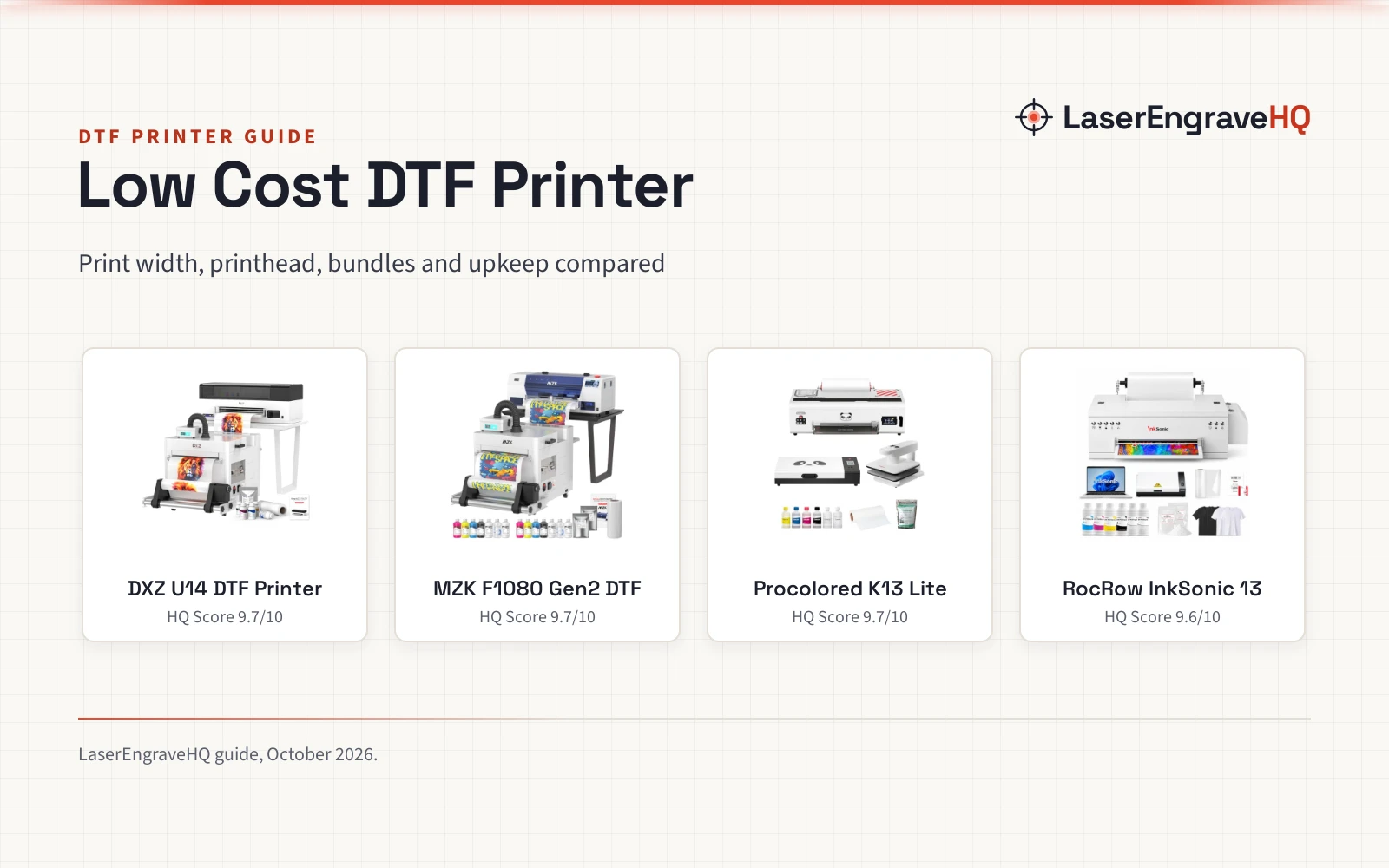
First is the RocRow InkSonic 14-inch F1080 DTF Printer with Shaker Dryer and Laptop, the most complete workflow in this group. Its F1080 low-temperature printhead is listed with a full A3 print in 3 minutes, and the bundle adds a shaker dryer, automatic curing, fume extraction and a pre-configured laptop, so the buyer starts printing without a separate software setup. The siphon-based one-click ink filling system and CISS white ink circulation system keep the white underbase steady, and the maker lists a 6 Months warranty. Its listed dimensions are 29.5 Inches x 11.0 Inches x 12.2 Inches.
Second is the Procolored K13 Lite DTF Printer, a 13-inch A3 apparel printer built around LiteHead Technology. Automatic cleaning helps reduce clogging and ink drying, while the White Ink Circulation System runs regularly to prevent sedimentation. Its G7-certified color accuracy, optimized color curves and Procolored Studio Lite software aim at consistent color from screen to fabric, and the Infrared Printhead SafeGuard System detects film warping and foreign particles as small as 2 mm. The listing states a 12-Month Limited Warranty on Non-Ink Contact Components and 6-Month Coverage on Ink Contact Components.
Third is the DXZ A4 DTF Printer with Roll Feeder and Oven. Its XP600 6-color printhead is rated at 2800 x 1400 dpi, and the built-in cutter plus roll feeder handle rolls or sheets up to 8.3 inches wide. A white ink stirring system and semi-automatic cleaning system keep white ink flowing on light and dark fabrics, and the bundle includes an oven for curing. The listing states a 1-year warranty on non-consumable parts and a 6-month warranty on the printhead, and it includes a two-year supply of ink: 6 bottles of 250ml each and 500g of powder. Its listed weight is 151.0 pounds.
Fourth is the BCH ST2K-DTF A4 DTF Printer with White Ink, the compact A4 printer here. Its four-channel CMY+W system prints full-color artwork with a white backing layer on DTF transfer film, which covers dark garments in a compact A4 form. The listing states a 90-day limited warranty on printer hardware and BCH conversion workmanship. It suits a buyer who wants to learn the DTF workflow or fill small orders without committing to a full batch setup.
FAQ: lasers and CNC
Can a DTF printer print on dark shirts?
Yes. The white ink underbase is the key: the RocRow listing describes a solid white underbase layer, and the BCH listing describes a white backing layer, both of which let full-color artwork show on dark garments.
Does sublimation work on dark cotton shirts?
No, not well. Sublimation has no white ink, so a design pressed onto a dark blank has no light base to show against, and cotton-style fabrics do not hold the dye the same way polyester-style blanks do. Dark garments point back to DTF.
What extra gear does a DTF workflow need?
A heat press for the transfer step, plus a curing step for the printed film. The RocRow bundle covers the curing step with a shaker dryer and automatic curing, while the DXZ bundle includes an oven. A buyer who picks any of these printers should plan for the heat press separately.
Which of these printers fits batch apparel work?
The RocRow InkSonic fits batch work best: the maker lists a full A3 print in 3 minutes, a shaker dryer, automatic curing and a pre-configured laptop make it a complete A3+ workflow for apparel production. The Procolored K13 Lite, with its 13-inch A3 printing area, is the next step down for steady small-batch runs.
How do these printers handle white ink upkeep?
Each one has its own answer. RocRow uses a CISS white ink circulation system with an anti-sedimentation module, Procolored uses a white ink circulation system with automatic cleaning, and DXZ uses a white ink stirring system with semi-automatic cleaning. Regular circulation and cleaning matter most for buyers who print in bursts rather than every day.
Related: the craft machines hub and the heat presses and sublimation category.