Carbide Insert vs Solid Carbide End Mill: Which One Should You Buy?
Indexable insert cutters against solid carbide end mills, with four insert tools compared by size, geometry, clamping and materials.

On this page
Top picks at a glance
As an Amazon Associate I earn from qualifying purchases.
- 1
 Slab Flattening Surfacing Router Bit 2" Cut Dia. 1/2 Shank9.7/10View on Amazon
- 2
 SpeTool 5PCS Spiral Downcut Router Bits 1/4" Shank 1" Cutting9.7/10View on Amazon
- 3
 SpeTool Spiral Router Bits Down Cut 1/4 inch Cutting Diameter9.7/10View on Amazon
- 4
 CDBP APMT1604 Indexable Carbide Milling Insert for ShoulderView on Amazon
- 5
 Zorqon 3/8'' Carbide Long End MillView on Amazon
- 6
 45-SD-C12-D3-100L 45 Degree Chamfer indexable Mill CutterView on Amazon
- 7
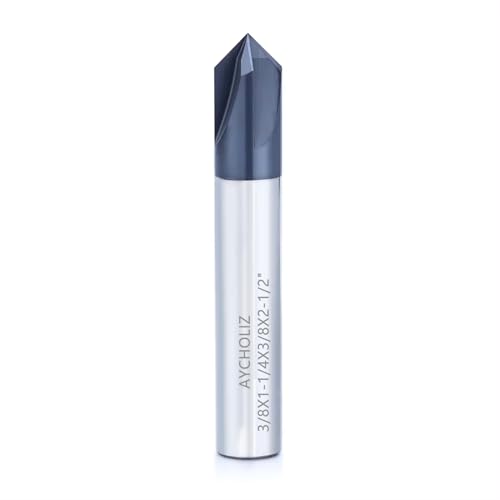 AYCHOLIZ Carbide Chamfer End Mill 90 Degree 3/8" Shank DiaView on Amazon
- 8
 SpeTool 5PCS O Flute Single Flute End Mill Set with 1/8 InchView on Amazon
- 9
 1/8" 3/16" 1/4" 5/16" 3/8" Carbide End Mills SetView on Amazon
At the mill, with a shoulder to cut and a cutter to choose, the carbide insert vs solid carbide end mill question comes down to what wears out. An indexable insert cutter holds replaceable carbide tips on a steel body: when an edge dulls, the tip is indexed or swapped and the body keeps working. A solid carbide end mill is one cutter ground from carbide: when it dulls, the whole cutter goes for resharpening or replacement. If the work is mostly shoulders, faces and slots in steel, the insert side is the practical pick; if the work needs small diameters or fine detail, a solid cutter is the usual answer. Every listing featured here is insert tooling, so the solid side is weighed in general terms only, with no solid end mill featured to compare.
Other machines to compare
 CDBP APMT1604 Indexable Carbide Milling Insert for ShoulderCheck price on Amazon
 Zorqon 3/8'' Carbide Long End MillCheck price on Amazon
 45-SD-C12-D3-100L 45 Degree Chamfer indexable Mill CutterCheck price on Amazon
 AYCHOLIZ Carbide Chamfer End Mill 90 Degree 3/8" Shank DiaCheck price on Amazon
 SpeTool 5PCS O Flute Single Flute End Mill Set with 1/8 InchCheck price on Amazon
 1/8" 3/16" 1/4" 5/16" 3/8" Carbide End Mills SetCheck price on Amazon
LaserEngraveHQ earns a commission from purchases made through these links, at no extra cost to you. Read our affiliate disclosure.
Carbide insert vs solid carbide end mill: the core difference
The difference is where the cutting edge lives. On an insert cutter, the edge is a small carbide tip screwed to a steel body, and the body stays in service while tips come and go; on kits like the KinRite, the arbor and holder are separate parts too. On a solid carbide end mill, the edge, flutes and shank are one piece of carbide, so the whole tool is the consumable. That split drives everything else: insert tooling suits larger diameters and heavy shoulder work, where a replaceable edge keeps running costs down, while solid tooling suits smaller diameters and detail work, where a one-piece cutter holds its geometry.
The insert side: what the listings show
All four listings here are insert tooling, and they show the pattern clearly. Screw-down clamping appears on every one: the Jerax cutter, the CDBP inserts, the KinRite kit and the Accusize end mill all seat their inserts with screws, so indexing or replacing an edge means loosening a screw, not replacing a tool. Positive rake geometry appears across the listings too, with 90 degree cutting angles for square shoulders on the Jerax, CDBP and Accusize tools and the KinRite arbor. Materials covered run from low carbon steel, medium carbon steel and high carbon steel in the HRB170-270 range plus stainless steel on the Jerax listing, to steels, alloy steels, stainless and heat-resistant steels, cast irons and aluminium alloys on the Accusize listing.
The solid side: what changes
With no solid end mill featured here, the solid side can only be weighed in general terms. A solid cutter has no insert pockets, no screws and no separate body, so there is nothing to index and nothing to come loose, and the cutter holds a single ground geometry from shank to tip. The trade is that every dull edge means the whole cutter leaves the spindle, for resharpening or replacement, where an insert cutter only loses a tip. For small-diameter work and fine profiles, that trade is often worth it, since insert pockets and screws need room that small cutters do not have. For the shoulder, face and slot work the listings here cover, the insert side carries the day on running cost alone.
The gear, ranked
The gear section runs in ranked order as follows. First, the KinRite kit, the most complete package here: an R8 FMB22 face mill arbor in alloy steel hardened to HRC 52-56, a BAP400R 50-22-4T face milling cutter with a 1.96 inch face diameter, 10 APMT1604PDER carbide inserts, and a T15 wrench. Its inserts are dual-edge and TiN coated, with a blade length of 0.63 inch, an inscribed circle of 0.366 inch, a thickness of 0.187 inch, a hole of 0.173 inch, a nose radius of 1/32 inch, a nose angle of 85 degrees and a relief angle of 11 degrees, and the listing suits them to hardened steel, die steel, bearing steel, gear steel and high-speed steel. Note a listing mismatch: the title lists a 1.9 inch shell cutter while the bullets and spec table list 1.96 inches, so check the diameter before ordering.
Second, the Accusize indexable end mill, a precisely specified tool here: a 3/4 inch cutting diameter, a 3/4 inch shank and a 3-1/2 inch overall length, with a maximum 0.433 inch depth of cut, 3 insert pockets, and 3 APKT11T308 inserts held by M2.5 x 6 screws. Its 90 degree cutting geometry pairs a -10 degree radial rake with a +7 degree axial rake, and its insert carries a 10 degree positive angle for high depth of cut and feed per tooth. It is supplied with the holder and the correct inserts installed, and it belongs to a family of sizes from 3/8 inch to 1-1/2 inch cutting diameter.
Third, the Jerax R8 indexable end mill, a 1-1/2 inch cutter with 4 flutes and a 90 degree cutting angle, an R8 shank and a 7/16-20 thread, using 4 inserts on a screw-down clamping system. Its tungsten carbide inserts are described as hard, wear resistant and sharp edged with a long service life, and the listing covers low carbon steel, medium carbon steel, high carbon steel in the HRB170-270 range, stainless steel, aluminium alloy, brass and rigid plastic parts. Fourth, the CDBP APMT1604 inserts alone: a pack of 10 PVD coated inserts with two effective cutting edges, positive rake geometry for clean 90 degree shoulders, and a design for shoulder milling, facing and slot milling. Note that these are inserts only, commonly matched with BAP400 style cutter bodies, so the pocket and screw specification must be verified before ordering, and no body is included.
Choosing between them
Choose insert tooling when the work is shoulders, faces and slots at diameters the listings here cover, from 3/4 inch to 1-1/2 inch and up to a 1.96 inch face diameter, and when running cost matters more than fine detail. Choose a solid carbide end mill when the cut needs a small diameter, a fine profile, or a geometry no insert pocket can hold, accepting that a dull edge costs a whole cutter. Within the insert listings, pick the KinRite kit for a complete arbor, holder and insert package, the Accusize tool for a precisely specified shoulder mill with inserts installed, the Jerax cutter for an R8 shank indexable mill, and the CDBP inserts when a BAP400 style body is already on hand.
FAQ: lasers and CNC
What is the difference between a carbide insert and a solid carbide end mill?
An insert cutter holds replaceable carbide tips screwed to a steel body, so a dull edge costs a tip. A solid carbide end mill is one piece of carbide from shank to tip, so a dull edge costs the whole cutter, for resharpening or replacement.
When should I choose an indexable insert end mill?
Choose one for shoulder milling, facing and slotting at the diameters the listings here cover, where a replaceable edge keeps running costs down. The listings here cover steels, stainless, cast irons, aluminium alloys and rigid plastics, with 90 degree square shoulders.
Do I need a separate body for APMT1604 inserts?
Yes, for the CDBP inserts: they are inserts only, commonly matched with BAP400 style cutter bodies, and the listing says to verify the insert pocket and screw specification before ordering. The KinRite kit and the Accusize tool include their holders, so no separate body is needed there.
What does positive rake do on an insert cutter?
On these listings, positive rake geometry supports efficient cutting and clean 90 degree corners, and the Accusize tool pairs a -10 degree radial rake with a +7 degree axial rake for stable shoulder milling and smooth chip evacuation.
Can insert tooling cut hardened steel?
The KinRite listing suits its inserts to hardened steel, die steel, bearing steel, gear steel and high-speed steel, and the Jerax listing covers high carbon steel in the HRB170-270 range. Match the insert grade and geometry to the steel at hand, and check the listing for the grade before ordering.
Related: the best end mill for aluminum, the ball nose vs flat end mill, the best end mill for plastic, and our CNC tooling hub.