Best Solder Wire for Circuit Boards (2026)
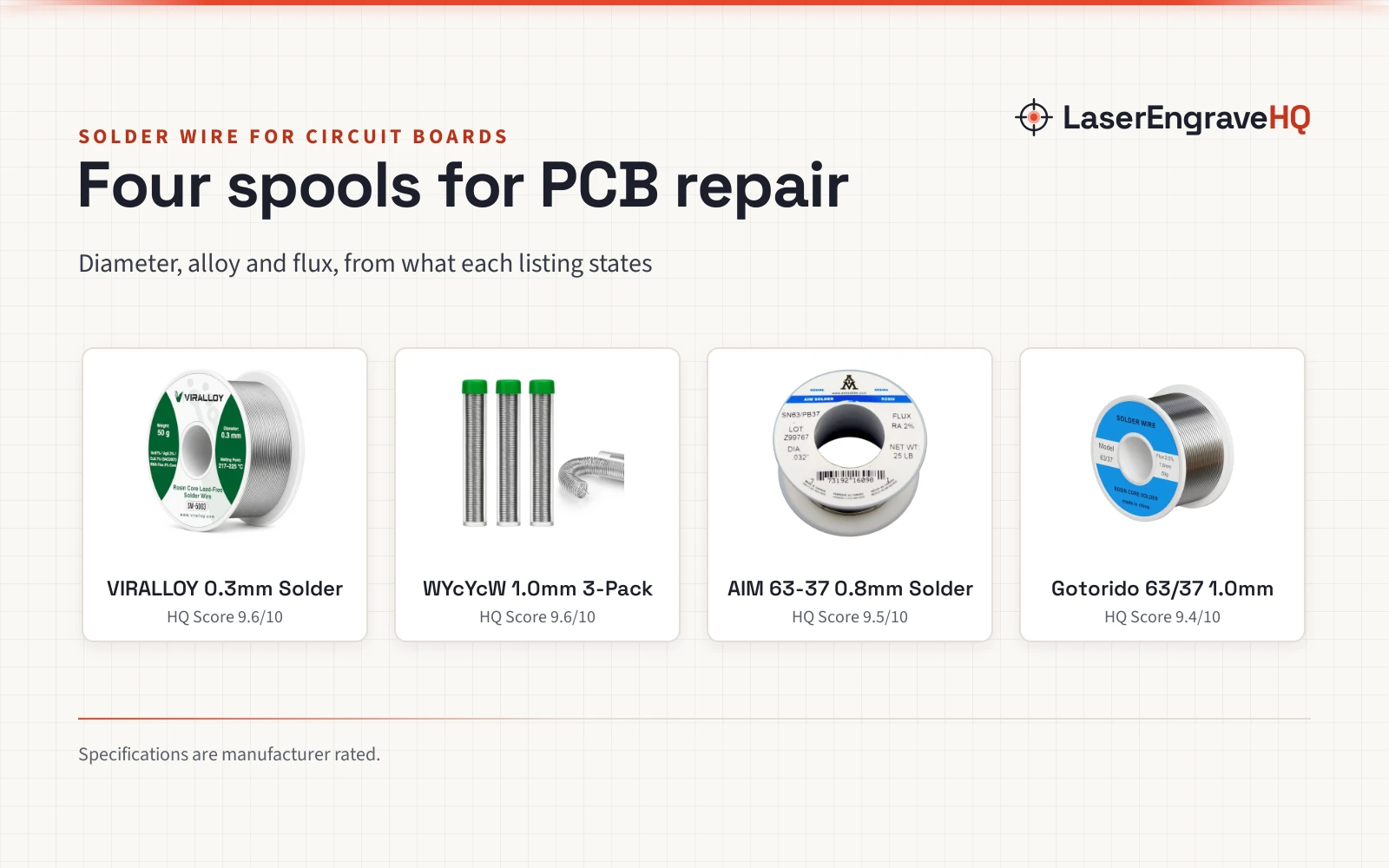
Four rosin-core solder wire spools for PCB repair, two lead-free and two leaded, compared by diameter, alloy, flux and spool size.

On this page
Top picks at a glance
As an Amazon Associate I earn from qualifying purchases.
- 1
 Best OverallVIRALLOY 0.3mm Solder9.6/10View on Amazon
- 2
 Best Lead-Free ValueWYcYcW 1.0mm 3-Pack9.6/10View on Amazon
- 3
 Best Leaded ClassicAIM 63-37 0.8mm Solder9.5/10View on Amazon
- 4
 Best for General RepairsGotorido 63/37 1.0mm9.4/10View on Amazon
A lifted pad, a cold joint and a component that will not stay put all trace back to the same thing: the wire in the hand. The best solder wire for circuit boards matches the joint in front of it, with a diameter that fits the pads, an alloy that flows the way the work needs, and flux that wets the joint without a separate step. This guide compares rosin-core spools, lead-free and leaded, by the figures each listing states.
LaserEngraveHQ earns a commission from purchases made through these links, at no extra cost to you. Read our affiliate disclosure.
Quick picks
- Best Overall VIRALLOY 0.3mm Solder: 0.3mm lead-free Sn97/Ag0.3/Cu0.7 wire with a rosin core on a 50g spool, made for fine PCB and micro soldering work. Check price on Amazon
- Best Lead-Free Value WYcYcW 1.0mm 3-Pack: Three spools of 1.0mm lead-free Sn99.3 Cu0.7 wire, 42g each, that melts at 422°F for general board and electronics repair. Check price on Amazon
- Best Leaded Classic AIM 63-37 0.8mm Solder: 63/37 tin-lead wire, 0.8mm on a 113g spool, with a 183°C eutectic melting point and a 2% rosin flux core. Check price on Amazon
- Best for General Repairs Gotorido 63/37 1.0mm: 63/37 tin-lead wire, 1.0mm on a 50g spool, with 2.0% flux and a 361°F melting point for board and cable repairs. Check price on Amazon
Machines on the list
VIRALLOY 0.3mm Lead Free Solder Wire
A 0.3mm lead-free solder wire with a rosin core, Sn97/Ag0.3/Cu0.7 alloy on a 50g spool, made for fine PCB and micro soldering work.
Pros
- 0.3mm diameter suits fine joints, small components and micro soldering on circuit boards
- Lead-free Sn97/Ag0.3/Cu0.7 alloy with a rosin core for smooth flow and neat joints
- Rosin flux core helps the solder wet evenly without separate flux for most electronics jobs
- 50g spool feeds smoothly and gives control during detailed soldering work
Cons
- 0.3mm wire feeds slowly on larger joints and thicker wires
- 50g spool holds less solder than the 113g AIM spool
- No warranty term is stated
- Suits precision work only; a 1.0mm wire covers general board work faster
WYcYcW 3Pcs Solder Wire Leadfree,High Purity Tin
Three spools of 1.0mm lead-free solder wire, Sn99.3 Cu0.7 with a rosin core, 42g per spool, that melts at 422°F.
Pros
- Three spools in the box, 42g each, for a bench that solders often
- 1.0mm diameter covers circuit boards, TVs, radios and general electronics repair
- Melts at 422°F for fast, even flow with low residue
- Lead free with rosin, no irritating gas and non-toxic as stated
Cons
- 1.0mm wire is coarse for fine-pitch parts and micro soldering
- 42g spools run out sooner than the 113g AIM spool on heavy bench use
- No warranty term is stated
- Three small spools mean more spool changes than one large spool
AIM Solder 63-37 Tin Lead Rosin Core Solder Wire
A 63/37 tin-lead rosin-core solder wire, 0.8mm diameter on a 113g spool, with a 183°C eutectic melting point.
Pros
- 63% tin and 37% lead eutectic alloy melts at 183°C (361°F) for smooth flow and strong joints
- 0.8mm diameter suits printed circuit boards, radios, speakers, motors and appliances
- 2% rosin activated flux core with great electrical and thermal conductivity as stated
- 113g spool is the largest single spool here
Cons
- Leaded alloy carries a California Proposition 65 lead warning
- Lead solder is not for food-contact items
- 0.8mm wire is thicker than the 0.3mm VIRALLOY wire for fine-pitch joints
- Leaded alloy needs more care with ventilation and cleanup than the lead-free picks here
63/37 Tin Lead Rosin Core Solder Wire Ideal
A 63/37 tin-lead rosin-core solder wire, 1.0mm diameter on a 50g spool, with a 361°F melting point.
Pros
- 63% tin content for strong bonds in electrical applications as stated
- 1.0mm diameter suits circuit boards, cables, TVs, radios and stereos
- 2.0% flux enhances wetting and reduces oxidation as stated
- 361°F (183°C) melting point for smooth flow and durable joints
Cons
- Leaded alloy with no lead-free option in this listing
- 50g spool holds less than the 113g AIM spool and the 3-pack
- 1.0mm wire is coarse for fine-pitch board work
- Compact 50g spool means more frequent spool changes on a busy bench
Specs compared
| Model | HQ Score | Diameter | Alloy | Flux | Spool | Melting point |
|---|---|---|---|---|---|---|
| VIRALLOY 0.3mm Solder | 9.6/10 | 0.3mm | Sn97/Ag0.3/Cu0.7, lead free | Rosin core | 50g | Not stated |
| WYcYcW 1.0mm 3-Pack | 9.6/10 | 1.0mm | Sn99.3 Cu0.7, lead free | 2.0 rosin core | 42g each, 3 spools | 422°F |
| AIM 63-37 0.8mm Solder | 9.5/10 | 0.8mm | 63% tin, 37% lead | 2% rosin core | 113g (0.25lb) | 183°C (361°F) |
| Gotorido 63/37 1.0mm | 9.4/10 | 1.0mm | 63% tin, 37% lead | 2.0% rosin core | 50g (0.11lbs) | 361°F (183°C) |
Size and performance figures are the brand’s ratings quoted from listings on 22 November 2026.
Best solder wire for circuit boards: what to match first
Diameter decides the joint. The 0.3mm VIRALLOY wire suits fine pads and micro soldering, the 0.8mm AIM wire covers general board work, and the 1.0mm wires suit larger joints, cables and general repairs. Alloy decides flow and cleanup: the lead-free Sn97/Ag0.3/Cu0.7 and Sn99.3 Cu0.7 wires avoid lead, while the 63/37 wires melt at 183°C (361°F).
Buying guide: solder wire for circuit boards
Match the diameter to the pads
Fine-pitch parts and small components call for the 0.3mm VIRALLOY wire, which feeds a small amount of solder per joint and keeps bridges down. General board work suits the 0.8mm AIM wire, and larger joints, cables and general repairs suit the 1.0mm WYcYcW and Gotorido wires. A wire that is too thick for the pads floods the joint; a wire that is too thin feeds slowly on larger joints.
Lead-free or leaded
The lead-free spools here are the VIRALLOY Sn97/Ag0.3/Cu0.7 wire and the WYcYcW Sn99.3 Cu0.7 wire, both with a rosin core. The AIM and Gotorido wires use the classic 63/37 tin-lead alloy, and the AIM listing carries a California Proposition 65 lead warning. Lead solder is not for food-contact items. Pick lead-free for a shared bench or where lead is a concern, and pick the eutectic 63/37 alloy where the classic melt behaviour matters.
Flux core and melting point
Every spool here has a rosin core, so no separate flux is needed for most electronics jobs. The AIM wire lists a 2% rosin activated flux core and the Gotorido wire lists 2.0% flux, while the WYcYcW wire lists flux 2.0. Melting points stated are 422°F for the WYcYcW wire and 183°C (361°F) for the AIM and Gotorido wires; the VIRALLOY listing states no melting point.
Spool size and pack count
The AIM spool holds 113g (0.25lb), the largest single spool here. The VIRALLOY and Gotorido spools hold 50g each, and the WYcYcW pack holds 3 spools of 42g each. A larger spool suits a busy bench; a small spool suits occasional repair work and keeps the wire fresh between jobs.
Project Match
Pair the spool with the project:
- Fine PCB repair and micro soldering: VIRALLOY 0.3mm Solder, 0.3mm lead-free wire with a rosin core.
- General electronics repair and spare spools: WYcYcW 1.0mm 3-Pack, 1.0mm lead-free wire that melts at 422°F.
- Classic board repair with eutectic alloy: AIM 63-37 0.8mm Solder, 0.8mm wire that melts at 183°C (361°F).
- General board and cable repairs: Gotorido 63/37 1.0mm, 1.0mm leaded wire with 2.0% flux.
How the scores add up
Each spool is scored on performance, build, value, safety and warranty, with the weights published in How we pick. A spec the listing does not publish scores nothing.
| Product | HQ Score | Perf. /35 | Build /25 | Value /25 | Safety /10 | Warranty /5 |
|---|---|---|---|---|---|---|
| VIRALLOY 0.3mm Solder | 9.6 | 30 | 22 | 20 | 5 | 0 |
| WYcYcW 1.0mm 3-Pack | 9.6 | 29 | 20 | 21 | 6 | 0 |
| AIM 63-37 0.8mm Solder | 9.5 | 32 | 21 | 21 | 0 | 0 |
| Gotorido 63/37 1.0mm | 9.4 | 29 | 20 | 20 | 0 | 0 |
We translate weighted points into a score with 9.2 as its floor and 9.8 as its cap; the straight-line conversion keeps the ranking exactly.
FAQ: lasers and CNC
What size solder wire for a circuit board?
Match the wire to the pads. Fine-pitch parts and small components suit 0.3mm wire, general board work suits 0.8mm wire, and larger joints suit 1.0mm wire. The spools here run 0.3mm, 0.8mm and 1.0mm.
Is solder wire lead?
Some is and some is not. The VIRALLOY and WYcYcW wires here are lead-free, while the AIM and Gotorido wires use a 63/37 tin-lead alloy. The AIM listing carries a California Proposition 65 lead warning.
How do I choose solder wire diameter?
Start from the pads and the joint size: fine pads need thin wire, larger joints need thicker wire. The 0.3mm VIRALLOY wire is the fine-work pick here, the 0.8mm AIM wire covers general board work, and the 1.0mm wires cover larger joints and cables.
What is the best solder wire to use?
For circuit boards, the best solder wire to use is the one that matches the joint: fine work calls for the 0.3mm lead-free VIRALLOY wire, and general board repair calls for the 0.8mm AIM wire or the 1.0mm lead-free WYcYcW wire. Alloy, flux and spool size matter as much as diameter.
How do I solder wire properly?
Use a rosin-core wire matched to the joint, heat the joint so the solder flows and wets it, and let the joint cool without moving it. Every spool here has a rosin core, so no separate flux is needed for most electronics jobs. The AIM and Gotorido wires melt at 183°C (361°F) and the WYcYcW wire melts at 422°F.
Related: best soldering iron for PCB work, best desoldering braid, best soldering stand and the electronics making hub. Also see our best soldering iron tip cleaner.