Best Multimeter for Electronics (2026): 5 Picks Compared
5 multimeters for electronics work, from a 2000-count clamp meter to a 19999-count 3-in-1 oscilloscope meter, compared by ranges, display and safety features.


On this page
Top picks at a glance
As an Amazon Associate I earn from qualifying purchases.
- 1
 Best OverallFNIRSI 2C53T 3-in-19.6/10View on Amazon
- 2
 Best for Repair BenchesFNIRSI DMT-999.6/10View on Amazon
- 3
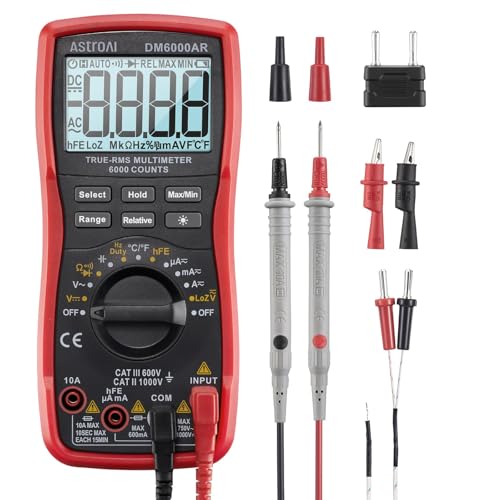 Best for Home and AutoAstroAI DM6000AR9.6/10View on Amazon
- 4
 Best Simple PickANENG SZ3019.5/10View on Amazon
- 5
 Best Clamp PickAstroAI CM2K0R Clamp9.5/10View on Amazon
A dead board on the bench, a pedal that stays silent, a lamp that will not light: each one starts with the same question, which part of the circuit is at fault. The best multimeter for electronics answers that question by reading voltage, current, resistance and continuity from a handheld unit, and the meters below cover that job from a simple case-and-leads kit to a handheld unit with a built-in oscilloscope.
LaserEngraveHQ earns a commission from purchases made through these links, at no extra cost to you. Read our affiliate disclosure.
Quick picks
- Best Overall FNIRSI 2C53T 3-in-1: A 50 MHz scope, a signal generator and a 19999-count meter in one handheld unit. Check price on Amazon
- Best for Repair Benches FNIRSI DMT-99: 9999-count True RMS with a graphic waveform view and ultra-fine leads for SMD boards. Check price on Amazon
- Best for Home and Auto AstroAI DM6000AR: 6000-count True RMS with temperature, duty cycle and a large backlit screen. Check price on Amazon
- Best Simple Pick ANENG SZ301: Case, leads and two AA batteries included, with voltage, current and resistance covered. Check price on Amazon
- Best Clamp Pick AstroAI CM2K0R Clamp: Reads AC current around one wire, with non-contact voltage sensing and a flashlight. Check price on Amazon
Machines on the list
FNIRSI 2C53T 3-in-1 50MHz 2CH Oscilloscope
A 3-in-1 handheld unit that pairs a 50 MHz oscilloscope and a signal generator with a 19999-count multimeter for electronics repair.
Pros
- Combines oscilloscope, multimeter and signal generator in one handheld unit
- 19999 counts with AC voltage to 0-750 V and DC voltage to 0-999.9 V
- 50 MHz bandwidth with 250 MSa/s sampling for waveform work
- 3000 mAh battery with Type-C charging and standby up to 6 H
Cons
- No warranty term is stated
- Oscilloscope record depth is only 1 Kpts
- 2.8 inch display is small for waveform viewing
- Max voltage is 400 V, so higher-voltage work needs another meter
FNIRSI DMT-99 Digital Multimeter 9999 Counts TRMS
A 9999-count True RMS meter with a rechargeable battery, graphic waveform view and ultra-fine leads for SMD boards.
Pros
- 9999-count True RMS with auto-identification of voltage, resistance and continuity
- Graphic View plots voltage and current fluctuations as waveforms
- 1500mAh rechargeable battery with Type-C charging, no battery swaps
- Ultra-fine leads suit SMD work and tight circuit boards
Cons
- No warranty term is stated
- Screen is 2.4 inch, smaller than the large LCD on the AstroAI
- Current measurement needs the leads in circuit, unlike a clamp meter
- Auto-Mode covers voltage, resistance and continuity; current, frequency and diode checks use other modes
AstroAI Digital Multimeter
A 6000-count True RMS auto-ranging meter that adds temperature and duty cycle to the usual voltage, current and resistance checks.
Pros
- True RMS with auto-ranging across voltage, current, resistance, capacitance, frequency, duty cycle and temperature
- Large backlit LCD with Data Hold and a kickstand for bench work
- Double ceramic fuses described as explosion-proof
- Suits automotive and household electrical troubleshooting
Cons
- Stated size is the longest of the 5, at 3.54 x 7.48 x 1.38 inches
- Current measurement runs through the leads, with no clamp option
- No non-contact voltage function, unlike the FNIRSI DMT-99 and the AstroAI clamp meter
- Auto shut-off can cut a long bench session short
ANENG Digital Multimeter with Case,DC AC
A straightforward digital multimeter with a silicone case, two AA batteries and leads included, covering voltage, current, resistance and capacitance.
Pros
- Measures AC/DC voltage, current, resistance, capacitance, diodes and continuity
- Silicone protective case and two AA batteries included
- Anti-burn double fuses, overload protection and insulated probes
- Clear display with modes that suit hobbyists, students and professionals
Cons
- Ranges are manual, with no auto-ranging like the AstroAI and FNIRSI picks
- No True RMS rating, unlike the FNIRSI DMT-99 and AstroAI DM6000AR
- No non-contact voltage function
- Capacitance range ends at 2mF
AstroAI Digital Clamp Meter Multimeter 2000 Counts
A 2000-count clamp meter that reads AC current around a single wire, with non-contact voltage sensing, a flashlight and a backlit screen.
Pros
- Measures AC current by clamping around one wire
- Non-contact voltage sensing with sound and light alarms
- Flashlight and backlit LCD for dim spaces
- Data Hold, Max/Min and auto shut-off included
Cons
- Does not measure DC current
- Clamp jaw measures current only; voltage needs the leads
- 2000 counts, the lowest stated count figure here
- Two 1.5V AAA batteries included, with no rechargeable option
Specs compared
| Multimeter | HQ Score | Counts | Voltage range | Current | Display | Battery |
|---|---|---|---|---|---|---|
| FNIRSI 2C53T 3-in-1 | 9.6/10 | 19999 | 0-750 V AC, 0-999.9 V DC | 0-9.999 A | 2.8 inch LCD | 3000 mAh, Type-C |
| FNIRSI DMT-99 | 9.6/10 | 9999 | AC/DC voltage | AC/DC current | 2.4 inch TFT | 1500mAh rechargeable, Type-C |
| AstroAI DM6000AR | 9.6/10 | 6000 | AC/DC voltage | AC/DC current | Large LCD backlit | Not stated |
| ANENG SZ301 | 9.5/10 | Not stated | 200mV~600V AC/DC | 2mA~10A | Clear display | Two AA batteries |
| AstroAI CM2K0R Clamp | 9.5/10 | 2000 | AC/DC voltage | AC current only | LCD backlit | Two 1.5V AAA batteries |
Specifications are manufacturer rated, as published by each maker and collected 13 November 2026. Counts are the display counts each maker states.
What the listings tell you, and what they leave out
No warranty term is stated for any of the 5 meters, and no safety certification such as UL or ETL is stated either. Two of the 5 have a built-in battery charged over Type-C: the FNIRSI 2C53T with a 3000 mAh battery and the FNIRSI DMT-99 with a 1500mAh rechargeable battery. One of the 5, the AstroAI clamp meter, states an overvoltage category III 600V safety standard, and two state dual ceramic fuses: the FNIRSI DMT-99 and the AstroAI DM6000AR.
Counts run from 2000 on the AstroAI clamp meter to 19999 on the FNIRSI 2C53T, and the ANENG SZ301 states no count figure. Only the FNIRSI 2C53T adds an oscilloscope and a signal generator, and only the AstroAI clamp meter reads current around a wire. Treat the count figure as one signal among others: ranges, display and safety features decide as much as the count does.
Buying guide: choosing the best multimeter for electronics
Counts and ranges
Counts run from 2000 on the AstroAI clamp meter to 19999 on the FNIRSI 2C53T, and the ANENG SZ301 states no count figure, so read the ranges beside the count. The FNIRSI 2C53T covers AC voltage to 0-750 V and DC voltage to 0-999.9 V, with current to 0-9.999 A, while the ANENG SZ301 covers 200mV~600V on both AC and DC voltage and 2mA~10A on current. A meter that covers the voltages on the bench matters more than a high count on its own, and a soldering iron for electronics pairs with any meter here for board work: see the soldering iron for electronics guide.
Display and battery
The FNIRSI 2C53T shows readings on a 2.8 inch LCD and the FNIRSI DMT-99 on a 2.4 inch HD TFT color screen, while the AstroAI DM6000AR uses a large backlit LCD and the AstroAI clamp meter a backlit LCD with a flashlight. Two of the meters carry a built-in battery charged over Type-C: the FNIRSI 2C53T with a 3000 mAh battery and the FNIRSI DMT-99 with a 1500mAh rechargeable battery. The ANENG SZ301 and the AstroAI clamp meter run on AA and AAA cells instead, with two AA batteries and two 1.5V AAA batteries included in the box.
Safety features and fuses
Fuses and overload protection decide how much abuse a meter survives. The FNIRSI DMT-99 uses dual ceramic fuses with anti-burn protection, the AstroAI DM6000AR uses a double ceramic fuse described as explosion-proof, and the ANENG SZ301 uses anti-burn double fuses with overload protection and insulated probes. The AstroAI clamp meter states an overvoltage category III 600V standard, and the FNIRSI 2C53T states a built-in high-voltage protection module. None of the meters states a UL or ETL certification, so treat the stated fuses and categories as the safety story.
Clamp or probes
The meters here measure through probes, except one that clamps around a wire instead. The AstroAI clamp meter reads AC current by clamping around one wire, and it does not measure DC current, so a bench that needs DC current readings should pick a probe meter. The FNIRSI DMT-99 suits tight boards with ultra-fine leads, and the soldering hub and the best multimeter guide cover the bench around the meter.
A meter is only as safe as its stated range. Check the voltage range before measuring a new circuit, use the insulated probes the maker supplies, and respect the overvoltage category stated for the meter.
Project Match
Match the pick to the project:
- Bench repair with waveform checks: FNIRSI 2C53T 3-in-1, with a 50 MHz oscilloscope and a signal generator beside the meter.
- SMD boards and tight layouts: FNIRSI DMT-99, with ultra-fine leads and a graphic waveform view.
- Automotive and household circuits: AstroAI DM6000AR, rated for automotive and home electrical troubleshooting, and ANENG SZ301, described for automotive repair and electricians.
- Current checks on a live wire: AstroAI CM2K0R Clamp, which reads AC current by clamping around one wire.
How the scores add up
Each meter is scored out of 10 on performance, build, value, safety and warranty, with the weights published on the How We Pick page. A spec the maker does not publish scores nothing.
| Product | HQ Score | Perf. /35 | Build /25 | Value /25 | Safety /10 | Warranty /5 |
|---|---|---|---|---|---|---|
| FNIRSI 2C53T 3-in-1 | 9.6 | 33 | 21 | 21 | 6 | 0 |
| FNIRSI DMT-99 | 9.6 | 30 | 21 | 21 | 7 | 0 |
| AstroAI DM6000AR | 9.6 | 29 | 20 | 21 | 6 | 0 |
| ANENG SZ301 | 9.5 | 26 | 19 | 21 | 6 | 0 |
| AstroAI CM2K0R Clamp | 9.5 | 24 | 19 | 20 | 7 | 0 |
We translate weighted points into a score with 9.2 as its floor and 9.8 as its cap; the straight-line conversion keeps the ranking exactly.
FAQ: lasers and CNC
Is a multimeter a tool?
Yes. A multimeter is an electronic tool for measuring voltage, current, resistance, continuity and diodes, and the ANENG SZ301 is described as an essential tool for anyone working with electronics or electrical systems.
Can multimeters measure AC?
Yes. Every meter here measures AC voltage, and the AstroAI clamp meter also measures AC current by clamping around one wire. The ANENG SZ301 covers AC voltage from 200mV~600V and AC current from 2mA~10A.
Which of these multimeters is rechargeable?
Two of them: the FNIRSI DMT-99 has a 1500mAh rechargeable lithium battery with Type-C charging, and the FNIRSI 2C53T has a 3000 mAh battery charged over Type-C at 5 V/1 A.
What is the difference between a clamp meter and a regular multimeter?
A clamp meter reads current by closing its jaw around one wire, while a regular multimeter measures through probes placed in the circuit. The AstroAI CM2K0R Clamp reads AC current this way and does not measure DC current, while the other meters here measure current through their leads.
Related: the soldering hub, best soldering iron for electronics, best soldering station, best soldering gun, best soldering iron and best multimeter.