PVC vs Acrylic Sheet: Which One Should You Buy?
Rigid PVC and clear acrylic sheets compared on cutting tools, laser safety, optical clarity, outdoor durability, machining and workshop projects.

On this page
Top picks at a glance
As an Amazon Associate I earn from qualifying purchases.
- 1
 Mega Format Expanded PVC Plastic Sheets9.6/10View on Amazon
- 2
 Pack of 10 Clear Cast Acrylic Sheet 8" x 10" x 1/8" Thick9.6/10View on Amazon
- 3
 Pack of 10 Clear Cast Acrylic Sheet 12" x 16" x 1/8" Thick9.6/10View on Amazon
- 4
 HYANG Transparent PVC Super Clear Holographic Vinyl Sheets 1View on Amazon
- 5
 Expanded PVC SheetView on Amazon
- 6
 PerformoreView on Amazon
- 7
 Performore Expanded PVC Sheet 12 x 12 InchView on Amazon
Polyvinyl chloride and acrylic are widely used plastic sheets in craft workshops, maker spaces, and signage shops, yet they serve fundamentally different fabrication roles. Polyvinyl chloride (PVC) is a versatile thermoplastic valued for durability and easy mechanical shaping, while acrylic (polymethyl methacrylate) is renowned for optical transparency and clean cutting. This comparison examines pvc vs acrylic sheet across laser safety, CNC routing, manual cutting, outdoor resilience, and material clarity using published listing specifications.
LaserEngraveHQ earns a commission from purchases made through these links, at no extra cost to you. Read our affiliate disclosure.
Verdict: choose acrylic sheet if you need glass-like optical clarity, rigid transparent display panels, or laser cutting compatibility on a CO2 machine. Choose PVC sheet if you need a lightweight, waterproof material for outdoor signage, architectural models, or tabletop protection shaped with a CNC router, saw, or utility knife. Never process PVC on a laser cutter.
Machines on the list


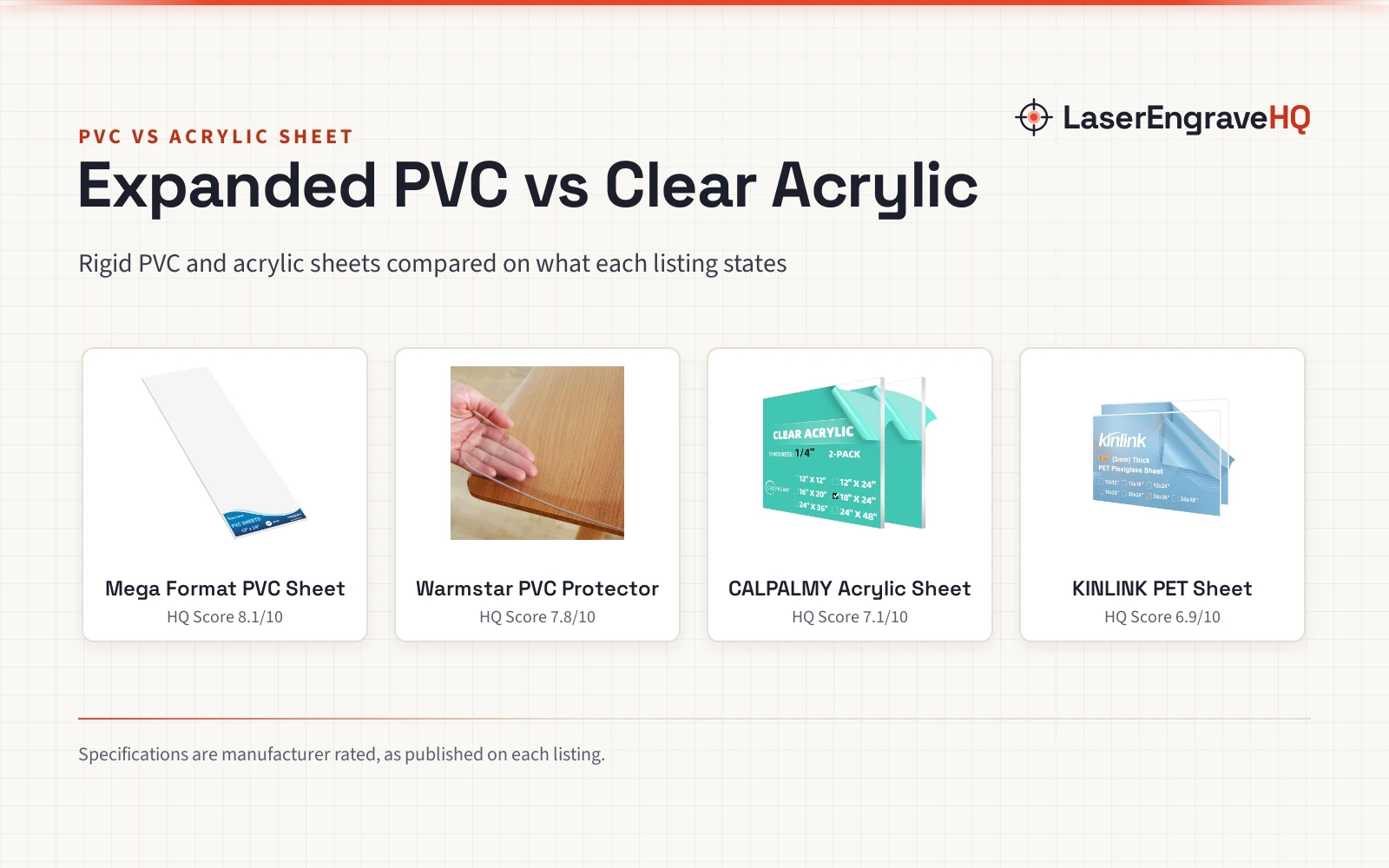
Mega Format Expanded PVC Plastic Sheets
A rigid 1/8-inch expanded PVC board for signage, outdoor displays and CNC routing or hand cutting.
Pros
- Rigid 1/8 inch (3mm) expanded PVC sheet cuts with a utility knife, scissors, or power tools
- Waterproof and weather-resistant surface suited for outdoor signage and displays
- Can be drilled, glued, painted with acrylics, and shaped or molded with heat
- Stated 12 by 24 inch size matches the spec table dimensions without contradictions
Cons
- PVC releases toxic fumes if cut with a laser, requiring CNC or mechanical cutting
- Opaque white finish does not provide optical transparency like acrylic
- No warranty term is stated in the listing
- Only one sheet included in the pack

Warmstar Clear Table Cover Protector 24 x 48 Inch
A 2mm flexible clear PVC sheet designed for tabletop protection, cut to size with household scissors.
Pros
- Large 24 by 48 inch work area offers extensive surface coverage
- Heat resistant up to 176 °F (80 °C) and safe for direct food contact
- BPA-free, waterproof, and easily cut to fit with household scissors
- Clear 2mm thick construction protects furniture from spills and scratches
Cons
- Flexible PVC material is not a rigid structural board and cannot be laser cut
- The maker notes it is cut slightly oversized to account for material shrinkage
- Smooth surfaces like glass or marble require frosted pads to prevent air bubbles
- No warranty term is stated in the listing

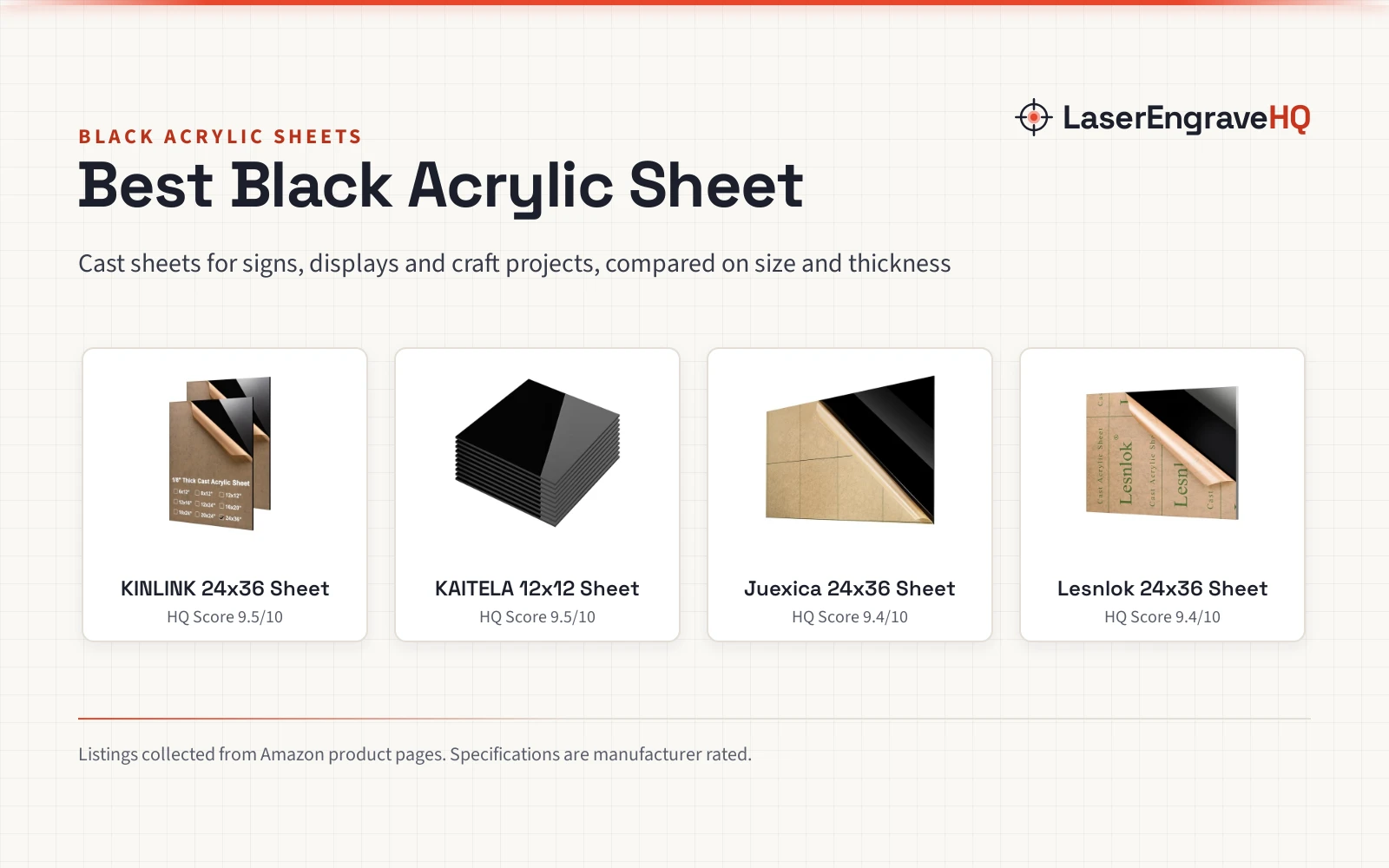
CALPALMY (2 Pack) 1/4" Thick Clear Acrylic Sheets
A 1/4-inch clear rigid acrylic sheet for display cases, signs and sneeze guards, cut with saws or routers.
Pros
- Heavy 1/4 inch thick acrylic delivers glass-like optical clarity at half the weight
- UV-resistant and temperature rated from -40 to 190 °F with a stated 30 year lifespan
- Compatible with mechanical engravers, CNC routers, power saws, and scoring knives
- Comes with protective film on both sides and shapes under heat
Cons
- Severe listing contradiction: spec table lists 24x36 inches while title states 18 by 24 inches
- Spec table lists 1/8 inch thickness and a white model number despite the 1/4 inch clear title
- Rigid acrylic can crack if drilled or cut without proper plastic-rated tooling
- No warranty term is stated in the listing

KINLINK 24x36 Clear PET Plexiglass Sheets 1/8 inch
A 1/8-inch clear PET plastic sheet marketed as plexiglass, offering UV coating and shatter resistance.
Pros
- Supplied as a 2 pack of large 24 by 36 inch sheets with protective surface paper
- Equipped with an anti-ultraviolet coating for UV resistance and outdoor stability
- Shatter-resistant construction cuts with CNC routers, table saws, jigsaws, or rotary tools
- Consistent 1/8 inch (3mm, 0.13 inches) thickness across the panel
Cons
- Listing confuses materials, advertising PET plastic as plexiglass, acrylic, and polycarbonate
- PET behaves differently from acrylic when heated and is not genuine acrylic
- Listing notes the material is prone to deformation
- No warranty term is stated in the listing
Other machines to compare
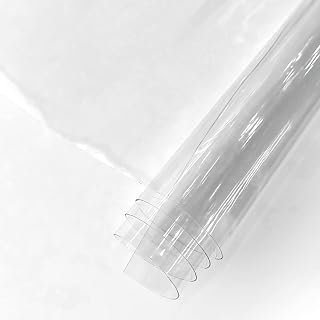 HYANG Transparent PVC Super Clear Holographic Vinyl Sheets 1Check price on Amazon
 Expanded PVC SheetCheck price on Amazon
 PerformoreCheck price on Amazon
 Performore Expanded PVC Sheet 12 x 12 InchCheck price on Amazon
Side by side
| Spec | Mega Format PVC Sheet | Warmstar PVC Protector | CALPALMY Acrylic Sheet | KINLINK PET Sheet |
|---|---|---|---|---|
| HQ Score | 60 | 58 | 53 | 51 |
| Material | Expanded PVC (Sintra, Celtec) | Flexible PVC plastic | Acrylic (Plexiglass) | Polyethylene Terephthalate (PET) |
| Laser cutting | Incompatible (releases chlorine gas and acid) | Incompatible (releases chlorine gas and acid) | Compatible material (listing states engraver, saws, routers) | Not stated (listing states mechanical engraver, saws, routers) |
| Cutting options | Scissors, utility knife, saws, CNC router | Scissors, utility knife | Engraver, saws, CNC router, box cutter | Engraving machine, saws, router, rotary tool |
| Stated thickness | 1/8 in (3 mm, 0.13 in) | 2 mm | 1/4 in (1/8 in in spec table) | 1/8 in (3 mm, 0.13 in) |
| Stated dimensions | 12 x 24 in (24 x 12 in spec table) | 24 x 48 in | 18 x 24 in (24×36 in in spec table) | 24 x 36 in |
| Pack count | 1 pack (1 item) | 1 count (1 item) | 2 pack | 2 pack (available in 2 or 5) |
| Optical clarity | Opaque white | Clear flexible cover | Clear glass-like clarity | Clear transparent panel |
| Thermal properties | Heat moldable and formable | Heat resistant up to 176 °F (80 °C) | Operating range -40 to 190 °F; heat moldable | Anti-UV coating; listing notes prone to deformation |
| Weather resistance | Waterproof for outdoor use | Waterproof and dustproof | UV and weather resistant (30 years claimed) | Anti-UV coating, weather resistant |
| Warranty | Not stated | Not stated | Not stated | Not stated |
Specifications are manufacturer rated, as published on each listing and collected 9 October 2026.
PVC vs acrylic sheet: core material differences
The primary division between pvc vs acrylic sheet begins with base chemical structure and physical form. Polyvinyl chloride appears in workshops either as rigid expanded foam board, like the Mega Format example, or as flexible protective sheet, like the Warmstar example. Expanded PVC board features a closed-cell foam core between smooth outer skins, offering structural stiffness at low weight. Acrylic, exemplified by the CALPALMY listing, is a solid thermoplastic offering high structural density and clarity comparable to glass. The KINLINK example illustrates an important market distinction: though advertised as plexiglass and acrylic, its spec table confirms it is Polyethylene Terephthalate (PET), a tough alternative that shares optical transparency with acrylic but differs in chemical and thermal behavior.
Laser cutting and critical safety limits
A major practical distinction between these materials is laser cutter compatibility. Acrylic cuts cleanly on a CO2 laser cutter because the material absorbs the infrared beam and vaporizes into methyl methacrylate monomer, producing smooth cut edges when paired with adequate air assist and exhaust ventilation. In contrast, PVC must never be placed inside a laser engraver or cutter under any circumstance. When polyvinyl chloride is heated by a laser, thermal decomposition releases hydrogen chloride gas and toxic chlorine fumes. Hydrogen chloride combines with airborne moisture to form hydrochloric acid, which corrodes optical mirrors, linear rails, and electronic hardware, while presenting severe respiratory hazards under OSHA workshop standards. Furthermore, listings that mention polycarbonate, like the KINLINK example, require caution: polycarbonate burns and discolors under a laser beam, producing heavy soot and hazardous fumes, and should not be laser cut.
CNC routing and machining
For shops operating a CNC router, both PVC and acrylic machine successfully, but they demand different bit choices and feed rates. Expanded PVC, such as the Mega Format board, machines easily on a CNC router. Its closed-cell foam structure cuts with low cutting resistance, producing light chips rather than fine dust when cut with standard spiral bits. Acrylic requires careful feed and speed management: as a rigid polymer, it can chip if the chipload is too high, or soften and melt against the cutter if friction builds up along the flute. Machining acrylic typically calls for O-flute end mills that clear chips rapidly before frictional heat accumulates. Both the CALPALMY acrylic and KINLINK PET panels state compatibility with routers, table saws, and mechanical engravers.
Manual cutting and shaping
In smaller shops without automated CNC equipment, cutting methods influence material selection. Expanded PVC sheet stands out for manual fabrication: the Mega Format example notes it cuts easily with a utility knife or household scissors, allowing rapid sizing without power tools. The Warmstar flexible PVC mat similarly trims to exact tabletop dimensions using standard scissors and a ruler. Rigid acrylic cannot be cut with scissors; it requires scoring with a plastic-cutting blade along a straightedge before snapping over a table edge, or processing on a table saw, miter saw, or jigsaw. The CALPALMY listing notes its 1/4 inch sheets can be scored with box cutters for manual sizing, though power saws or routers provide cleaner edges on 1/4 inch stock.
Clarity, finish and outdoor durability
When rigid, optical-grade transparency is required, acrylic is the superior choice. Acrylic sheets provide optical clarity comparable to glass at half the weight, making them the standard for display cases, picture frames, and protective sneeze guards. While flexible PVC sheets like Warmstar offer transparency for tabletop pads, they do not provide rigid structural panels. For outdoor weatherability, the CALPALMY acrylic listing claims a 30 year lifespan with resistance to ultraviolet light and temperature swings from -40 to 190 °F. KINLINK’s clear panel lists an anti-ultraviolet coating for surface protection. In contrast, expanded PVC board like Mega Format is an opaque white sheet that resists water and outdoor weathering, providing a smooth matte surface for paint, vinyl lettering, and signs.
Choose PVC sheet if
- You need an opaque white board for outdoor signage, architectural models, or displays (like the Mega Format expanded PVC).
- You plan to cut parts with a CNC router, hand saw, or utility knife rather than a laser.
- You need flexible tabletop surface protection against spills and scratches (like the Warmstar PVC mat).
- You want a lightweight, waterproof material that drills without chipping and accepts paint.
Choose acrylic sheet if
- You need rigid, glass-like optical clarity for display cases, signage, or protective barriers.
- You plan to cut or engrave parts using a CO2 laser cutter.
- You need outdoor weather resistance with high UV stability and a wide temperature tolerance.
- You want rigid plastic panels that can be scored, machined with plastic-rated bits, or edge-polished.
For more material options, see engraving materials.
Never cut PVC or vinyl with a laser cutter. Heating polyvinyl chloride produces corrosive hydrogen chloride and chlorine gas, creating workshop safety hazards under OSHA standards and destroying laser equipment. Use CNC routers, saws, or manual blades for PVC, and reserve laser cutting for acrylic with proper exhaust ventilation.
FAQ: lasers and CNC
What machine do I need to cut acrylic sheets?
Acrylic sheets cut cleanly on CO2 laser cutters, desktop CNC routers, and workshop saws such as table saws, miter saws, or jigsaws. On a CNC router, O-flute bits prevent chip re-welding. For manual sizing, the CALPALMY listing notes handheld box cutters can score sheets for snapping, though power saws or routers deliver cleaner edges on 1/4 inch panels.
What is acrylic sheet material?
Acrylic sheet material is polymethyl methacrylate (PMMA), a rigid synthetic polymer known for optical clarity, impact resistance, and weatherability. It serves as a shatter-resistant alternative to glass in signage and displays. While some listings conflate PET or polycarbonate with acrylic, genuine acrylic possesses distinct chemical properties that allow smooth vaporization under a CO2 laser beam.
Why is laser cutting PVC sheet dangerous?
Thermal cutting of polyvinyl chloride releases toxic hydrogen chloride gas and chlorine fumes. Hydrogen chloride reacts with ambient moisture to create hydrochloric acid, which corrodes optical mirrors, linear rails, and electronic hardware inside the laser cutter while presenting severe respiratory hazards under OSHA workshop standards.
How to remove paper from acrylic sheet?
To remove protective paper masking from an acrylic sheet, lift a corner using a fingernail or plastic scraper, then peel the paper back steadily at a low angle across the surface. If the adhesive has aged or hardened, warming the surface gently with a hair dryer can soften the glue for easier removal without overheating the plastic.
Which material is better for outdoor signs?
The better choice depends on sign construction. Expanded PVC board, such as the Mega Format example, is ideal for opaque, painted, or vinyl-applied outdoor signs because it is waterproof, lightweight, and easy to mount. Acrylic is better for illuminated, backlit, or transparent signs due to its optical clarity and UV resistance.
Related: best acrylic sheet, acrylic sheets for laser engraving, best CNC router for plastics, and CNC router vs laser cutter.