Filament Dryer vs Dry Box: Which One Should You Buy?
Creality filament dryers compared on heating, chambers, spools and storage, with the dry box side left unstated where no listing covers it.

On this page
When filament picks up moisture, prints can suffer, and filament dryer vs dry box comes down to whether the filament needs active drying or just dry storage. A dryer heats and dries filament, while a dry box is a storage container for keeping filament dry between prints. This comparison uses the dryer listings here as concrete examples, and states plainly where a dry box listing is missing, so the choice stays tied to what the listings actually state.
As an Amazon Associate I earn from qualifying purchases. LaserEngraveHQ earns a commission from purchases made through these links, at no extra cost to you. Read our affiliate disclosure.
Verdict: pick a filament dryer if the filament needs active drying, and pick a dry box if storage alone is enough, but no dry box listing is included here, so dry box specs are Not stated and cannot be ranked against these dryers.

Official Creality Filament Dryer 4 Spools
A dual-chamber filament dryer with dual 200W PTC heaters, independent temperature control, auto-drying mode and real-time humidity monitoring, for 4 spools at once.
Pros
- Dual independent chambers with own PTC each
- Dry and print 4 spools at once stated
- Auto-drying mode with real-time humidity monitoring
- Double insulation, exterior at or below 60 degrees Celsius
Cons
- Maximum temperature 75 degrees Celsius, lower than the X4 maximum stated
- Spec table weight and dimensions do not fit a 4-spool dryer, so neither figure is relied on here
- US 110V only as stated, 220V can damage it
- No warranty term stated

Creality Filament Dryer Box 4 Spools
A dual-chamber filament dryer and storage box with dual 200W heaters up to 85 degrees Celsius, for 4 standard 1kg spools or 2 large 2kg spools.
Pros
- Higher maximum temperature stated, 85 degrees Celsius
- Holds 4 standard 1kg spools or 2 large 2kg spools
- Silicone-sealed enclosure maintains humidity during pauses stated
- Custom temperatures stated for PLA, PETG, TPU and advanced filaments
Cons
- No warranty term stated
- No safety certification or double insulation stated
- 30% faster claim has no comparison model or conditions stated in the listing
- Voltage not stated in the listing
Side by side
| Spec | Creality Space Pi X4L | Creality Space Pi X4 | Dry box side |
|---|---|---|---|
| HQ Score | 66 | 59 | Not stated in the listings |
| Heating | Dual 200W PTC, up to 75 degrees Celsius | Dual 200W, up to 85 degrees Celsius | Not stated in the listings |
| Chambers | Dual independent chambers, own PTC each | Dual independent heating chambers | Not stated in the listings |
| Spools | 4 spools at once | 4 standard 1kg spools or 2 large 2kg spools | Not stated in the listings |
| Filament sizes | 1.75/2.85mm | 1.75mm/2.85mm | Not stated in the listings |
| Storage | Moisture-free storage box stated | Silicone-sealed enclosure, maintains humidity during pauses | Not stated in the listings |
| Voltage | US standard 110V stated, 220V can damage it | Not stated in the listing | Not stated in the listings |
| Safety | Double insulation, exterior at or below 60 degrees Celsius | Not stated in the listing | Not stated in the listings |
| Warranty | Not stated | Not stated | Not stated in the listings |
Specifications are manufacturer rated, as published on each listing and collected 4 November 2026.
Heating and temperature
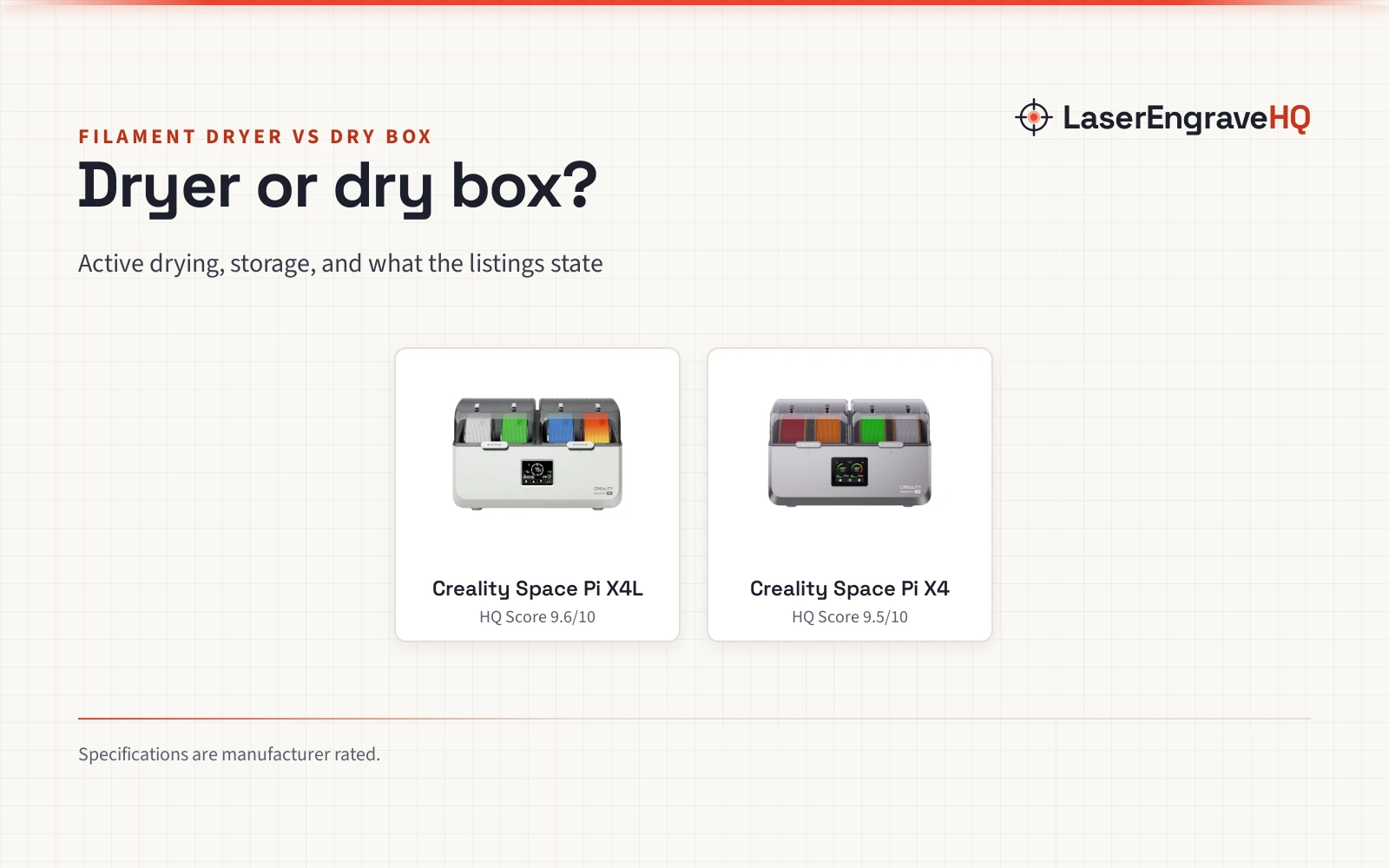
Both dryer examples state dual heating, but their stated maximum temperatures differ. The Creality Space Pi X4L states dual 200W PTC heaters with a maximum of 75 degrees Celsius, while the Creality Space Pi X4 states dual 200W heating chambers with a maximum of 85 degrees Celsius. That difference is between the two dryer listings, both of which state a maximum, and it is not a claim about a dry box, for which no maximum is stated here.
Temperature control also differs. The X4L listing states independent temperature control for each chamber, an auto-drying mode and real-time humidity monitoring. The X4 listing states custom temperatures of 50 to 60 degrees Celsius for PLA, PETG and TPU, and 80 to 85 degrees Celsius for advanced filaments.
Chambers and spools
Both examples are four-spool dryers, but their spool options differ in what the listings state. The X4L listing states that it can dry and print 4 spools at once, with each chamber having its own PTC heater. The X4 listing states that it holds 4 standard 1kg spools or 2 large 2kg spools, which is a spool size option that the X4L listing does not state. Neither listing states a dry box spool option, so no spool comparison with a dry box can be made from these listings.
Filament sizes are the same in both listings, at 1.75mm and 2.85mm, with PLA, PETG, TPU and ABS named in both titles. That shared range does not separate these two dryer examples, and it says nothing about a dry box, for which no filament size is stated here.
Storage while printing
Storage is where the dryer and dry box ideas overlap in these listings. Both dryer examples claim storage as well as drying: the X4L title names a moisture-free filament storage box, and the X4 listing names a dryer plus storage function, with a silicone-sealed enclosure that prevents moisture re-absorption and maintains humidity during printing pauses. No dry box listing here states its seal, capacity or humidity control, so that storage comparison cannot be ranked from these listings.
Voltage and safety
Voltage is stated for one dryer example and not for the other, and that gap matters for buying. The X4L listing states that the US standard voltage is 110V, and that connecting it to 220V can easily damage it. The X4 listing states no voltage, so a buyer should check the voltage for that model from its listing before ordering, rather than assuming it matches the X4L voltage.
Safety features are also stated for one example and not for the other. The X4L listing states double insulation, with an internal temperature up to 75 degrees Celsius while the exterior stays at or below 60 degrees Celsius. The X4 listing states no comparable safety feature, so the X4L safety score reflects its stated features only.
The picks: filament dryer vs dry box
Choose the Creality Space Pi X4L if
- You want independent temperature control for each chamber, with an auto-drying mode and real-time humidity monitoring.
- You value the stated double insulation and exterior temperature limit, and you use US standard 110V power.
- You want to dry and print 4 spools at once from a dryer that also names moisture-free storage.
Choose the Creality Space Pi X4 if
- You want a higher stated maximum temperature, at 85 degrees Celsius, with stated ranges for advanced filaments.
- You want the stated spool option of 4 standard 1kg spools or 2 large 2kg spools.
- You want a silicone-sealed enclosure that maintains humidity during printing pauses, with an illuminated window for monitoring spools.
For more filament choices, see our best PLA filament for 3D printers guide.
Check voltage before ordering. The X4L listing states US standard 110V and warns that connecting it to 220V can easily damage it. The X4 listing states no voltage, so check that model separately.
FAQ: lasers and CNC
Is a filament dryer the same as a dry box?
No, in this comparison a dryer actively heats and dries filament, while a dry box is for storage. Both dryer examples here also claim storage, but only the dryers state active heating. No dry box listing is included here, so dry box specs are Not stated.
Which dryer reaches a higher temperature?
The Creality Space Pi X4 states a maximum of 85 degrees Celsius, while the Creality Space Pi X4L states a maximum of 75 degrees Celsius. That comparison is between the two dryer listings only, and it says nothing about a dry box, for which no maximum is stated here.
Can these dryers print while drying?
The X4L listing states that it can dry and print 4 spools at once. The X4 listing does not state print while drying; it states that it maintains humidity during printing pauses and allows monitoring through an illuminated window. Check each listing for the exact printing setup it describes.
Do these dryers work with PLA and PETG?
Yes, on the titles. Both titles name PLA, PETG, TPU and ABS, with filament sizes of 1.75mm and 2.85mm. The X4 listing also states custom temperatures for PLA, PETG and TPU, and a higher range for advanced filaments.
What is missing from these listings?
A dry box listing is missing, so dry box capacity, seal and humidity control cannot be compared from these listings. The X4 listing also states no voltage and no warranty term, while the X4L spec table lists weight and dimensions that do not fit a four-spool dryer and are not relied on here.
Related: FDM versus resin printer and best 3D printer enclosure with exhaust fan.