Creality K1C vs K1 Max: Which One Should You Buy?
Two Creality printers with the same rated speed, compared on build volume, leveling, cameras, extruders and cooling.

On this page
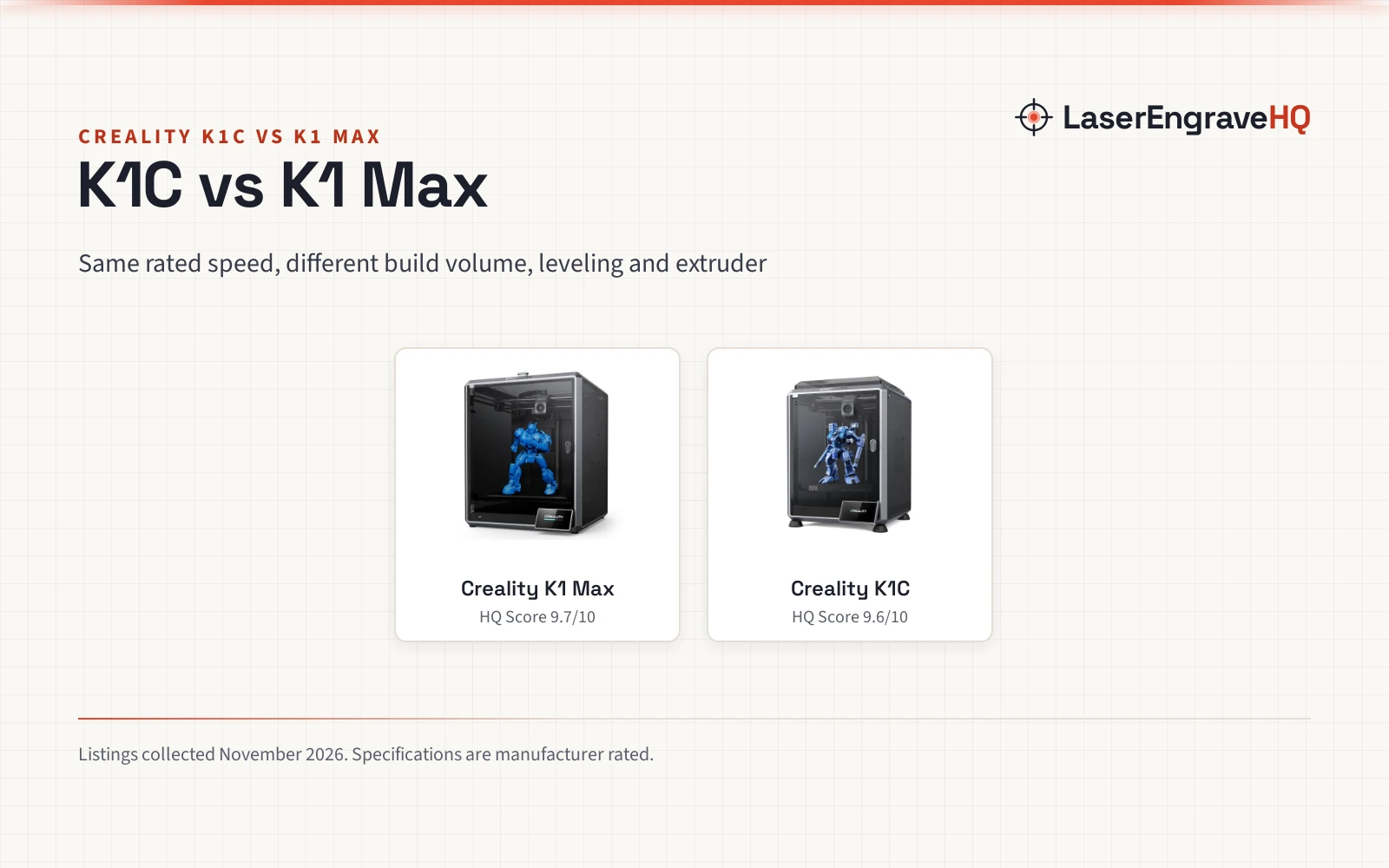
A maker with a shelf of small parts and an eye on bigger projects faces a familiar fork when shopping Creality: a machine tuned for carbon fiber filament, or a machine with the larger stated build volume for larger prints. Creality K1C vs K1 Max is that choice in miniature, with each listing describing automatic leveling and a camera that watches the print. The short verdict is that the K1 Max suits makers who want room for large models and Lidar scanning, while the K1C suits makers who want carbon fiber support and high-temperature printing in a machine with the smaller stated build volume. The sections below compare what each listing actually states.
As an Amazon Associate I earn from qualifying purchases. LaserEngraveHQ earns a commission from purchases made through these links, at no extra cost to you. Read our affiliate disclosure.
Verdict: the K1 Max ranks first here, with the larger stated build volume and Lidar scanning, while the K1C is the pick for carbon fiber filament and high-temperature printing in a machine with the smaller stated build volume. Choose by the size of the models and the filaments planned.
Machines on the list

Creality K1 Max 3D Printer with Smart AI Function
A Core XY printer with a large 11.81 inch cube build volume, Lidar first-layer scanning, an AI camera and strain-sensor auto leveling.
Pros
- 11.81x11.81x11.81 inch build volume for larger models
- 1 Micrometer Resolution AI Lidar scans the first layer and stops the job on a problem
- Strain sensors in the heatbed for hands-free auto leveling
- Core XY structure with a printhead fan and chamber auxiliary fan for cooling
Cons
- No carbon fiber filament support stated in the listing
- No high-temperature printing figure stated in the listing
- Listing weight figures disagree between the spec table and another figure
- No print speed edge over the K1C: both list 600mm/s

Creality K1C 3D Printer Support Carbon Fiber
A smaller-build-volume printer with a clog-free direct extruder, 300°C high-temperature printing, carbon fiber filament support and an AI camera.
Pros
- Clog-free direct extruder supports carbon fiber filament
- 300°C high-temperature printing with support for many filament kinds
- AI camera recognizes spaghetti failure, foreign matter and debris
- Arrives assembled with a boot-up guide, ready 3 minutes from unboxing to powering on
Cons
- Smaller build volume than the K1 Max, at 8.66x8.66x9.84 inch
- No Lidar first-layer scanning stated in the listing
- Listing weight figures disagree between the spec table and another figure
- No strain-sensor leveling stated; leveling is by auto calibration
Side by side
| Spec | Creality K1 Max | Creality K1C | Notes |
|---|---|---|---|
| HQ Score | 66 | 64 | Higher total ranks first |
| Print speed | 600mm/s | 600mm/s | Same rated speed on both listings |
| Build volume | 11.81×11.81×11.81 inch | 8.66×8.66×9.84 inch | K1 Max states the larger volume |
| Auto leveling | Strain sensors in the heatbed | Auto leveling and auto Z offset | Different leveling methods stated |
| Camera and scanning | AI Camera and 1 Micrometer Resolution AI Lidar | AI Camera | K1 Max adds Lidar scanning of the first layer |
| Extruder | Dual-gear extruder | Clog-free direct extruder, 300°C | K1C states carbon fiber support |
| Cooling | Printhead fan and chamber auxiliary fan | Hotend, part cooling and auxiliary fans | Both state chamber auxiliary fans |
| Warranty | 1 year | 1 year | Same stated term |
| Weight | 39.68 pounds | 27.33 pounds | Spec table figures |
Specifications are manufacturer rated, as published on each listing and collected 3 November 2026.
Creality K1C vs K1 Max: speed, size and leveling
Speed does not separate these two listings. Both state a 600mm/s printing speed and 20000 millimeters per square second acceleration, and both listings claim 12 times faster than a normal 3D printer. A buyer who picks on speed alone will find no edge in either listing.
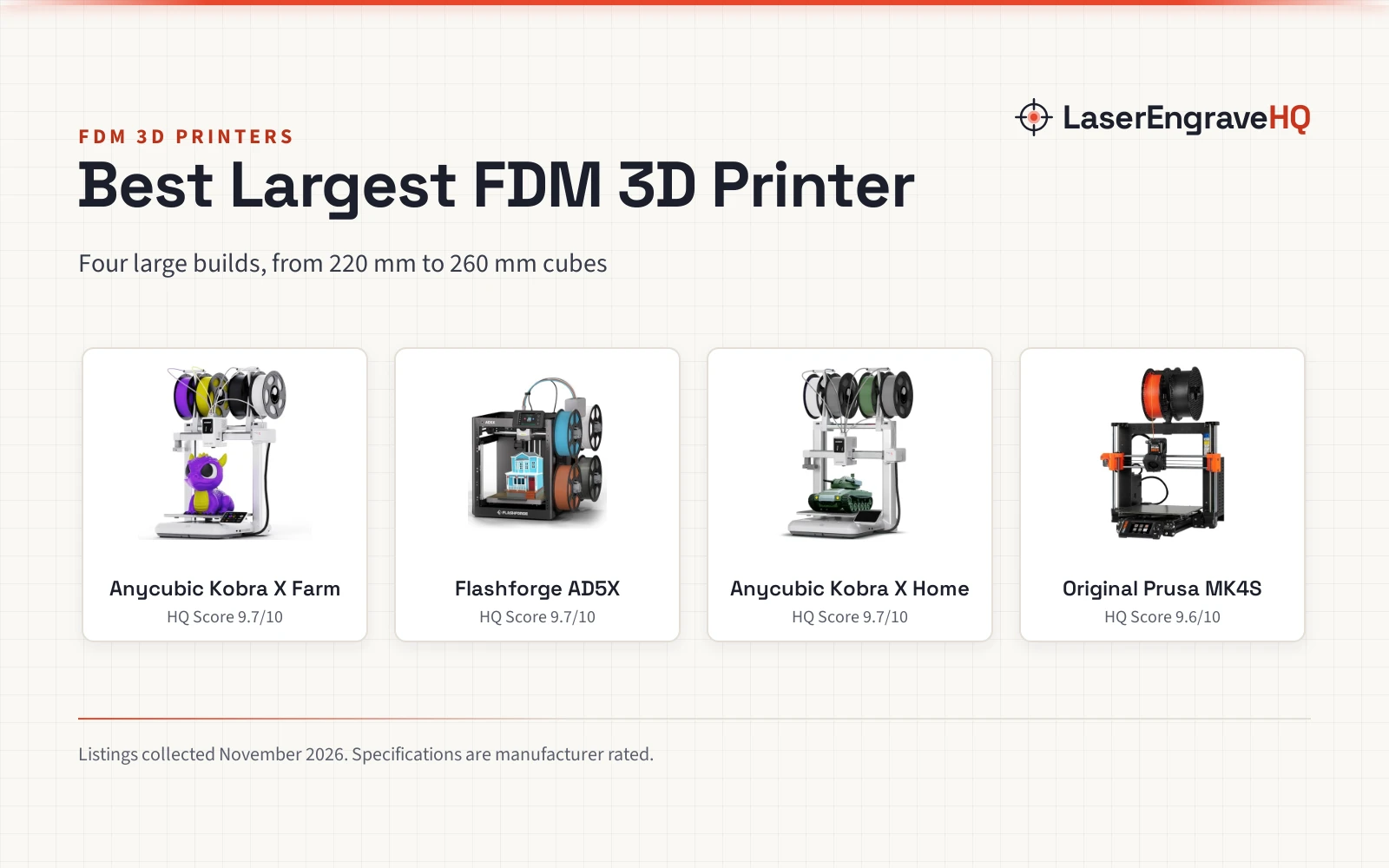
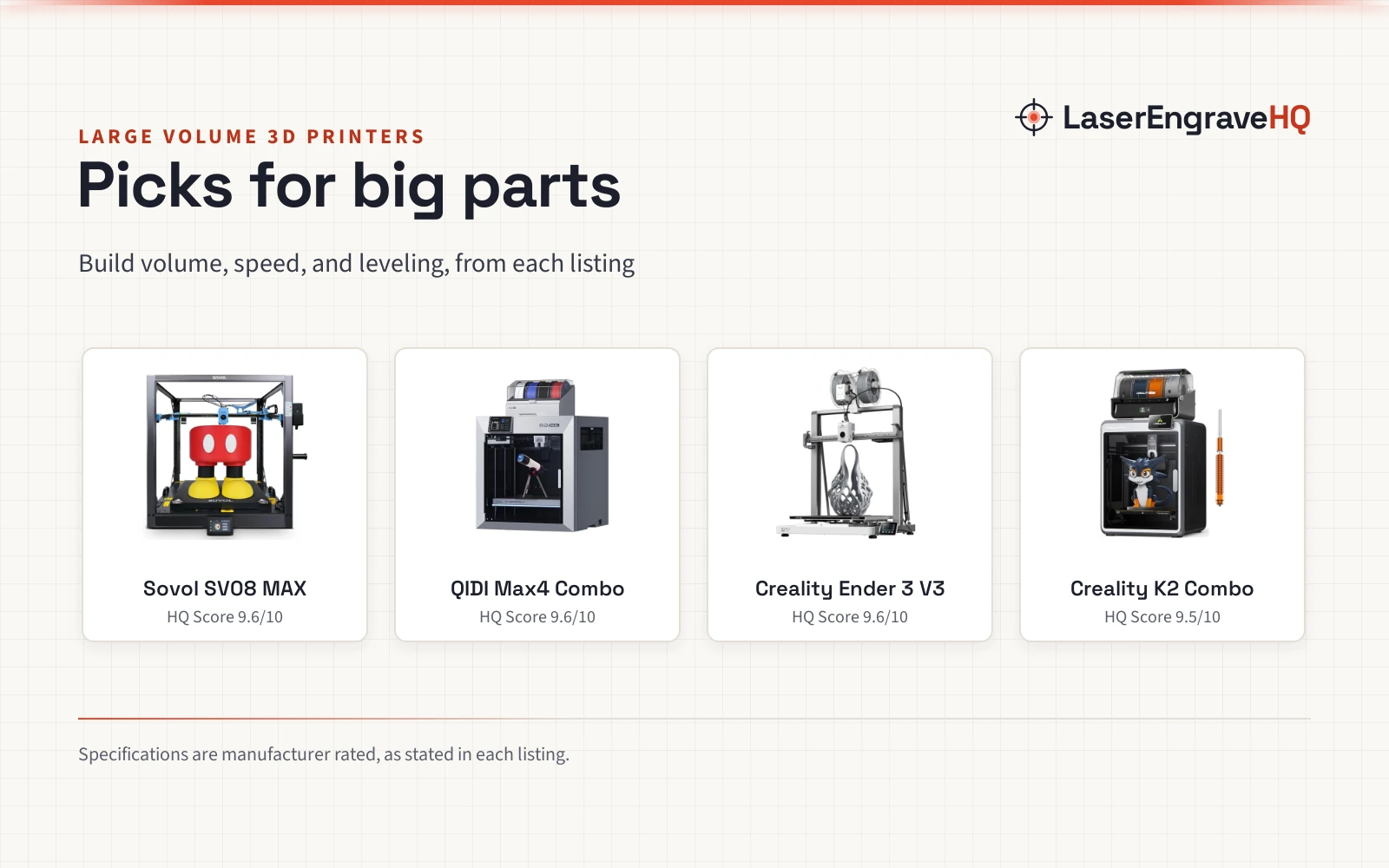
Build volume separates them clearly. The K1 Max listing states an 11.81×11.81×11.81 inch build volume, while the K1C listing states 8.66×8.66×9.84 inch, so the K1 Max states room for larger models and for a print farm, as its listing puts it. Leveling also differs in method rather than in promise: the K1C listing describes auto calibration with auto Z offset and auto leveling, while the K1 Max listing describes dual hands-free auto leveling through strain sensors in the heatbed, with no operation or attention needed.
Extruder and filaments
The K1C listing is the filament-flexible one. Its clog-free direct extruder supports carbon fiber filament and many kinds of filament, with a bolster spring and a ball plunger that grip filament tightly, a steel-tipped copper nozzle and a titanium alloy heatbreak, and 300°C high-temperature printing. The K1 Max listing describes a dual-gear extruder but states no carbon fiber support and no high-temperature figure, so a buyer who plans to print carbon fiber should weigh the K1C listing’s stated support.
Cameras and monitoring
Both listings state an observant AI camera that recognizes spaghetti failure, foreign matter and debris, and supports real-time monitoring and time-lapse filming. The K1 Max listing adds the 1 Micrometer Resolution AI Lidar, which scans the first layer and stops the printing job if there is a problem. That Lidar check is the K1 Max listing’s clearest monitoring edge, since the K1C listing states no equivalent first-layer scanning.
Structure and cooling
The K1 Max listing states a Core XY structure for more stable printing, with a fan on the printhead using directional air ducts and an auxiliary fan in the build chamber. The K1C listing describes an upgraded fan design: a hotend fan for minimal heat creep, a part cooling fan for instant hardening through a special air duct, and an auxiliary fan on the chamber side to assist model cooling and minimize stringing and warping for bridges and overhangs. Neither listing states a safety certification, so no safety score is given to either machine here.
Choose the Creality K1 Max if
- You want the larger stated build volume for big models or a print farm.
- You want Lidar first-layer scanning plus an AI camera watching the print.
- You want hands-free leveling through strain sensors in the heatbed.
Choose the Creality K1C if
- You want stated carbon fiber filament support and 300°C high-temperature printing.
- You want a machine that arrives assembled and starts quickly.
- You want a clog-free direct extruder with a steel-tipped copper nozzle.
Project Match
- Large models and print farm batches: K1 Max, with its 11.81×11.81×11.81 inch stated build volume.
- Carbon fiber parts: K1C, the only listing here that states carbon fiber filament support.
- High-temperature filament work: K1C, with its stated 300°C printing.
- Monitored long prints: K1 Max, with Lidar first-layer scanning plus an AI camera.
- Quick-start small projects: K1C, with its stated assembled arrival and 3 minutes from unboxing to powering on.
FAQ: lasers and CNC
Which prints larger models, the K1C or the K1 Max?
The K1 Max. Its listing states an 11.81×11.81×11.81 inch build volume, while the K1C listing states 8.66×8.66×9.84 inch.
Do both print at the same speed?
By the listings, yes. Both state a 600mm/s printing speed and 20000 millimeters per square second acceleration.
Which one supports carbon fiber filament?
The K1C. Its listing states that its clog-free direct extruder can print carbon fiber filament. The K1 Max listing states no carbon fiber support.
How does auto leveling differ between the two?
The K1C listing describes auto calibration with auto Z offset and auto leveling. The K1 Max listing describes dual hands-free auto leveling through strain sensors in the heatbed, with no operation or attention needed.
Do both have cameras?
Yes. Both listings state an AI camera for real-time monitoring and time-lapse filming. The K1 Max listing adds a 1 Micrometer Resolution AI Lidar that scans the first layer.
Related: FDM 3D printers, best large volume 3D printer, enclosed vs open 3D printer and FDM vs resin 3D printer.