Chamfer vs Bevel Router Bit: Which One Should You Buy?
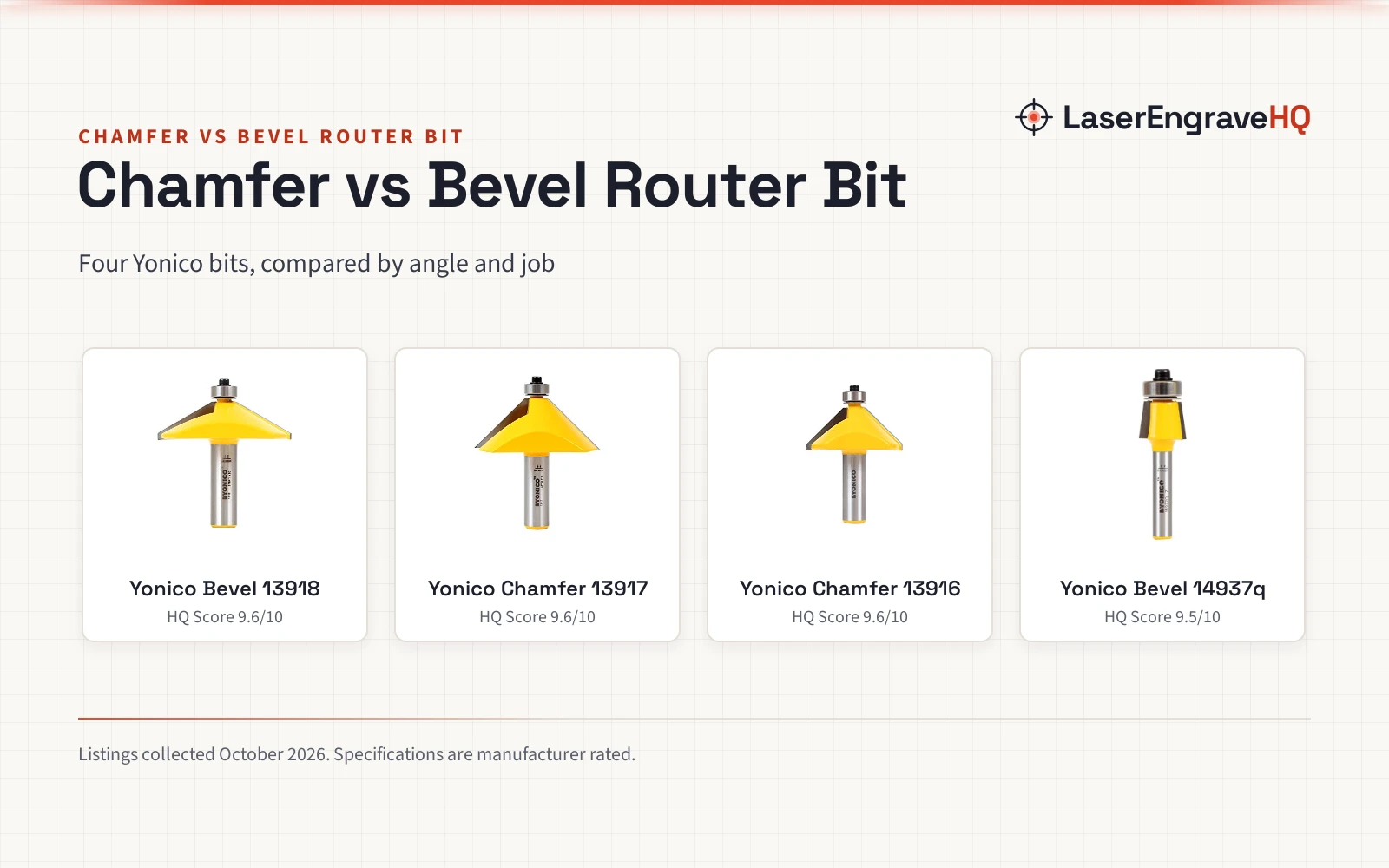
Four Yonico chamfer and bevel router bits compared by angle, depth, shank, and joint, for edge work, miter joints, and trim.

On this page
Top picks at a glance
As an Amazon Associate I earn from qualifying purchases.
- 1
 4Pcs Carbide Chamfer End Mill V Groove Router Bit 60 Degree9.7/10View on Amazon
- 2
 XDENGP 45 Degree Chamfer Router Bit with 3/4 Inch Cutting9.6/10View on Amazon
- 3
 YONICO Chamfer Router Bits Bevel Edge Forming 45 Degree9.4/10View on Amazon
- 4
 YONICO Chamfer Router Bits Bevel Edge Forming 15 DegreeView on Amazon
- 5
 Akylin 4Pcs 45° Chamfer Router Bit SetView on Amazon
- 6
 Whiteside 2305 45 Degree Chamfer Router Bit: 45 Degree AngleView on Amazon
- 7
 KOWOOD Plus 45 Degree Chamfer Router Bit SetView on Amazon
- 8
 Yakamoz 45 Degree Chamfer Router BitView on Amazon
- 9
 Freud 1-5/8" Chamfer Router Bit with Tico Hi-Density CarbideView on Amazon
A workshop edge can change how a piece looks and feels: chamfer and bevel bits both cut an angled face, and the angle and the joint separate them. This chamfer vs bevel router bit comparison uses Yonico examples from both sides, and the verdict below says who should pick which side.
LaserEngraveHQ earns a commission from purchases made through these links, at no extra cost to you. Read our affiliate disclosure.
Verdict: Pick a chamfer bit for 45-degree edge work; the Yonico Chamfer 13917 example also states a 90-degree miter joint. Pick a bevel router bit for a 60-degree bevel edge, as shown by the Yonico Bevel 13918 example, or for a 7-degree veneer trim, as shown by the Yonico Bevel 14937q example. Choose by the angle and the joint, not by the name on the bit.
Machines on the list

YONICO Router Bits Bevel Edge Forming 60 Degree
A 60-degree bevel edge-forming bit with a 1/2-inch shank for bevels and miter joints.
Pros
- 60-degree bevels at 1 inch deep and 9/16 inch high
- Creates a 120-degree miter joint
- Two-flute carbide cutters with a 1/2-inch shank
- For table-mount and handheld router use
Cons
- No warranty term is stated
- 60-degree angle only, not an adjustable angle
- Diameter is not stated in the listing
- 60-degree angle suits bevel edges, not 45-degree chamfer work

YONICO Router Bits Edge Forming Chamfer 45 Degree
A 45-degree chamfer bit with a 1/2-inch shank for bevels, chamfers, and miter joints in stock up to 1 inch thick.
Pros
- Cuts 45-degree bevels and chamfers at 1 inch deep and high
- Creates a 90-degree miter joint
- For stock up to 1 inch thick
- Two-flute carbide cutters with a 1/2-inch shank
Cons
- No warranty term is stated
- 45-degree profile only, not an adjustable angle
- Diameter given only as an up-to figure of 2-1/2 inches
- Stock limited to 1 inch thick, as stated

YONICO Router Bits Edge Forming Chamfer 45 Degree
A 45-degree chamfer bit with a 1/2-inch shank, a 3/4-inch cutting height, and a 2-inch diameter.
Pros
- 45-degree angle with a 3/4-inch cutting height
- 2-inch diameter for edge work
- Creates 4-sided shapes
- C3 carbide blades with silver induction brazing
Cons
- No warranty term is stated
- 45-degree profile only, not an adjustable angle
- No miter joint angle stated
- No flute count stated

YONICO Bevel Trim Router Bits Bevel 7 Degree
A 7-degree bevel trim bit with a 1/4-inch shank for trimming and beveling countertop veneers and trim.
Pros
- 7-degree bevel trim for veneers and trim
- Two-flute carbide cutters
- 1/4-inch shank, as stated
- For table-mount and handheld router use
Cons
- No warranty term is stated
- No cutting depth or height stated
- Narrow 7-degree angle, not for general edge forming
- Trim-focused profile, not for miter joints
Other machines to compare
 YONICO Chamfer Router Bits Bevel Edge Forming 15 DegreeCheck price on Amazon
 Akylin 4Pcs 45° Chamfer Router Bit SetCheck price on Amazon
 Whiteside 2305 45 Degree Chamfer Router Bit: 45 Degree AngleCheck price on Amazon
 KOWOOD Plus 45 Degree Chamfer Router Bit SetCheck price on Amazon
 Yakamoz 45 Degree Chamfer Router BitCheck price on Amazon
 Freud 1-5/8" Chamfer Router Bit with Tico Hi-Density CarbideCheck price on Amazon
Side by side
| Spec | Yonico Bevel 13918 | Yonico Chamfer 13917 | Yonico Chamfer 13916 | Yonico Bevel 14937q |
|---|---|---|---|---|
| HQ Score | 59 | 58 | 57 | 53 |
| Angle | 60 degrees | 45 degrees | 45 degrees | 7 degrees |
| Cutting depth and height | 1 inch deep, 9/16 inch high | 1 inch deep and high | 3/4-inch cutting height | Not stated |
| Shank | 1/2 inch | 1/2 inch | 1/2 inch | 1/4 inch |
| Also makes | 120-degree miter joint | 90-degree miter joint | 4-sided shapes | Countertop veneer trim |
| Cutters | Two-flute carbide | Two-flute carbide | C3 carbide blades | Two-flute carbide |
| Warranty | Not stated | Not stated | Not stated | Not stated |
Specifications are manufacturer rated, as published on each listing and collected 30 October 2026.
Chamfer vs bevel router bit: angles, depths, and joints
The chamfer examples here are both 45-degree bits. The Yonico Chamfer 13916 example states a 3/4-inch cutting height and a 2-inch diameter, and states that it creates 4-sided shapes. The Yonico Chamfer 13917 example states 45-degree bevels and chamfers at 1 inch deep and high, a 90-degree miter joint, and stock up to 1 inch thick. Both chamfer examples state a 1/2-inch shank and C3 micro-grain tungsten carbide blades.
The bevel examples here differ from each other more than the chamfer examples do. The Yonico Bevel 13918 example states 60-degree bevels at 1 inch deep and 9/16 inch high, a 120-degree miter joint, and a 1/2-inch shank. The Yonico Bevel 14937q example states a 7-degree bevel trim for countertop veneers and trim, with a 1/4-inch shank. All four examples state two-flute carbide cutters except the 13916 example, which states C3 carbide blades without a flute count, and all four state use on a table-mount and handheld router.
Two gaps are worth noting before choosing. No listing here states a warranty term, so warranty does not separate these examples. Diameter is also uneven: the 13916 example states a 2-inch diameter, while the 13917 example gives diameter only as an up-to figure of 2-1/2 inches, so its exact diameter stays unclear from the listing.
Shanks and cutters
Three examples state a 1/2-inch shank, and only the 14937q bevel example states a 1/4-inch shank, so collet fit is one more check before ordering. All four listings state C3 micro-grain tungsten carbide blades or cutters with silver induction brazing, and three of them state two-flute carbide cutters. The 13916 chamfer example states C3 carbide blades without a flute count, so its cutter layout stays less detailed than the other three examples.
Choose a chamfer bit if
- You want a 45-degree edge profile.
- You want a stated miter joint, such as the 90-degree joint on the 13917 example.
- You want a stated 4-sided shape cut, as on the 13916 example.
Choose a bevel router bit if
- You want a 60-degree bevel edge, as on the 13918 example.
- You want a 7-degree trim bevel for veneers, as on the 14937q example.
- You want a 120-degree miter joint, as stated by the 13918 example.
Project Match
- Miter joints at 90 degrees: the Yonico Chamfer 13917 example.
- Miter joints at 120 degrees: the Yonico Bevel 13918 example.
- 4-sided shapes: the Yonico Chamfer 13916 example.
- Countertop veneer trim: the Yonico Bevel 14937q example.
FAQ: lasers and CNC
What is the difference between a chamfer bit and a bevel bit?
In these listings, the chamfer examples are both 45-degree edge-forming bits, while the bevel examples are a 60-degree edge-forming bit and a 7-degree trim bit. Both sides state beveled edges, so the angle and the job separate them, not the name alone.
Can a chamfer bit make a miter joint?
The 13917 chamfer example states a 90-degree miter joint, and the 13916 chamfer example states accurate miter joints without giving an angle. Check the stated angle against the joint you need.
What shank sizes do these bits use?
Three examples state a 1/2-inch shank, and the 14937q bevel example states a 1/4-inch shank. Match the shank to the router collet you own.
Do these bits work in a handheld router?
Yes. All four listings state use on a table-mount and handheld router.
Related: best chamfer bit for router, best bevel router bit with bearing, and carbide vs diamond router bits.