How to Choose Laser Safety Glasses: A Step-by-Step Guide
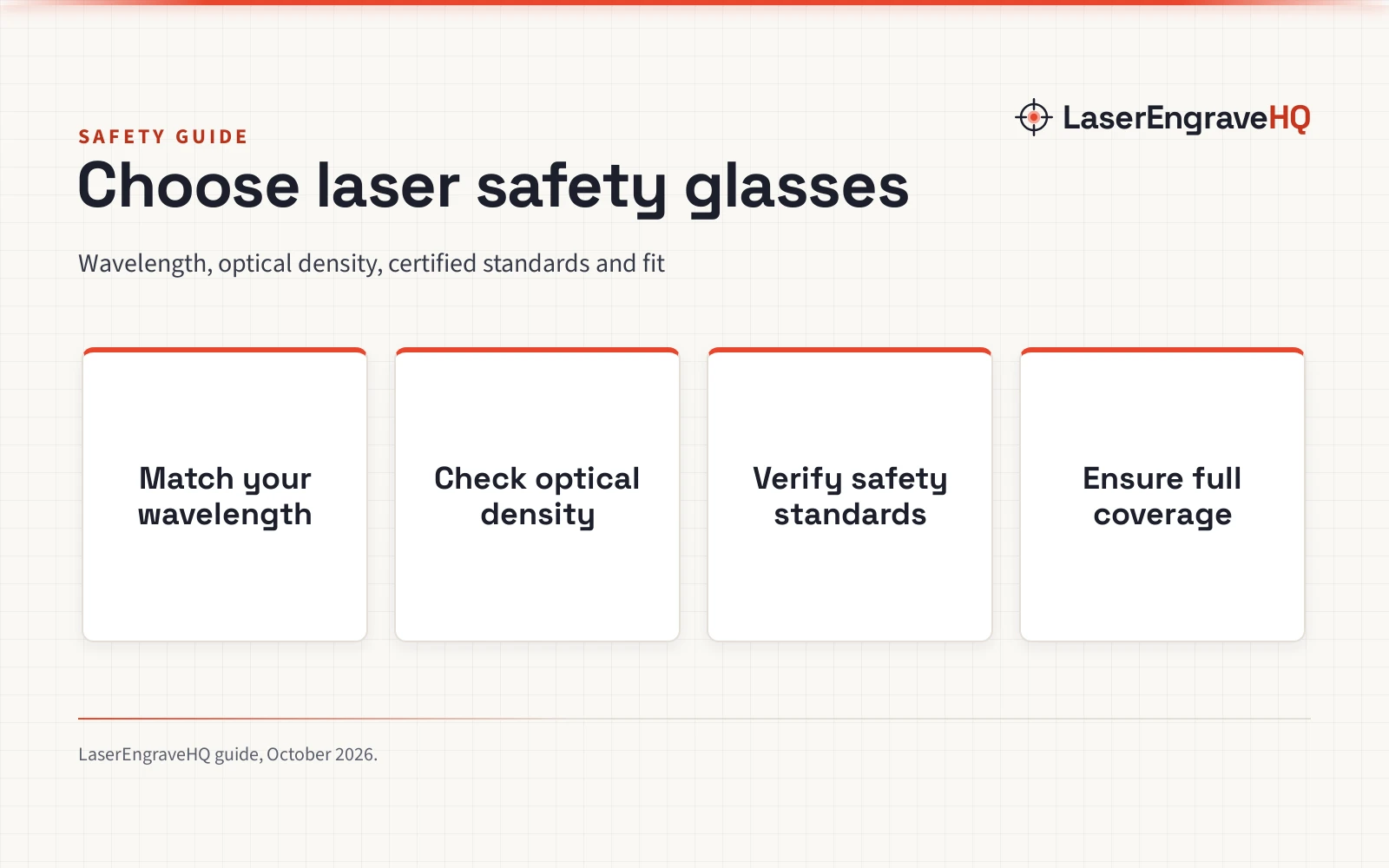
A step-by-step guide to choosing laser safety glasses: match your laser wavelength, select the right optical density, check certified standards and pick a snug fit.

On this page
Top picks at a glance
As an Amazon Associate I earn from qualifying purchases.
- 1
 LaserPair Laser Safety Glasses 200-534nm and 740-1095nm Laser9.7/10View on Amazon
- 2
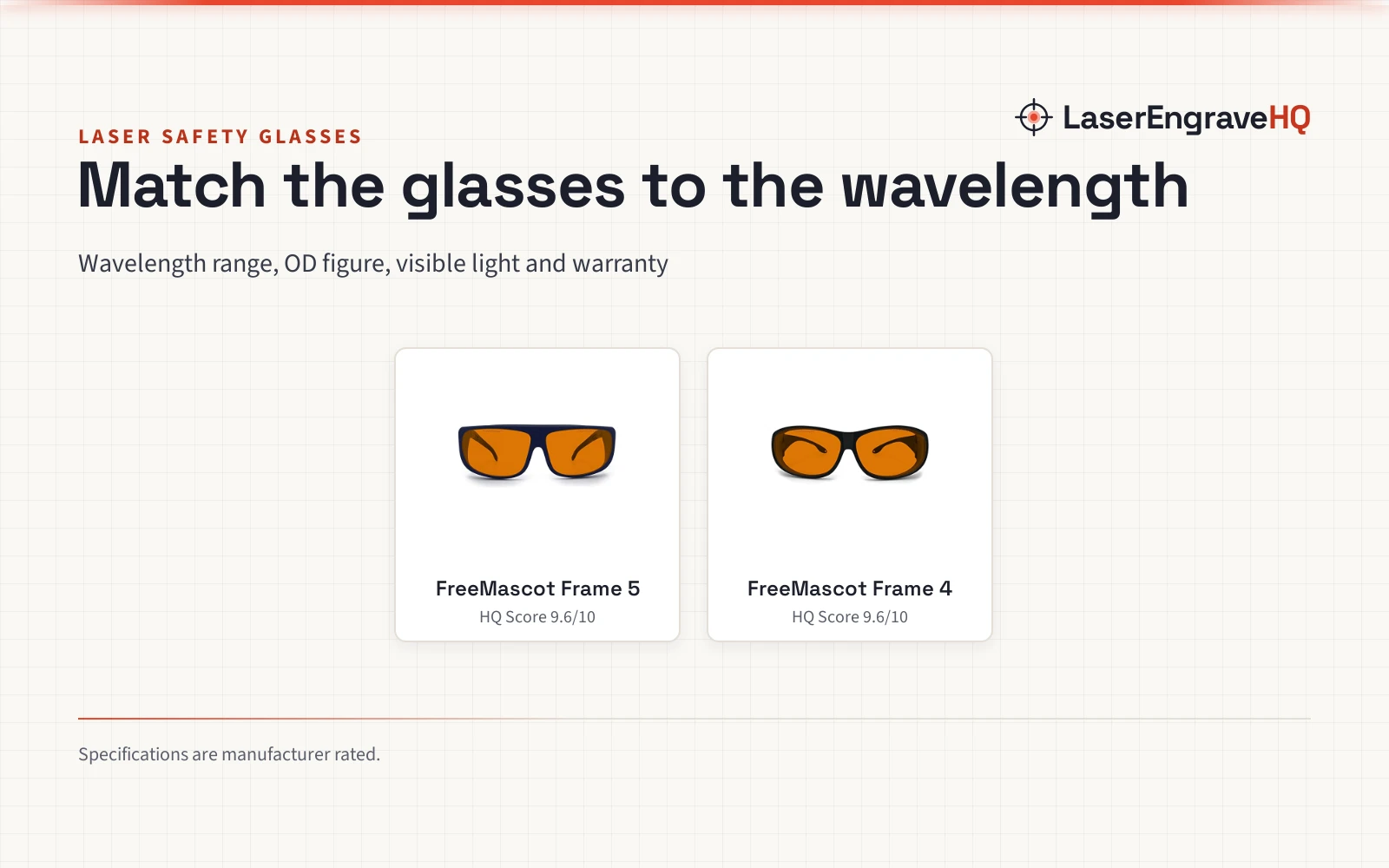
 FreeMascot Professional OD 6+ 190nm-490nm Wavelength9.7/10View on Amazon
- 3
 190nm-490nm OD 6+ Laser Safety Eye Protection Glasses UV9.6/10View on Amazon
- 4
 LaserPair Laser Safety Glasses 200-460nm OD6+ & 800-1095nmView on Amazon
- 5
 xTool Laser Safety GlassesView on Amazon
- 6
 Duco 1/8" Clear Cast Acrylic SheetView on Amazon
- 7
 FreeMascot New Professional OD 6+ 190nm-490nm Wavelength UVView on Amazon
- 8
 Duco 1/4" Clear Cast Acrylic SheetView on Amazon
- 9
 Twotrees TTS-20 Max 20000mW Laser Engraver and Cutter MachineView on Amazon
How to choose laser safety glasses comes down to matching your laser wavelength, selecting an optical density rating that blocks hazardous radiation, verifying certified safety standards and choosing a frame style that prevents peripheral light leaks. Laser protection is wavelength-specific, meaning filters only attenuate radiation within their certified bands. While multi-wavelength glasses can protect across different machine types, a filter built solely for one wavelength provides no protection against uncertified bands. The sections below explain how to check manufacturer specifications, identify certified ratings and pick comfortable protective frames for your workshop.
Other machines to compare
 LaserPair Laser Safety Glasses 200-460nm OD6+ & 800-1095nmCheck price on Amazon
 xTool Laser Safety GlassesCheck price on Amazon
 Duco 1/8" Clear Cast Acrylic SheetCheck price on Amazon
 FreeMascot New Professional OD 6+ 190nm-490nm Wavelength UVCheck price on Amazon
 Duco 1/4" Clear Cast Acrylic SheetCheck price on Amazon
 Twotrees TTS-20 Max 20000mW Laser Engraver and Cutter MachineCheck price on Amazon
LaserEngraveHQ earns a commission from purchases made through these links, at no extra cost to you. Read our affiliate disclosure.
Tinted sunglasses, welding masks and unrated plastic shields do not provide laser protection. Protective glasses only safeguard your vision when their markings specify the exact wavelength and optical density matching your machine beam.
Step 1: Identify your laser wavelength
Protective eyewear must correspond directly to the operating wavelength of your machine. Diode engravers typically operate in the blue spectrum around 450nm. Fiber lasers used for metal marking operate in the infrared spectrum around 1064nm. In contrast, CO2 laser cutters operate in the far-infrared spectrum around 10600nm. If you are comparing machine types, our diode vs CO2 laser guide details their operational differences.
Laser safety glasses absorb narrow spectral bands while transmitting other light so you can see your work area. Because protection depends on matching specific wavelengths, glasses designed solely for a 450nm blue diode will not shield your eyes from a 1064nm fiber laser or a 10600nm CO2 beam unless the filter carries multi-wavelength ratings. Manufacturer listings show how protective ranges are published. For instance, LP-LaserPair publishes multi-wavelength glasses protecting 200-534nm and 740-1095nm, covering wavelengths including 355nm, 405nm, 445nm, 450nm, 532nm, 740nm, 808nm, 980nm and 1064nm. For broad multi-band protection, MCWlaser lists protective goggles covering 190-540nm and 800-1700nm, targeting diode, fiber and Nd:YAG lasers. Meanwhile, mozeeda lists broad protection spanning 190nm-2000nm, and Bantida and ULTREMA list 200-2000nm. Always identify your laser beam wavelength from your machine manual before looking at eyewear.
Step 2: Check the optical density rating
Optical density, abbreviated as OD, measures the attenuation of laser energy through the protective filter on a logarithmic scale. A higher optical density rating indicates greater absorption and blockage of laser radiation at the designated wavelength. Higher optical power levels produce more hazardous direct and diffuse reflections, requiring higher optical density ratings to keep exposure below permissible limits.
When reviewing eyewear specifications, look for the OD rating stamped on the lens or frame for your specific wavelength. Listings show varying protection levels across different bands. For example, LP-LaserPair lists safety glasses delivering OD 7+ protection for 180-534nm, OD 5+ for 740-900nm and OD 7+ for 900-1095nm. Another LP-LaserPair model publishes OD 6+ for 200-460nm and OD 7+ for 800-1095nm. MCWlaser specifies an OD 5+ rating across both 190-540nm and 800-1700nm ranges. In comparison, ULTREMA and Bantida publish OD 4+ for 200-2000nm, while mozeeda states OD 2+ in its bullets. Choosing an adequate optical density ensures that even scattered reflections from reflective surfaces will not damage your vision.
Step 3: Verify certified safety standards
A legitimate laser safety filter must comply with recognized safety standards. In the laser industry, the benchmark European standard is EN 207, which requires protective eyewear to withstand direct laser exposure at rated energy densities without cracking or degrading. Do not confuse laser safety ratings with general workshop eye protection standards like basic impact resistance, as general workshop glasses offer zero attenuation against focused laser light.
When shopping for protective gear, check whether the listing explicitly names third-party compliance. For example, LP-LaserPair cites CE certification by DIN CERTCO meeting EN207 and A1EN207 standards. MCWlaser specifies compliance with standard EN 207:2017. In contrast, mozeeda references EN207 1998 alongside EN166-2001, EN167-2001, EN168-2001 and GB30863. If a listing does not state a certified laser standard or optical density rating, assume the glasses provide zero protection. For our reviewed picks, visit our best safety glasses for laser engraving guide.
Step 4: Select frame style and side coverage
Laser reflections can enter your eyes from the sides or brow area, especially when operating open-frame machines. A protective lens is only effective if the frame prevents stray reflections from bypassing the filter. Wrap-around designs and integrated side shields block lateral light paths while maintaining ventilation to prevent lens fogging.
Physical dimensions and frame weight dictate how comfortable eyewear remains during long engraving sessions. Manufacturers publish various frame sizes and styles. For example, xTool lists full-rim goggles measuring 7.48 x 3.15 x 3.15 inches, publishing a temple-to-temple width of 3 inches and an item weight of 0.17 kg (6 ounces). LP-LaserPair lists wrap-around goggles with dimensions of 6.3 x 6.3 x 2.05 inches, a temple-to-temple width of 20 centimeters and a weight of 0.19 kg, with other models weighing 0.1 kg and 3.52 ounces. For compact frames, mozeeda reports 6.09 x 5.9 x 2.08 inches and 14.5 centimeters width, while ULTREMA lists a lightweight model at 1.44 ounces and MCWlaser specifies 0.05 kg. If you wear prescription lenses, choose an over-glasses frame style such as the style published by MCWlaser to ensure a comfortable fit over your existing glasses.
Step 5: Evaluate visible light transmission
Visible light transmission, or VLT, indicates the percentage of normal ambient light that passes through the protective filter to your eyes. A higher VLT percentage allows you to clearly see your workpiece, alignment marks and machine controls. If the VLT is too low, the room will appear dark, reducing visual clarity and increasing eye fatigue.
Different lens materials and optical filters yield noticeably different visible light transmission levels. Published specifications illustrate this range: LP-LaserPair lists models offering 23%, 29%, 30%, 43% (with 50% in its spec table) and 45% (with 40% in its spec table). MCWlaser publishes 35% visible light transmission for its multi-band goggles. In contrast, broad-spectrum models from ULTREMA and Bantida specify 15% transmission, and mozeeda lists 10% (with 15% in its spec table). Comparing stated transmission percentages helps you balance optical protection with workspace illumination.
Step 6: Check for listing discrepancies and warranty terms
When browsing online marketplaces for protective equipment, scrutinize listing details for internal contradictions. Some listings display conflicting numbers between title text, feature bullets and technical specification tables. For instance, MCWlaser titles its model for 190-540nm and 800-1700nm diode and fiber applications with 35% visible light transmission, yet its specification table lists 10600nm for CO2 lasers with 99.7% transmission. Similarly, mozeeda states OD 2+ in its bullets but lists OD 4+ in the specification table, while reporting both 10% and 15% visible light transmission. LP-LaserPair also lists 43% visible light transmission in its product bullets but shows 50% in the specification table for model YHP33.
Warranty terms also vary widely across makers. xTool lists a 2 Years warranty for its protective eyewear, and LP-LaserPair publishes a 2 Year Manufacturer term on model RTD33. ULTREMA and Bantida each state 1 year of manufacturer warranty support, whereas mozeeda states a lifetime warranty. Verifying checkable specifications before purchasing ensures you receive genuine, reliable eye protection for your workspace. If you prefer a machine that includes factory-fitted enclosure protection, explore our enclosed laser engraver guide or read about selecting equipment in how to choose a laser engraver.
Common mistakes to avoid
- Using tinted sunglasses or welding shields that lack a certified optical density rating.
- Assuming glasses rated solely for 450nm blue diode lasers will protect against 1064nm fiber lasers or 10600nm CO2 beams without multi-wavelength certification.
- Selecting low visible light transmission eyewear that makes workspace alignment difficult.
- Choosing open frames without side shields that leave peripheral vision exposed to reflections.
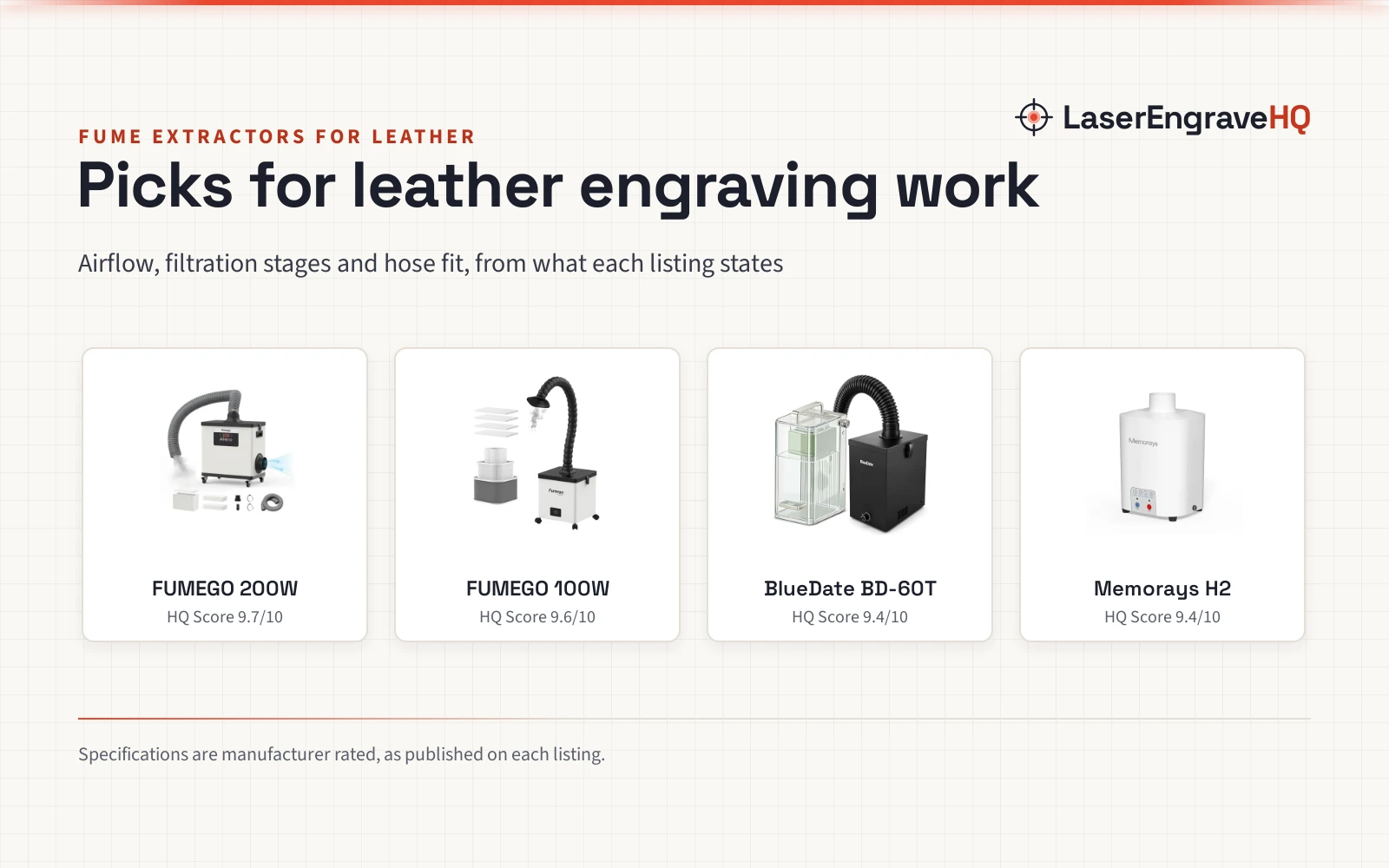
- Overlooking ventilation and fume management while operating cutting equipment; consult our fume extractor guide.
- Processing hazardous materials such as PVC, vinyl, PVC-based faux leather, polycarbonate or ABS in your machine.
How to choose laser safety glasses: the short version
- Check your machine manual to identify your exact beam wavelength (such as 450nm, 1064nm or 10600nm).
- Determine the required optical density (such as OD 4+, OD 5+, OD 6+ or OD 7+) specified in your machine documentation.
- Confirm certified compliance with established laser standards such as EN 207.
- Select a wrap-around frame with integrated side shields or an over-glasses design that fits your face.
- Check visible light transmission ratings to ensure clear workpiece visibility in your workshop.
- Verify listing specifications carefully and discard listings with conflicting protection ratings.
Following these steps ensures your eyes remain safeguarded from direct radiation and stray reflections during every engraving and cutting job.
FAQ: lasers and CNC
What optical density do I need for laser engraving?
The required optical density depends on your laser beam power and operating wavelength. Rather than guessing, check your machine manual for the manufacturer’s recommended optical density rating. Reference listings show common protective ratings ranging from OD 4+ and OD 5+ up to OD 6+ and OD 7+ for high-power beams. Always select eyewear that meets or exceeds the minimum rating specified for your equipment.
Can a single pair of safety glasses protect against every laser type?
No single filter protects against all laser types simultaneously while allowing adequate visibility. Laser filters are formulated to absorb designated wavelength bands. While multi-wavelength glasses can protect against both 450nm diode lasers and 1064nm fiber lasers, they do not automatically protect against other wavelengths. Always verify that your eyewear explicitly lists each operating wavelength used in your workshop.
Do regular sunglasses protect against laser beams?
No. Regular sunglasses and tinted workshop glasses only reduce general brightness and provide zero rated attenuation against concentrated laser beams. True laser safety eyewear requires certified optical density ratings and specialized absorbing dyes or reflective coatings.
How can I verify that laser safety glasses are genuine?
Genuine laser safety glasses display permanent markings stamped directly on the lens or frame. These markings list the protected wavelength range, the optical density rating and standard compliance such as EN 207. Discard listings that make broad claims without published certified ratings.
Can I wear laser safety glasses over prescription spectacles?
Yes, provided you choose an over-glasses frame design. Makers such as MCWlaser publish over-glasses frames designed with deep temples and wide brow bars that fit comfortably over standard corrective eyewear without leaving peripheral gaps.
What does visible light transmission mean for laser glasses?
Visible light transmission indicates the percentage of ordinary visible ambient light that passes through the protective filter. Higher ratings like 35% or 45% allow a brighter view of your engraving workspace, while lower ratings like 10% or 15% provide darker vision.
Related: our laser safety hub, best safety glasses for laser engraving and laser engraver with enclosure. Also see our how to choose a laser engraver and diode vs CO2 laser.