Dial Indicator vs Edge Finder: Which One Should You Buy?
Dial indicators and edge finders compared on what each listing states, so you can pick the setup tool your job needs.

On this page
Top picks at a glance
As an Amazon Associate I earn from qualifying purchases.
- 1
 Fowler 52-520-109-09.7/10View on Amazon
- 2
 Mitutoyo 0501029.6/10View on Amazon
- 3
 Mitutoyo "2416S" Dial Indicator9.7/10View on Amazon
- 4
 Accusize AGD 2 Dial IndicatorView on Amazon
- 5
 Brown & Sharpe Audible Edge Finder 3/8" Shank DiameterView on Amazon
- 6
 Starrett Edge FinderView on Amazon
- 7
 Starrett 25 Series Dial IndicatorView on Amazon
- 8
 Edge Finder And Center Finders Set Of 4 Pcs Double End &View on Amazon
- 9
 HHIP 4401-0040 Combo Edge and Center FinderView on Amazon
Setting up a mill or lathe starts with finding edges and checking surfaces, and makers weigh dial indicators against edge finders for that job. This comparison puts dial indicator vs edge finder side by side, using what each listing states, so you can pick the side your setup work needs.
LaserEngraveHQ earns a commission from purchases made through these links, at no extra cost to you. Read our affiliate disclosure.
Verdict: pick a dial indicator when you need to read surface variation, and pick an edge finder when you need to locate a workpiece edge before milling or machining.
Machines on the list
Fowler 52-520-109-0, Adg Dial Indicator With 0-1"
A dial indicator with a 0-1 in range, 0.001 in graduations and a 2.25 in dial face, with a carbide ball contact point and a center lug back.
Pros
- 0-1 in measuring range with 0.001 in graduations and a 0-100 continuous reading
- Carbide ball contact point for extended wear resistance
- Forged brass body with a hardened stainless steel spindle rack and pinion
- Center lug back allows positioning every 90°, and the knurled bezel adjusts 360°
Cons
- No accuracy figure is stated
- No stem diameter is stated
- Warranty is limited to a 1-year term
- Only the center lug back mounting is stated
Mitutoyo "2416S" Dial Indicator, #4-48 UNF Thread
A standard dial indicator with a 0-1 in range, 0.001 in graduations and +/-0.002 in accuracy, a 2.244 in dial dia and a #4-48 UNF contact point thread.
Pros
- 0-1 in range with 0.001 in graduations and +/-0.002 in accuracy
- 0.375 in stem with a #4-48 UNF contact point thread
- Meets ANSI, JIS B7503-1997 and AGD standards
- Lug back, with a rotating bezel and limit markers
Cons
- No warranty term is stated
- No contact point material is stated
- Bullets describe fractional-inch display while the title lists decimal figures
- No measuring pressure is stated
Mitutoyo 050102, Edge Finder, 1/2 Dia. Shank
A dual-end edge finder with a 1/2 in shank and a 0.200 in tip, hardened and ground on all surfaces.
Pros
- Dual-end design with a 1/2 in shank and a 0.200 in tip
- Hardened, ground working surfaces in premium alloy steel
- Resets to zero point for later operations
- Suits facing, drilling and machining
Cons
- No warranty term is stated
- No accuracy figure is stated
- No tip material beyond alloy steel is stated
- No shank options beyond 1/2 in are stated

Brown & Sharpe Standard Edge Finder
A single-end edge finder with a 3/8 in shank and a 0.200 in tip, machined to ±0.0005 in of nominal size.
Pros
- Machined to ±0.0005 in of nominal size
- Visible deflection on contact gives a clear indication
- Precision-ground contact surfaces for smooth movement
- Hardened steel construction for wear and corrosion resistance
Cons
- No warranty term is stated
- Spec table cutting diameter of 2 inches conflicts with the 0.200 in tip in the title and bullets
- Single-end only; no dual-end option is stated
- No shank options beyond 3/8 in are stated
Other machines to compare
 Accusize AGD 2 Dial IndicatorCheck price on Amazon
 Brown & Sharpe Audible Edge Finder 3/8" Shank DiameterCheck price on Amazon
 Starrett Edge FinderCheck price on Amazon
 Starrett 25 Series Dial IndicatorCheck price on Amazon
 Edge Finder And Center Finders Set Of 4 Pcs Double End &Check price on Amazon
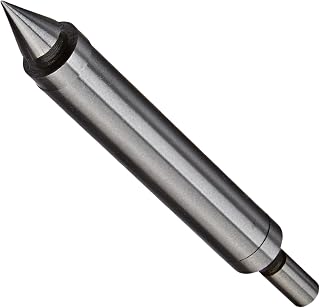 HHIP 4401-0040 Combo Edge and Center FinderCheck price on Amazon
Dial indicator vs edge finder at a glance
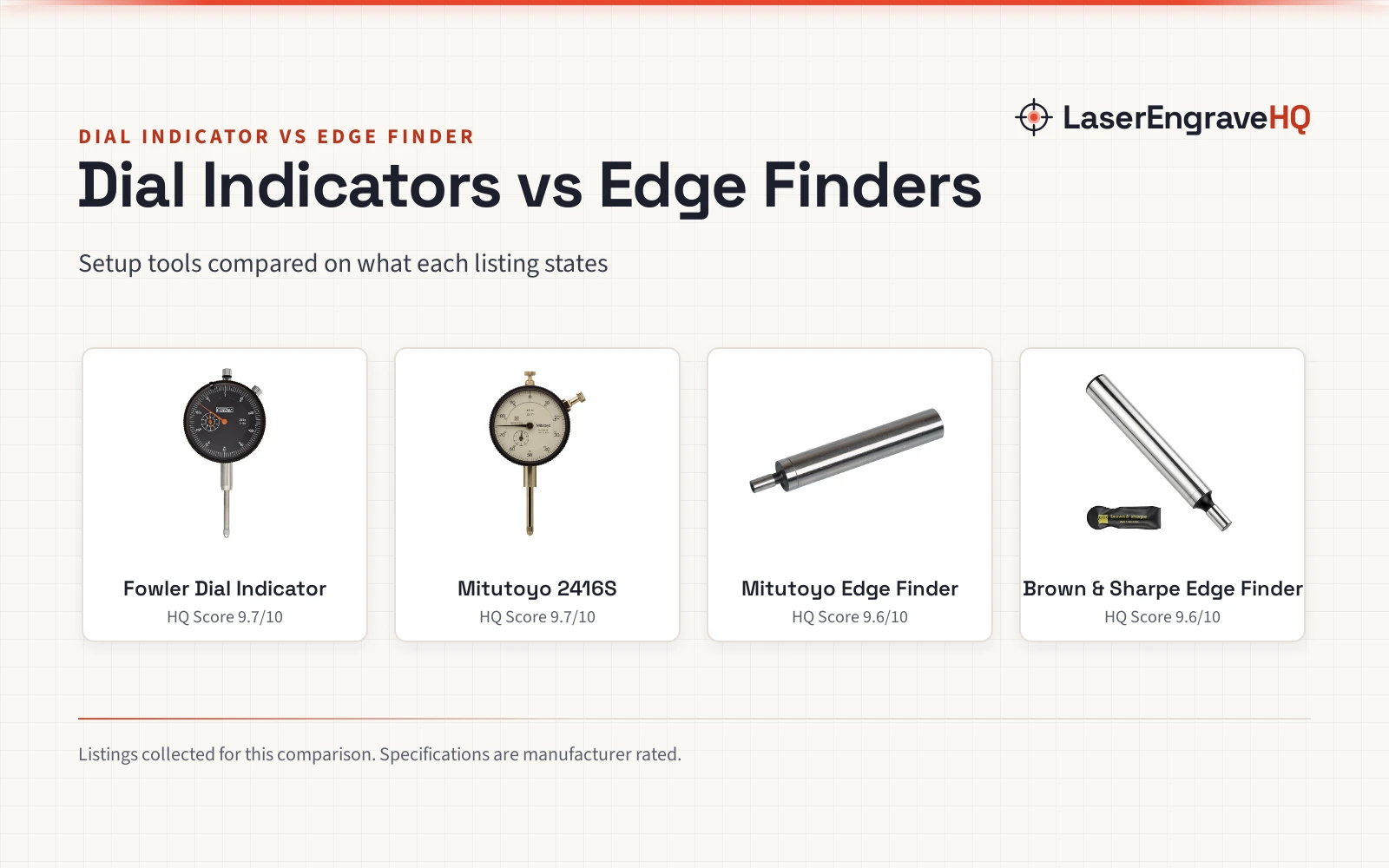
| Spec | Fowler Dial Indicator | Mitutoyo 2416S | Mitutoyo Edge Finder | Brown & Sharpe Edge Finder |
|---|---|---|---|---|
| HQ Score | 67 | 62 | 58 | 56 |
| Side | Dial indicator | Dial indicator | Edge finder | Edge finder |
| Range or tip | 0-1 in range | 0-1 in range | 0.200 in tip | 0.200 in tip |
| Graduation or accuracy | 0.001 in graduations | 0.001 in graduations, +/-0.002 in accuracy | Not stated | ±0.0005 in of nominal size |
| Dial or shank | 2.25 in dial face | 2.244 in dial dia | 1/2 in shank | 3/8 in shank |
| Design | Center lug back | Lug back | Dual-end | Single-end |
| Warranty | 1-year warranty | Not stated | Not stated | Not stated |
Specifications are manufacturer rated, as published on each listing and collected 24 October 2026.
What each side does
A dial indicator reads variation: the Mitutoyo 2416S listing describes measuring surface variations, and both dial indicators state a range with graduations. An edge finder locates edges: the Mitutoyo edge finder listing describes locating edges for milling and machining, and the Brown & Sharpe example describes edge location for CNC milling and lathe machining. For a related comparison, see tool setter vs edge finder.
Reading and accuracy
The Fowler dial indicator states a 0-1 in measuring range with 0.001 in graduations and a 0-100 continuous reading, with a revolution hand that indicates every .10 in. The Mitutoyo 2416S states the same range and graduations, and adds an accuracy figure of +/-0.002 in. The edge finders state no graduated reading: the Brown & Sharpe example is machined to ±0.0005 in of nominal size and gives a visible deflection on contact, while the Mitutoyo edge finder states a 0.200 in tip and resets to zero point. The two sides state different kinds of precision.
Shanks, tips and mounting
The Fowler example uses a center lug back that allows positioning every 90°, with a knurled bezel that adjusts 360°. The Mitutoyo 2416S is the lug-back model, with a rotating bezel, limit markers and a 0.375 in stem. The edge finders differ by shank: the Mitutoyo example uses a 1/2 in shank with a dual-end design, while the Brown & Sharpe example uses a 3/8 in shank with a single-end design, and both state a 0.200 in tip.
Build and materials
The Fowler listing pairs a forged brass body with hardened brass gears and a hardened stainless steel spindle rack and pinion. The Mitutoyo 2416S lists a stem with a long clamping range, no through screw-hole on the frame for dust- and water resistance, and an involute curved lifting lever with a dovetail joint for tool-less connection. Both edge finders use hardened steel working surfaces: the Mitutoyo example uses premium alloy steel with hardened, ground surfaces, and the Brown & Sharpe example uses high-grade hardened steel with precision-ground contact surfaces.
Support and warranty
Only the Fowler listing states a warranty term: a full 1-year warranty offered by Fowler High Precision. The remaining listings state no warranty term, so warranty reads as Not stated for the rest.
Choose a dial indicator if
- You need to read surface variation rather than locate an edge.
- You want stated graduations and a measuring range for setup checks.
- A stated warranty term matters.
Choose an edge finder if
- You need to locate a workpiece edge before milling, drilling or machining.
- You want a stated shank and tip size for your collet and holder.
- You prefer the visible deflection the Brown & Sharpe example states on contact.
Project Match
Pair the job with the pick:
- Milling and machining setup: the Mitutoyo edge finder for dual-end work, or the Brown & Sharpe example for single-end work.
- Checking surface variation: either dial indicator.
- CNC milling and lathe machining: the Brown & Sharpe edge finder.
- Work where a stated warranty matters: the Fowler dial indicator.
FAQ: lasers and CNC
Do I need both a dial indicator and an edge finder?
They do different jobs: a dial indicator reads surface variation, while an edge finder locates a workpiece edge.
What does the 0.200 in tip mean on an edge finder?
The 0.200 in figure is the diameter of the contact head that touches the workpiece edge, and both edge finders state it. The listings do not state an offset procedure, so follow your machine manual.
Which dial indicator states an accuracy figure?
The Mitutoyo 2416S states +/-0.002 in accuracy; the Fowler listing states none.
Can an edge finder measure surface variation?
No. Edge finders locate edges; measuring surface variations is dial indicator work.
What shank sizes do the edge finders use?
The Mitutoyo edge finder uses a 1/2 in shank and the Brown & Sharpe example uses a 3/8 in shank.
Related: best metric dial indicator, edge finder vs probe and tool setter vs edge finder.