Dovetail vs Finger Joint Router Bit: Which Should You Buy?
A dovetail joint locks with angled tails while a finger joint stacks straight glue-dependent fingers; this guide explains both joints and ranks four dovetail bits by their stated specs.

On this page
Top picks at a glance
As an Amazon Associate I earn from qualifying purchases.
- 1
 MICROJIG Matchfit MB-050-0514 Dovetail Router Bit for9.7/10View on Amazon
- 2
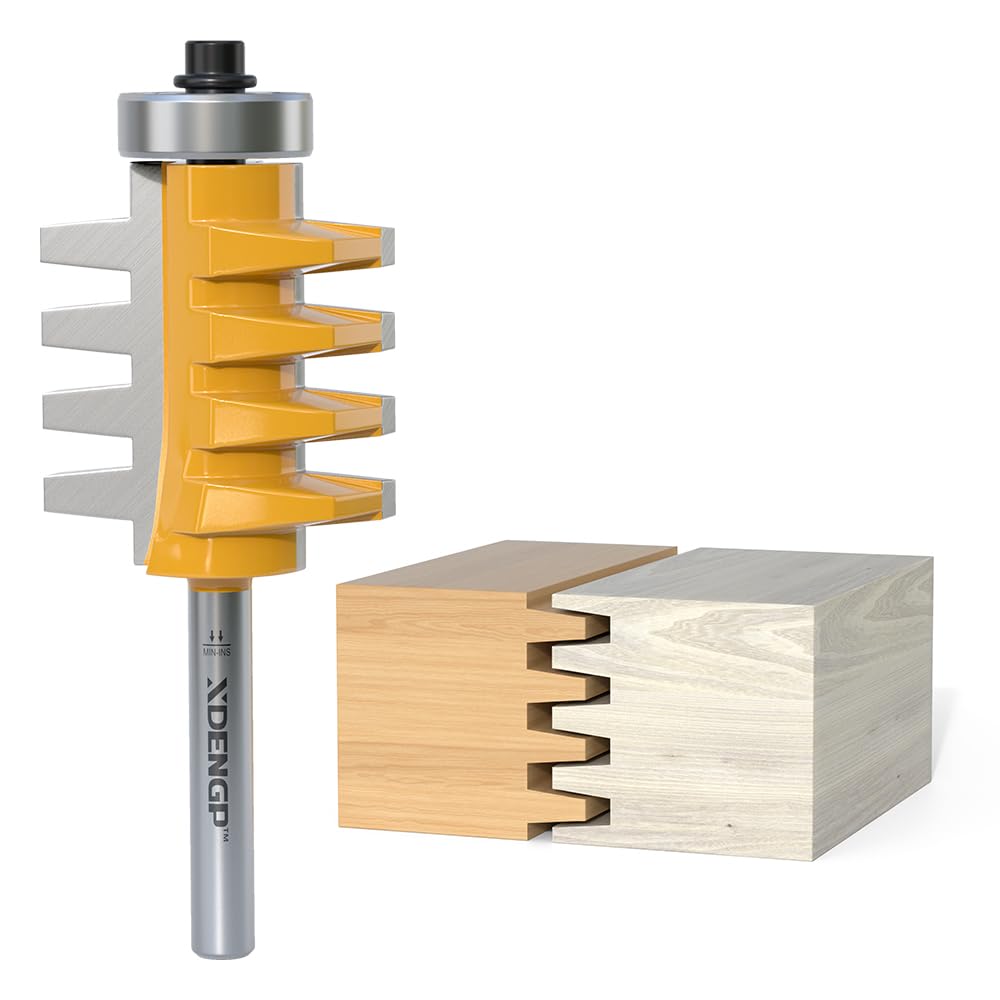 Professional Finger Joint Router Bit 1/4" Shank9.5/10View on Amazon
- 3
 Wolfride 2Pcs Dovetail Router Bits 1/4 Inch Shank Dovetail9.4/10View on Amazon
- 4
 Freud 22-124: 1/2"View on Amazon
- 5
 YONICO Dovetail Router Bit Set 5 Bit 1/2-Inch Shank 14520View on Amazon
- 6
 Dovetail Router Bits 2 Pieces with Bearing 1/4 Inch ShankView on Amazon
- 7
 2pc 1/4 Inch Shank Dovetail Router Bit SetView on Amazon
- 8
 HARFINGTON Dovetail Router Bit 1/2" Shank 1-1/2" Dia TungstenView on Amazon
- 9
 Freud 22-114: 3/4"View on Amazon
A dovetail joint locks itself together with angled tails, while a finger joint stacks straight interlocking fingers that depend on glue, so the dovetail vs finger joint router bit question comes down to strength versus simplicity. Choose the dovetail bit for drawers and boxes that take pulling force; choose the finger joint bit for quick carcass joinery where glue does the work. The sections below explain what each bit cuts, when to pick which joint, and which dovetail bits to buy.
Other machines to compare
 Freud 22-124: 1/2"Check price on Amazon
 YONICO Dovetail Router Bit Set 5 Bit 1/2-Inch Shank 14520Check price on Amazon
 Dovetail Router Bits 2 Pieces with Bearing 1/4 Inch ShankCheck price on Amazon
 2pc 1/4 Inch Shank Dovetail Router Bit SetCheck price on Amazon
 HARFINGTON Dovetail Router Bit 1/2" Shank 1-1/2" Dia TungstenCheck price on Amazon
 Freud 22-114: 3/4"Check price on Amazon
LaserEngraveHQ earns a commission from purchases made through these links, at no extra cost to you. Read our affiliate disclosure.
The four bits in the gear section all cut dovetail joints. The finger joint side of this guide is explained from the joint itself, since no finger joint bit appears in this article’s product set.
Dovetail vs finger joint router bit: the short answer
Dovetail bits cut flared, angled tails, 10 degrees on the YAKAMOZ set and 14 degrees on the Freud 22-124, that wedge together and resist pulling apart. Finger joint bits cut straight square fingers with parallel sides, so the joint slides together along the finger direction and relies on glue surface for strength. When the joint must hold against a pulling force, as in a drawer front, the dovetail is the stronger shape; when speed and simplicity matter more, the finger joint is the easier cut.
What a dovetail bit cuts
A dovetail bit mills the flared tail and the matching pin socket, one pass for each side of the joint. The listings here show the working range: cutting diameters of 1/2 inch and 5/8 inch, a 10-degree cutting angle on the YAKAMOZ bits and a 14-degree angle on the Freud, with two carbide flutes on three of the four bits. Makers list furniture building, cabinet making, drawers, boxes and chests among the uses. Because each tail is wider at the tip than at the base, the assembled joint cannot pull straight apart the way a straight finger can.
What a finger joint bit cuts
A finger joint bit, sometimes sold as a box joint bit, cuts straight fingers of even width with square shoulders. The fingers interlock with generous glue surface on every face, which makes the joint strong in shear but dependent on glue to hold along the finger direction. Layout is fast, since every finger matches every slot and there are no angled pins to fit. It suits carcass corners and shop boxes where the joint will not see much pulling force.
Which joint should you choose
Match the joint to the load. Drawer boxes, chests and cabinet doors get opened, pulled and racked, so the mechanical lock of the dovetail earns its extra setup time. Simple boxes, drawer dividers and shop storage see little pulling force, so the finger joint’s single setup and fast glue-up win on speed. The table below sums up the trade-off.
| Joint | Bit shape | Holding power | Layout effort |
|---|---|---|---|
| Dovetail | Flared tails, 10 or 14 degrees here | Resists pull-apart | Matched pins and tails |
| Finger joint | Straight square fingers | Glue-dependent | One setup cuts both sides |
Four dovetail bits, ranked by stated specs
The four bits below appear in ranked order, from the most complete stated spec set to the thinnest. All four cut dovetail joints; none of the listings describes a finger joint bit.
| Bit | Cutting diameter | Shank | Angle | Guide bearing | Set size |
|---|---|---|---|---|---|
| YAKAMOZ Dovetail 2-Pc Set | 1/2 in, 5/8 in | 1/4 in | 10 degrees | Yes | 2 bits |
| KOWOOD Dovetail 2-Pc Set | 1/2 in, 5/8 in | 1/4 in | Not stated | Yes | 2 bits |
| Freud 22-124 Dovetail Bit | 1/2 in | 1/4 in | 14 degrees | Not stated | 1 bit |
| Yonico 14520 5-Bit Set | 1/2 in | 1/2 in | Not stated | Not stated | 5 bits |
The YAKAMOZ set tops the ranking: two bits with 1/2-inch and 5/8-inch cutting diameters, a 10-degree angle, 1/4-inch shanks and a bearing guide on each, with cutting lengths of 1/2 inch and 5/8 inch stated. The KOWOOD set runs second with the same two cutting diameters and bearing guides on a 1/4-inch shank, in heat-treated C3 carbide, listed for wood, MDF, laminate, particleboard and plywood. The Freud 22-124 comes third as a single 1/2-inch bit at 14 degrees with a Perma-SHIELD coating, a 1/4-inch shank and 2-5/8-inch overall length, listed for CNC, handheld and table-mounted routers. The Yonico 14520 set lands fourth: five dovetail bits on 1/2-inch shanks in C3 micro-grain carbide, though its spec table says Number of Items 1 against a 5-bit title, and the title and bullets win that disagreement.
Setting up the cut
Match the shank to the collet before anything else: three of these bits use a 1/4-inch shank and the Yonico set uses a 1/2-inch shank. The 1/4 vs 1/2 shank router bits comparison explains the trade-off. Bearing-guided bits like the YAKAMOZ and KOWOOD follow an edge or template, while the Freud and Yonico bits need a fence or jig for guidance. For machine work, the best dovetail bit for CNC picks cover bits proven on routers with computer control. Clamp the workpiece, wear eye protection, and switch the router off before changing bits.
FAQ: lasers and CNC
Can a dovetail bit cut a finger joint?
No. Dovetail bits cut flared, angled tails, 10 degrees on the YAKAMOZ set and 14 degrees on the Freud, while a finger joint needs straight-sided fingers. The two shapes are not interchangeable.
What shank size do these dovetail bits use?
The YAKAMOZ, KOWOOD and Freud bits use a 1/4-inch shank. The Yonico 14520 set uses a 1/2-inch shank.
Do I need a bearing guide on a dovetail bit?
Not always, but it helps. The YAKAMOZ and KOWOOD sets include a bearing guide on each bit. The Freud and Yonico listings state no bearing, so those bits need a fence or jig.
Can these bits run in a CNC router?
The Freud, Yonico and KOWOOD listings state use in CNC routers as well as handheld and table-mounted routers. The YAKAMOZ listing names furniture and cabinet work without stating CNC use.
What dovetail angle do these bits cut?
The YAKAMOZ bits cut a 10-degree angle and the Freud 22-124 cuts a 14-degree angle. The Yonico and KOWOOD listings state no angle.
Related: the CNC tooling hub, best dovetail bit for drawer boxes and best dovetail bit for CNC. Also see the best CNC bit set for woodworking.