Rigid vs Flexible Dust Hose for Cnc: Pick the Right One
A guide to rigid vs flexible dust hose for CNC: airflow, static, routing and the four listed hoses, ranked.

On this page
Top picks at a glance
As an Amazon Associate I earn from qualifying purchases.
- 1
 4" x 20' PVC Dust Collection Hose9.7/10View on Amazon
- 2
 2 1/2" x 20' PVC Dust Collection Hose9.6/10View on Amazon
- 3
 4" x 50' Flexible Dust Collection Hose9.6/10View on Amazon
- 4
 PVC Dust Collection Hose w/4 Thumbscrew Clamps 2-1/2"x20'View on Amazon
- 5
 2 1/2" x 5' PVC Dust Collection HoseView on Amazon
- 6
 3" x 10' Flexible Dust Collection HoseView on Amazon
- 7
 4" x 5' Flexible Dust Collection HoseView on Amazon
- 8
 POWERTEC 3" x 10' Dust Collection HoseView on Amazon
- 9
 POWERTEC 4'' x 36" Dust Collection HoseView on Amazon
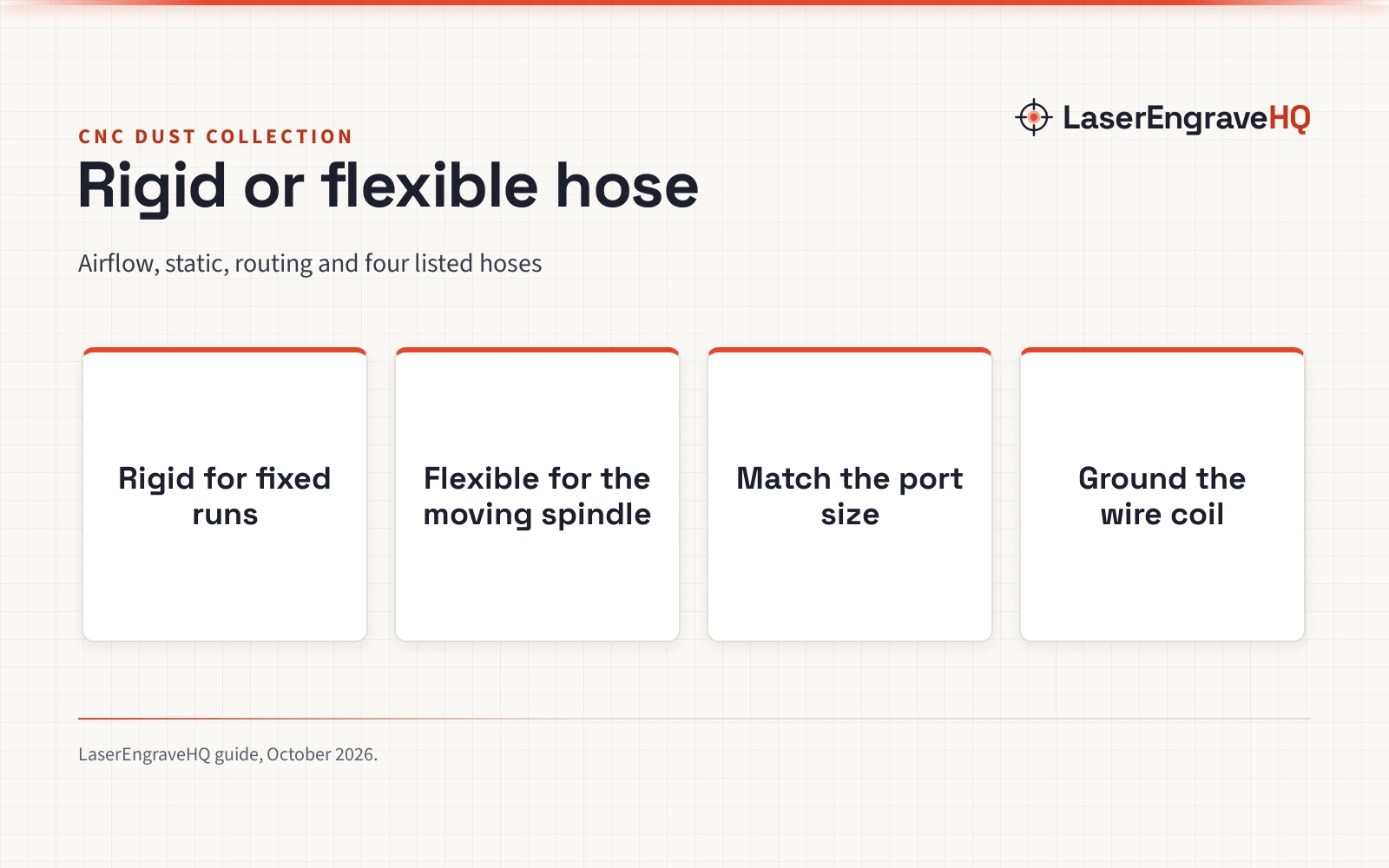
Rigid vs flexible dust hose for CNC is a routing question more than a quality question: use rigid duct for the fixed run from the collector, and flexible hose for the last stretch to the moving spindle or dust boot. Rigid duct is the usual choice for long straight fixed runs, while flexible hose wins wherever the gantry moves, corners turn or a quick disconnect matters. The four hoses below show what the listings actually offer, ranked from the strongest stated specs to the most specialized.
Other machines to compare
 PVC Dust Collection Hose w/4 Thumbscrew Clamps 2-1/2"x20'Check price on Amazon
 2 1/2" x 5' PVC Dust Collection HoseCheck price on Amazon
 3" x 10' Flexible Dust Collection HoseCheck price on Amazon
 4" x 5' Flexible Dust Collection HoseCheck price on Amazon
 POWERTEC 3" x 10' Dust Collection HoseCheck price on Amazon
 POWERTEC 4'' x 36" Dust Collection HoseCheck price on Amazon
LaserEngraveHQ earns a commission from purchases made through these links, at no extra cost to you. Read our affiliate disclosure.
Hose performance depends on the collector, the duct layout and the dust boot, so this guide compares what each listing states rather than promising a suction figure. Match the hose to the ports you have, not the ports you wish you had.
Rigid vs flexible dust hose for CNC: the direct answer
Use rigid ducting for the long fixed run from the dust collector to the machine: a smooth straight run keeps airflow high and gives dust fewer places to settle. Use flexible hose from the end of that run to the dust boot, where the gantry moves and the hose must bend, twist and follow the spindle. Many shops run both: rigid overhead, flexible at the machine.
What rigid hose does well
In principle, rigid pipe holds its shape and keeps a smooth interior wall for wall-mounted runs and drops to each machine. None of the four listings here is a rigid pipe, so treat that as background: source rigid duct from a dust-collection supplier and use the listed hoses for the flexible part of the run.
What flexible hose does well
Flexible hose bends around corners, follows a moving gantry and connects in seconds with clamps. Three of the four listings here use clear PVC walls so you can see dust moving and spot a clog early; the fourth is a silver TPE vacuum hose. Steel wire coils appear in three of the four listings; the Qucship listing specifically says its coil resists kinking, collapsing and deformation. The trade is airflow: bends and corrugation add resistance compared with a straight smooth run.
Routing the hose at the machine
Keep the flexible run short and supported. A hose that drags on the floor or hangs in a wide loop will kink at the bends and collect dust in the low spots. Support it from above so it follows the gantry without pulling on the dust boot. Leave enough slack for full travel in every axis, then take up the rest: slack is better than tension, but a controlled loop beats a tangled pile.
The gear: four hoses, ranked
Ranked by stated specs. First, the Fulton 2-1/2 inch by 20 foot PVC hose: clear pure PVC, embedded steel coils, puncture resistant, with 4 thumbscrew clamps in the box. Second, the POWERTEC 3 inch by 10 foot hose: the largest diameter here, flexible PVC with spring steel wire, and the only listing that names CNC machines. Third, the Qucship 2-1/2 inch hose: thickened puncture-resistant PVC with a carbon steel wire coil and 2 clamps. Fourth, the Cen-Tec 16 foot hose: a 1-1/4 inch highly flexible vacuum hose with a multi-brand adapter set, built for shop vacuums and power tools rather than a CNC dust boot.
The Qucship listing contradicts itself on length: the title says 5 feet, the bullets say the hose reaches 20 feet when fully extended, and the spec table says 60.2 inches. Treat it as a 5 foot hose that stretches, and confirm the port size before ordering.
Static and grounding
Plastic hose can build static, and one listing addresses it directly: the Qucship hose has a carbon steel wire coil that, when properly grounded at both ends, helps dissipate built-up static. If your hose has a wire coil, the Qucship listing’s advice applies: ground it at both ends. The other three listings do not mention static or grounding.
Port size and clamps
Match the hose to the dust boot and collector ports before ordering: the listings here span 1-1/4 inch, 2-1/2 inch and 3 inch. Two list included clamps: 4 thumbscrew clamps with the Fulton, and 2 stainless clamps with the Qucship. The POWERTEC and Cen-Tec listings name no clamps, so plan your own.
When the hose and the port do not match, a short adapter section works, but each transition adds resistance. The Cen-Tec kit includes the most adapters: 3/4 inch, 1 inch, 1-1/4 inch and 1-1/2 inch fittings plus a 2-1/2 inch vacuum connection. Buy the hose that fits natively first, and treat adapters as a backup plan.
FAQ: lasers and CNC
Can I use a shop vacuum hose for CNC dust collection?
You can, with limits. The Cen-Tec 16 foot hose is a 1-1/4 inch shop vacuum hose with adapters for power tools and a 2-1/2 inch vacuum connection. It suits small ports, but it is built for vacuums and hand tools, not for a CNC dust boot. For a CNC, the 2-1/2 inch and 3 inch listings here suit larger dust ports.
Do I need to ground a flexible dust hose?
If the hose has a wire coil, yes. The Qucship listing states that when properly grounded at both ends, the carbon steel wire coil helps dissipate built-up static. The other listings say nothing about grounding, so check the listing before you assume.
What size hose fits a CNC dust boot?
Measure the boot port and the collector port first. The listings here cover 1-1/4 inch, 2-1/2 inch and 3 inch. Pick the hose that matches both ends; adapters exist, but every adapter and bend costs some airflow.
Is clear hose better than opaque for dust collection?
For spotting problems, yes. Three listings here use clear PVC walls so you can see dust moving through and catch a clog before it backs up into the boot. An opaque hose hides a blockage until the suction drops.
Can I mix rigid pipe and flexible hose in one system?
Yes. A common layout is rigid duct for the fixed run with flexible hose for the final connection to the moving machine. Keep the flexible section as short as the job allows.
Related: our CNC tooling hub, the best CNC hold-down clamps, the best CNC router bits for hardwood and our CNC router hub.