Best Finger Joint Router Bit (2026)
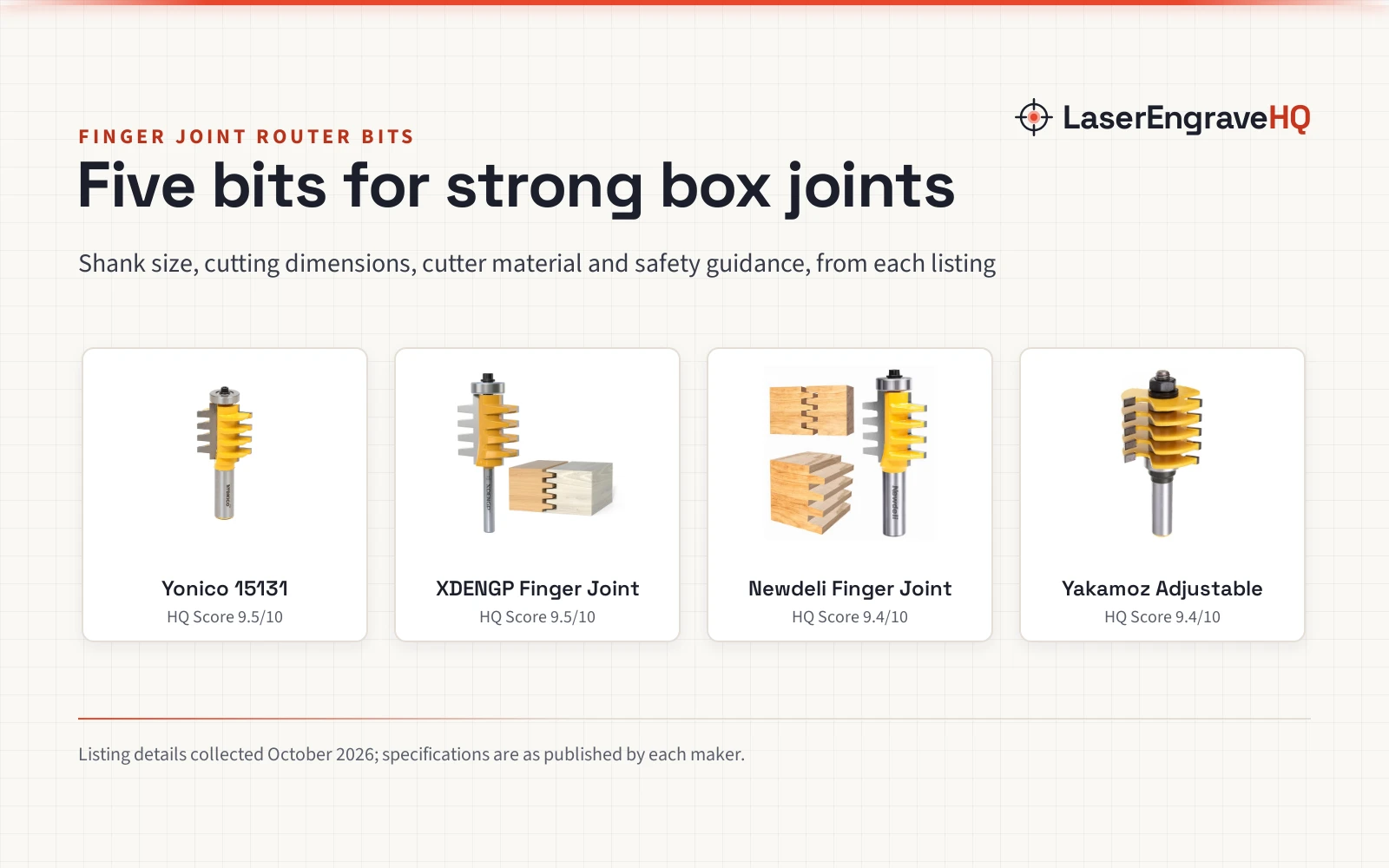
Five finger joint router bits with 1/4 and 1/2 inch shanks, compared on cutting height, cutter material, router use and the safety guidance each listing states.

On this page
Top picks at a glance
As an Amazon Associate I earn from qualifying purchases.
- 1
 Best OverallYonico 151319.5/10View on Amazon
- 2
 Best for Tall JointsXDENGP Finger Joint9.5/10View on Amazon
- 3
 Best for Handheld RoutersNewdeli Finger Joint9.4/10View on Amazon
- 4
 Best AdjustableYakamoz Adjustable9.4/10View on Amazon
- 5
 Professional Finger Joint Router Bit 1/2" ShankView on Amazon
- 6
 Freud 99-037: 1-3/8"View on Amazon
- 7
 HARFINGTON Dovetail Router Bit 1/2" Shank 1-1/2" Dia TungstenView on Amazon
- 8
 HARFINGTON Dovetail Router Bit 1/2" Shank 1-1/8" Dia TungstenView on Amazon
- 9
 CNC Spoilboard Surfacing Router Bit 1/4 Inch ShankView on Amazon
Every wooden box, drawer and crate lives or dies by its corners. Glue alone gives up on end grain, nails split thin stock, and screws look wrong on a small keepsake box. A finger joint router bit cuts interlocking fingers that glue into a corner far stronger than a butt joint, and this guide compares the best finger joint router bit listings available, scored on what each one actually publishes: shank size, cutting dimensions, cutter material and safety guidance.
LaserEngraveHQ earns a commission from purchases made through these links, at no extra cost to you. Read our affiliate disclosure.
Quick picks
- Best Overall Yonico 15131: The most consistent listing here: a 1/2 inch shank, a 1.38 inch cutting diameter, 2 flutes and C3 carbide blades with silver induction brazing, and stated joints from 7/16 to 1-1/4 inch high. Check price on Amazon
- Best for Tall Joints XDENGP Finger Joint: A 1-1/2 inch cutting height with a 5/16 inch cutting depth, anti-kickback design and a stated 18,000 RPM limit, for table-mount or handheld routers. Check price on Amazon
- Best for Handheld Routers Newdeli Finger Joint: A 1/2 inch shank bit the listing covers for both handheld and table routers, with a stated bearing, joints from 7/16 to 1-1/4 inch high and the widest material list here. Check price on Amazon
- Best Adjustable Yakamoz Adjustable: Adjustable blades that fit different board thicknesses, on a 1/2 inch shank with a 1-7/8 inch overall diameter for router tables. Check price on Amazon
Machines on the list
YONICO Finger Joint Router Bits 1-1/4-Inch
A 1/2 inch shank finger joint bit with 2 flutes, a 1.38 inch cutting diameter and silver induction brazing, listed for table-mount routers.
Pros
- 1/2 inch shank with a 1.38 inch cutting diameter and 1.25 inch cutting length, matching the stated 7/16 to 1-1/4 inch joint range
- Premium C3 micro-grain tungsten carbide blades with silver induction brazing for strength
- 2 flutes for smooth cutting on box and crate work
- Listed for straight or 90 degree corners on small boxes and crates
Cons
- No warranty term stated in the listing
- Table mount only; no handheld use is stated
- No material list beyond boxes and crates
- No anti-kickback design is mentioned
Professional Finger Joint Router Bit 1/4" Shank
A reversible 1/4 inch shank finger joint bit with a 1-1/2 inch cutting height, a stated 18,000 RPM limit and an anti-kickback design.
Pros
- 1-1/2 inch cutting height with a 5/16 inch cutting depth, the tallest cutting face stated here
- Anti-kickback design with a stated 18,000 RPM limit and a clamp-to insert line
- C3 tungsten carbide cutters on a carbon steel shank for heavy-duty use
- Listed for table-mount and handheld routers, and for wood, MDF, particleboard, plywood and compact panels
Cons
- No warranty term stated in the listing
- The spec table lists a 0.25 inch cutting diameter that conflicts with the 1-3/8 inch overall diameter in the bullets
- 1/4 inch shank is slimmer than the 1/2 inch shanks here
- The listing warns against cutting metal and non-wood materials such as steel, iron and sand
Reversible Finger Glue Joint Router Bit 1/2 Inch
A 1/2 inch shank finger joint bit with a stated bearing, joints from 7/16 to 1-1/4 inch high, and listed handheld or table use.
Pros
- 1/2 inch shank with a 1-3/8 inch cutting diameter stated in the bullets
- Bearing finger joint design stated in the title
- Anti-kickback design, heat-resistant Teflon coating and a 1.26 inch minimum shank insertion stated
- Listed for solid woods, MDF, laminate, particle board, plywood, compact panel and acrylic, for handheld or table routers
Cons
- No warranty term stated in the listing
- The spec table lists a 1.25 inch cutting diameter, conflicting with the 1-3/8 inch diameter in the bullets
- The title states a bearing but no bearing size is given
- The listing calls acrylic suitable while also telling users to avoid non-wood materials
Yakamoz Professional Adjustable 1/2 Shank Finger
An adjustable 1/2 inch shank finger joint bit with a 1-7/8 inch overall diameter and carbide-tipped blades, for router tables.
Pros
- Adjustable blades for different board thicknesses, the only adjustable bit here
- 1/2 inch shank with 2 flutes and carbide-tipped blades
- Anti-kickback design and router-table-only use stated
- Listed for composition materials, plywoods, hardwoods and softwoods
Cons
- No warranty term stated in the listing
- The cutter is only described as carbide tipped, with no carbide grade stated
- Joint height is not stated; only a 1/2 inch cut depth and 3/20 inch blade height are given
- Router table only, so no handheld use is covered

FivePears Finger Joint Router Bit with 1/4"
A reversible 1/4 inch shank finger joint bit with 2 flutes, C3 carbide cutters and an anti-kickback design.
Pros
- 2 flutes with C3 tungsten carbide cutters on a carbon steel shank
- Anti-kickback design with a heat-resistant Teflon coating
- Reversible design for finger joint work on drawers and boxes
- Listed for MDF, solid wood, particle board and plywood
Cons
- No warranty term stated in the listing
- No cutting diameter or joint height is stated
- 1/4 inch shank only; no 1/2 inch option is stated
- Support is a 24 hour reply promise, which is not a warranty
Other machines to compare
 Professional Finger Joint Router Bit 1/2" ShankCheck price on Amazon
 Freud 99-037: 1-3/8"Check price on Amazon
 HARFINGTON Dovetail Router Bit 1/2" Shank 1-1/2" Dia TungstenCheck price on Amazon
 HARFINGTON Dovetail Router Bit 1/2" Shank 1-1/8" Dia TungstenCheck price on Amazon
 CNC Spoilboard Surfacing Router Bit 1/4 Inch ShankCheck price on Amazon
Specs compared
| Bit | HQ Score | Shank | Joint height | Cutting diameter | Flutes | Router use | Cutter |
|---|---|---|---|---|---|---|---|
| Yonico 15131 | 9.5/10 | 1/2 inch | 7/16 to 1-1/4 inch | 1.38 inch | 2 | Table mount only | C3 carbide |
| XDENGP Finger Joint | 9.5/10 | 1/4 inch | Cutting height 1-1/2 inch | 1-3/8 inch | 2 | Table or handheld | C3 carbide |
| Newdeli Finger Joint | 9.4/10 | 1/2 inch | 7/16 to 1-1/4 inch | 1-3/8 inch | 1 | Table or handheld | C3 carbide |
| Yakamoz Adjustable | 9.4/10 | 1/2 inch | Not stated | 1-7/8 inch overall | 2 | Router table only | Carbide tipped |
| FivePears Finger Joint | 9.4/10 | 1/4 inch | Not stated | Not stated | 2 | Not stated | C3 carbide |
All dimensions are as stated on each listing, reviewed 22 October 2026. Where a listing contradicts itself, the title and bullets win over the spec table; each conflict is noted in that bit’s review.
What the listings tell you, and what they leave out
Five finger joint router bit listings went into this guide. Every one states a shank size and a cutter material, and four of the five state an anti-kickback design. None of the five states a warranty term, so warranty scores zero across the board. Two of the five contradict their own spec tables: one prints a cutting diameter in the table that does not match the bullets, and another lists a single flute in the table while the bullets say nothing about flutes. The reviews note each conflict.
Shank size is the first filter. Two bits here carry a 1/4 inch shank and three carry a 1/2 inch shank, so check the collets on the router before ordering. For a closer look at the trade-off, see the 1/4 vs 1/2 shank router bits guide.
Buying guide: the best finger joint router bit
Shank size: 1/4 inch or 1/2 inch
Two of the five bits use a 1/4 inch shank (FivePears, XDENGP) and three use a 1/2 inch shank (Newdeli, Yakamoz, Yonico). A 1/2 inch shank gives the collet more to grip, which matters when a wide finger joint cutter meets hardwood. A 1/4 inch shank fits compact palm and trim routers that only take 1/4 inch collets. Check the router’s collet before ordering; a 1/2 inch bit does not fit a 1/4 inch collet.
Joint height and cutting dimensions
The joint height is the stock thickness the bit can cut in one pass. Two listings state a joint range of 7/16 to 1-1/4 inch high (Newdeli, Yonico). The XDENGP listing states a 1-1/2 inch cutting height with a 5/16 inch cutting depth, and the Yakamoz listing states a 1/2 inch cut depth with adjustable blades for different board thicknesses. The FivePears listing states no cutting dimensions, so match the bit to the project by shank size and cutter material alone.
Cutter material and coatings
Four of the five listings name C3 tungsten carbide cutters (FivePears, Newdeli, Yonico, XDENGP); the Yakamoz listing says carbide tipped without giving a grade. Two listings add a heat-resistant Teflon coating that the makers say resists resin build-up (FivePears, Newdeli). The Yonico listing adds silver induction brazing between blade and body for strength. Feed the stock slowly and let the cutters do the work; forcing the pass is what burns edges and shortens cutter life.
Table mount or handheld
Two listings limit the bit to a table-mount router (Yonico, Yakamoz), where the fence and a push block keep the stock square. Two list both handheld and table use (Newdeli, XDENGP). The FivePears listing states neither. A table gives the most control for finger joints, which need square, repeatable passes; handheld work needs a steady edge guide and even more care with feed direction.
Router bits spin fast and throw chips. Wear eye and hearing protection; the hearing protection for woodworking guide and the dust mask for woodworking guide cover workshop picks. Insert the shank at least to the maker’s minimum line, tighten the collet, and respect stated speed limits such as the 18,000 RPM maximum on the XDENGP listing. Push the stock slowly and steadily, and never leave a running router unattended.
Project Match
- Small boxes and crates: the Yonico 15131 and the Newdeli bit both list boxes and crates, with stated joint ranges of 7/16 to 1-1/4 inch high.
- Drawers and furniture parts: the FivePears bit lists handmade drawers; the Newdeli bit lists doors, frames, cabinet boxes, shelves and furniture; the XDENGP bit lists doors, tables, cabinets, shelves and furniture.
- Thick stock and tall joints: the XDENGP bit states the tallest cutting face here, a 1-1/2 inch cutting height.
- Matching the bit to stock thickness: the Yakamoz bit has adjustable blades for different board thicknesses, on a 1-7/8 inch overall diameter for router tables.
- Shops that also use a handheld router: the Newdeli and XDENGP listings cover handheld use; the Yonico and Yakamoz listings are table-mount only.
How the scores add up
Each bit is scored on performance, build, value, safety and warranty. A spec the listing does not publish scores nothing, and the published HQ Score comes from the raw totals. Bits earn points for stated cutting dimensions that agree with each other, named cutter materials, and concrete safety guidance such as anti-kickback design, insertion minimums and speed limits.
| Product | HQ Score | Perf. /35 | Build /25 | Value /25 | Safety /10 | Warranty /5 |
|---|---|---|---|---|---|---|
| Yonico 15131 | 9.5 | 32 | 21 | 20 | 3 | 0 |
| XDENGP Finger Joint | 9.5 | 29 | 20 | 20 | 4 | 0 |
| Newdeli Finger Joint | 9.4 | 27 | 19 | 19 | 4 | 0 |
| Yakamoz Adjustable | 9.4 | 26 | 19 | 19 | 3 | 0 |
| FivePears Finger Joint | 9.4 | 24 | 19 | 19 | 3 | 0 |
Scores run from 9.2 to 9.8: each product’s point total is placed on that range, so more points always means a higher score.
FAQ: lasers and CNC
What shank size should I choose for a finger joint router bit?
Match the shank to the router’s collet. A 1/2 inch shank gives the collet more grip for wide cutters; the Newdeli, Yakamoz and Yonico bits here use one. A 1/4 inch shank fits compact routers; the FivePears and XDENGP bits use one. A 1/2 inch bit does not fit a 1/4 inch collet.
Can I use a finger joint router bit in a handheld router?
Only if the listing says so. The Newdeli and XDENGP listings cover both handheld and table-mount routers. The Yonico and Yakamoz listings are table-mount only. A router table with a fence gives the squarest, most repeatable joints.
What is the difference between a finger joint and a dovetail joint?
A finger joint uses straight interlocking fingers; a dovetail uses angled tails that lock mechanically. Finger joints are simpler to cut with one bit and suit boxes and crates. For angled joints, see the dovetail bit for drawer boxes guide.
What materials do these finger joint bits cut?
The listings name solid wood, MDF, particle board, plywood, laminate and compact panel. The Newdeli listing also names acrylic, while telling users to avoid ferrous metals and non-wood materials such as steel, iron and sand. The XDENGP listing gives the same metal warning. Do not cut metal with these bits.
Do I need a router table for a finger joint bit?
Not always, but it helps. Two of the five bits are table-mount only, and even the bits listed for handheld use cut squarer joints with a fence guiding the stock. If the shop has no table, the Newdeli or XDENGP bits are the ones whose listings cover handheld use.
Related: the dovetail bit for drawer boxes guide, the flush trim bit for CNC guide, the router bits for Shapeoko guide, the 1/4 vs 1/2 shank router bits guide, the pattern router bit guide, the router bits for raised panel doors guide, the hearing protection for woodworking guide, the dust mask for woodworking guide, the wood for CNC furniture guide, and the CNC router for cutting boards guide.