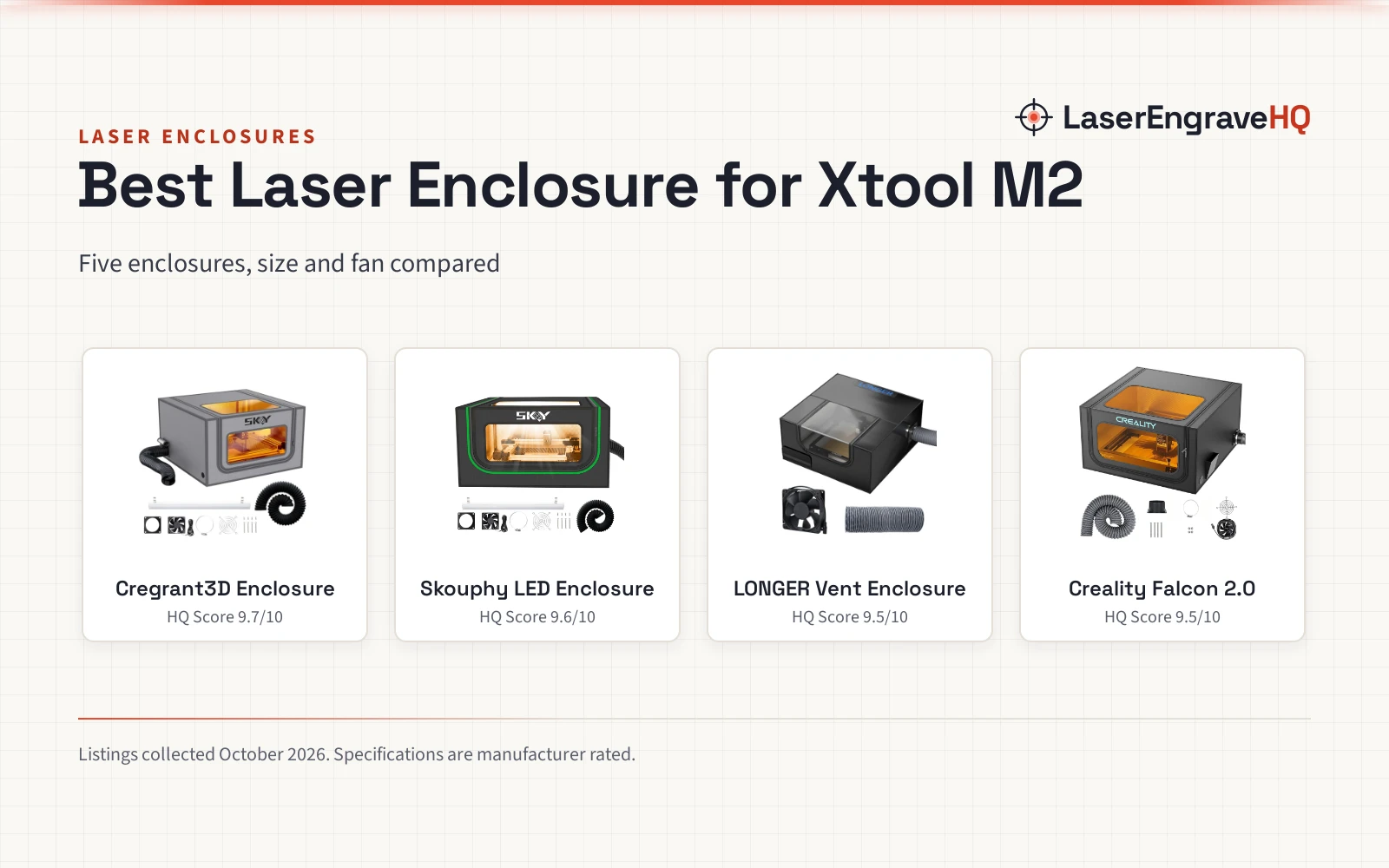
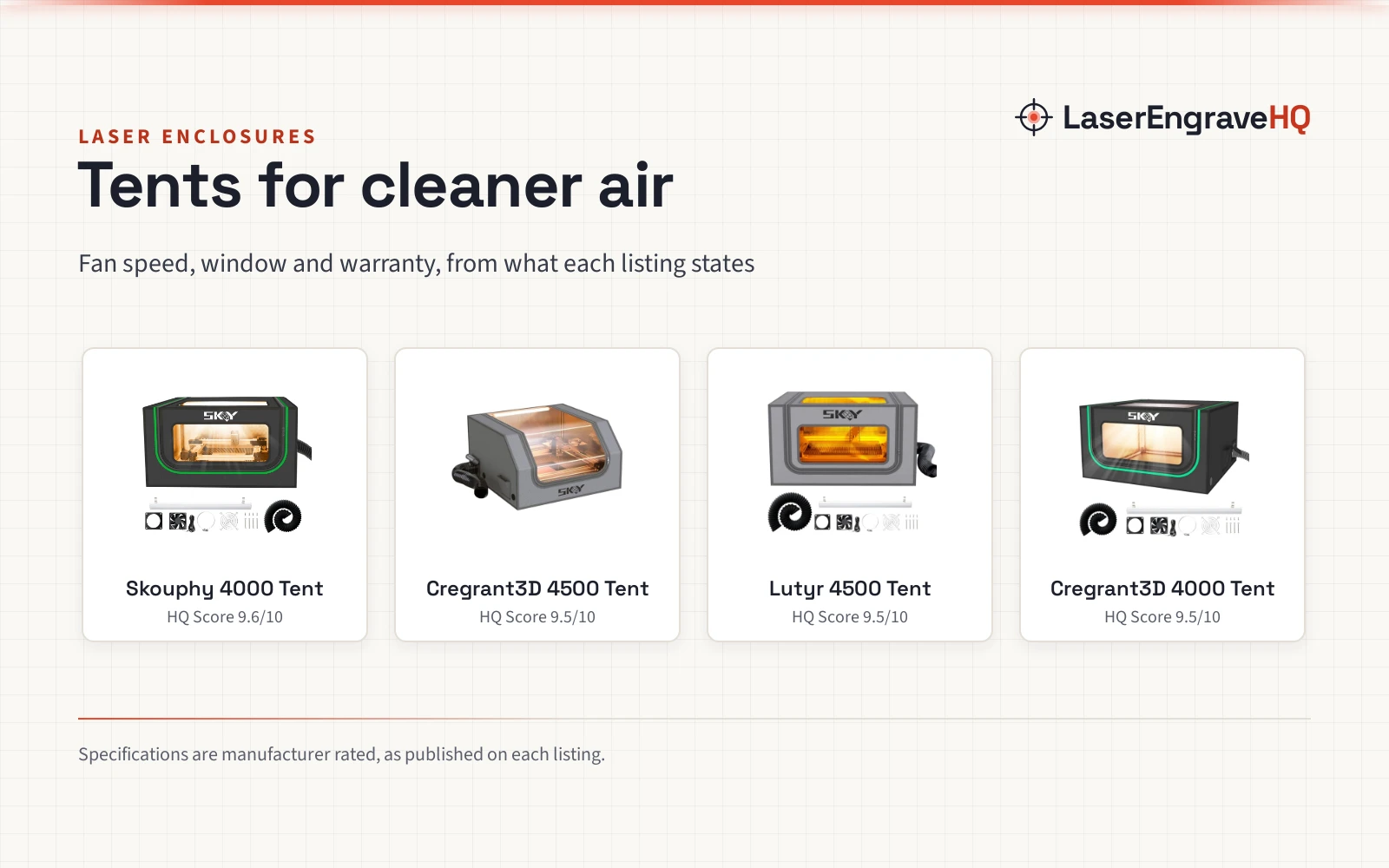
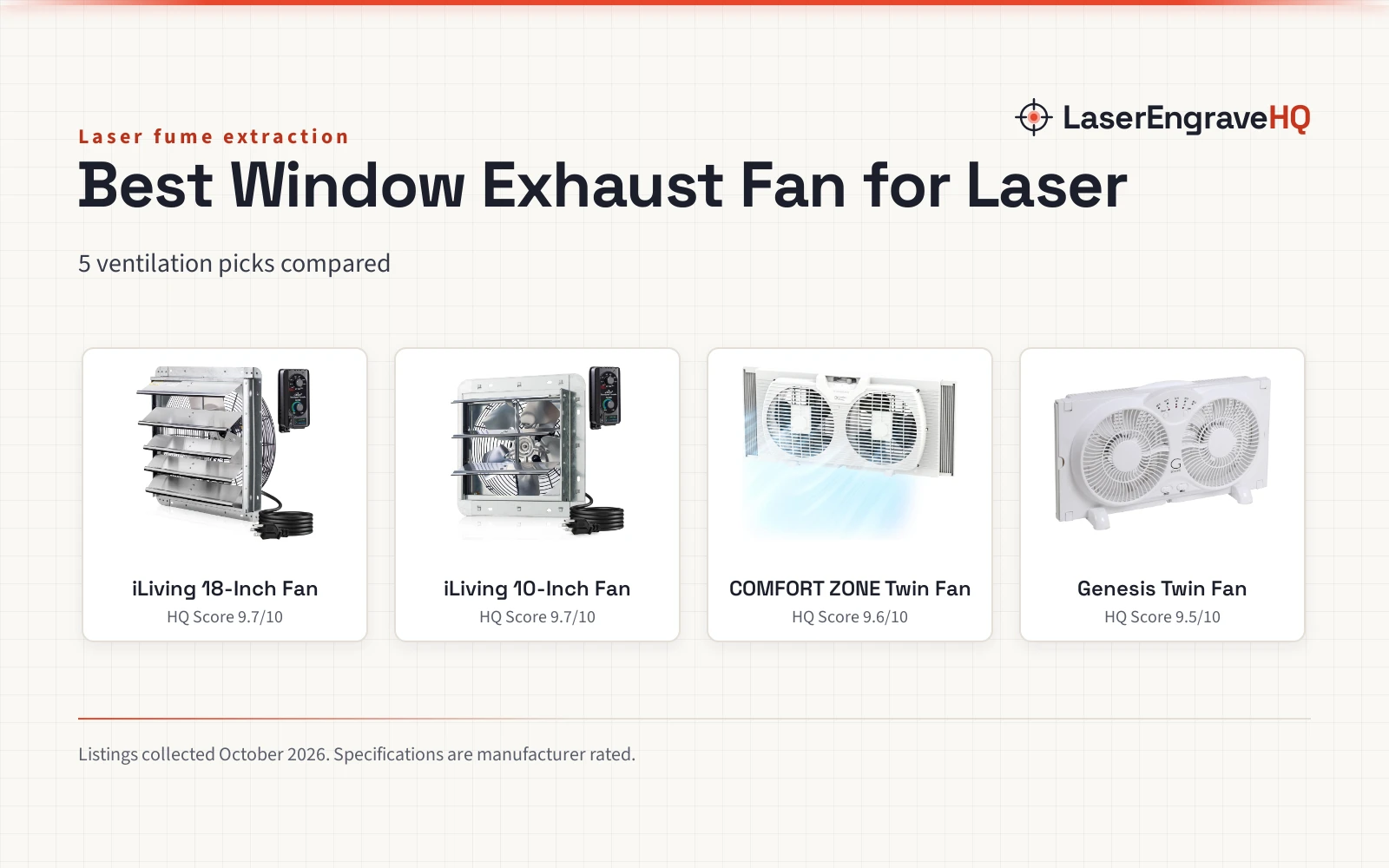
Best Window Exhaust Fan for Laser (2026): 5 Picks
Five exhaust fans for laser ventilation compared by airflow, power, mounting, thermostat control and warranty, with HQ Scores and project matching.

On this page
Top picks at a glance
As an Amazon Associate I earn from qualifying purchases.
- 1
 Best OveralliLiving 18-Inch Fan9.7/10View on Amazon
- 2
 Best 10-InchiLiving 10-Inch Fan9.7/10View on Amazon
- 3
 Best Window FitGenesis Twin Fan9.5/10View on Amazon
- 4
 Best ValueCOMFORT ZONE Twin Fan9.6/10View on Amazon
- 5
 Vornado PORTAL® Window FanView on Amazon
- 6
 3 Inch Inline Duct Fan with Variable Speed Controller & PipeView on Amazon
- 7
 Amazon Basics Twin Window Fan with Reversible AirflowView on Amazon
- 8
 9" Twin Window FanView on Amazon
- 9
 Nalle 10 Inch Window Reversible Exhaust Fan Through-wallView on Amazon
Cutting and engraving fills the air with smoke and dust, and a laser without ventilation coats the room in it. A window exhaust fan pulls that air outside before it settles on the machine, the walls and everything else in the room. This guide to the best window exhaust fan for laser compares five picks by airflow, power, mounting, thermostat control and warranty.
LaserEngraveHQ earns a commission from purchases made through these links, at no extra cost to you. Read our affiliate disclosure.
Quick picks
- Best Overall iLiving 18-Inch Fan: 1736 CFM with thermostat and variable speed control, UL listed Check price on Amazon
- Best 10-Inch iLiving 10-Inch Fan: 820 CFM shutter fan with thermostat, covers up to 1200 sq ft Check price on Amazon
- Best Window Fit Genesis Twin Fan: 706.21 CFM reversible twin fan with 60 to 80 degree thermostat Check price on Amazon
- Best Value COMFORT ZONE Twin Fan: Reversible twin window fan with bug screen, ETL and UL listed Check price on Amazon
Machines on the list


iLIVING 18" Wall Mounted Shutter Exhaust Fan
An 18 in wall-mount shutter exhaust fan with 1736 CFM, a thermostat and variable speed control, UL listed with a 1-year warranty.
Pros
- 1736 CFM, the highest airflow here
- Thermostat control from 32 to 130F
- Variable speed with Thermospeed controller
- UL listed with OSHA compliant wire guards
Cons
- 97W, the hungriest pick here
- 16.7 lb needs solid mounting
- Wall mount only, no window fit
- Spec table says hardwired, connector is a plug

iLiving 10" Wall Mounted Shutter Exhaust Fan
A 10 in wall-mount shutter exhaust fan with 820 CFM, thermostat and variable speed control, UL listed with a 1-year warranty.
Pros
- 820 CFM with automatic shutters
- Thermostat control from 32 to 130F
- Covers up to 1200 sq ft per the listing
- UL listed, galvanized steel frame
Cons
- Wall mount only, no window fit
- 13 in square frame needs a matching opening
- 65W power draw
- Heavier than the window fans at 9 lb

COMFORT ZONE Window Fan for Bedroom
A 9 in twin window fan with reversible airflow, 2 speeds, a bug screen and fabric cover, ETL listed with a 1-year warranty.
Pros
- Reversible: intake or exhaust
- Bug screen and fabric cover included
- ETL listed, UL in the spec table
- Auto-locking expanders for the window fit
Cons
- 272 CFM, the lowest airflow here
- 45.9W draw for the output
- Window-fit figures differ on the listing
- Plastic build

Genesis Twin Fan High Velocity Reversible AirFlow
A 9 in twin window fan with 3 speeds, reversible airflow and a 60 to 80 degree thermostat, ETL certified.
Pros
- 706.21 CFM, strong for a window fan
- Thermostat with 60 to 80 degree range
- 3 speeds with LED indicators
- Dual copper motors
Cons
- No warranty term is stated
- Title says Genesis, maker field says Avalon
- Spec table says 3 rpm against 3 speeds
- Plastic build

Amazon Basics Window Fan for Home Bedroom
A 9 in twin window fan with 3 speeds, reversible airflow and a copper motor, ETL listed.
Pros
- 3 speeds with manual controls
- Reversible intake or exhaust
- Copper motor stated
- Expandable panels fit 25 to 32 in windows
Cons
- No airflow (CFM) figure is stated
- No warranty term is stated
- 63W with no output rating
- Plastic build
Other machines to compare
 Vornado PORTAL® Window FanCheck price on Amazon
 3 Inch Inline Duct Fan with Variable Speed Controller & PipeCheck price on Amazon
 Amazon Basics Twin Window Fan with Reversible AirflowCheck price on Amazon
 9" Twin Window FanCheck price on Amazon
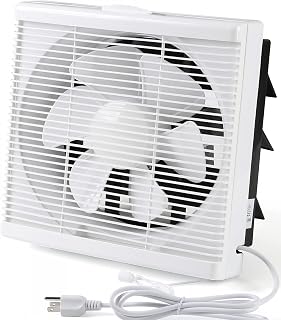 Nalle 10 Inch Window Reversible Exhaust Fan Through-wallCheck price on Amazon
Specs compared
| Model | HQ Score | Airflow | Power | Size | Mount | Safety | Warranty |
|---|---|---|---|---|---|---|---|
| iLiving 18-Inch Fan | 9.7/10 | 1736 CFM | 97W | 18 in | Wall mount | UL | 1 year |
| iLiving 10-Inch Fan | 9.7/10 | 820 CFM | 65W | 10 in | Wall mount | UL | 1 year |
| COMFORT ZONE Twin Fan | 9.6/10 | 272 CFM | 45.9W | 9 in twin | Window mount | ETL, UL | 1 year |
| Genesis Twin Fan | 9.5/10 | 706.21 CFM | 30W | 9 in twin | Window mount | ETL | Not stated |
| Amazon Basics Twin Fan | 9.4/10 | Not stated | 63W | 9 in twin | Window mount | ETL | Not stated |
Specifications are manufacturer rated, as published on each listing and collected 22 October 2026. Airflow is the maker’s stated CFM; the Amazon Basics listing does not state one.
What the listings tell you, and what they leave out
Five exhaust fan listings went into this guide. Four state an airflow figure, from 272 CFM to 1736 CFM; the Amazon Basics twin fan states none, so its output can only be guessed from the 63W draw. Three listings state a warranty term, all of them a 1-year warranty; the Genesis and Amazon Basics listings state no warranty at all. Two listings carry a UL mark, three an ETL mark, and the COMFORT ZONE carries both.
The listings also contradict themselves in small ways. The Genesis title brands the fan Genesis while the manufacturer field names Avalon, and the spec table lists “Speed: 3 rpm” next to the 3 speed settings in the bullets. The COMFORT ZONE bullets give two different window-fit ranges: the expanders adjust from 22-1/4 in to 33 in, while the fit line claims 23-1/2 in to 37 in. The iLiving 18 in model lists “Installation Type: hardwired” in the spec table but a standard NEMA 5-15 plug as the connector. In each case the title and bullets are the safer read.
Buying guide: the best window exhaust fan for laser
Airflow first
Airflow decides how fast smoke leaves the room. The iLiving 18 in model moves 1736 CFM, the 10 in model 820 CFM, the Genesis 706.21 CFM and the COMFORT ZONE 272 CFM; the Amazon Basics listing states no CFM. For a small engraving room the twin window fans move enough air to keep the space clear, while a garage or workshop with a bigger volume suits the shutter fans. Match the fan to the room, not to the laser: the listings rate airflow, not machines.
Window mount or wall mount
The three twin fans mount in a window: the COMFORT ZONE fits windows with auto-locking expanders, the Genesis with expandable side panels, and the Amazon Basics with expandable panels for 25 to 32 in windows. All three are reversible, so the same fan can pull air in or push it out. The two iLiving shutter fans are wall-mount units with automatic shutters that close when the fan stops, which keeps weather and pests out of a garage wall opening. A wall mount needs a cut opening; a window mount needs a sash that fits.
Thermostat and speed control
Three picks include a thermostat: the Genesis adjusts from 60 to 80 degrees, and both iLiving models regulate from 32 to 130F with variable speed control. A thermostat lets the fan run only when the room needs it, which matters in a shop that heats up under the laser and cools down overnight. The COMFORT ZONE and Amazon Basics use manual speed dials with 2 and 3 speeds respectively, so they run when you switch them on and stop when you switch them off.
Safety listings
The iLiving pair is UL listed with OSHA compliant wire guards, the Genesis is ETL certified, the Amazon Basics carries ETL in its spec table, and the COMFORT ZONE is ETL listed with ETL and UL in the specification table. A listing mark means the maker had the design checked against a standard; no mark means no such statement. Keep the fan clear of dust buildup regardless of the mark, and follow the wiring instructions in the manual.
Sizing the fan to the space
The iLiving listings state coverage: up to 1200 sq ft for the 10 in model and up to 2600 sq ft for the 18 in model. The window-fan listings state no coverage figure, so judge them by CFM and by the room they already serve: bedrooms and home offices in the listings’ own words. A laser in a spare room pairs with a twin window fan; a laser in a garage pairs with a shutter fan on the wall. When in doubt, the higher CFM pick moves more air per minute, and the thermostat models stop it from running all day.
Project Match
- Garage or workshop laser with a wall opening: the iLiving 18 in or 10 in shutter fan, wall mount with automatic shutters and thermostat control.
- Spare-room or home-office laser with a sash window: the Genesis or COMFORT ZONE twin window fan, reversible for intake or exhaust.
- Small engraving setup that runs in sessions: a thermostat model (Genesis, iLiving 10 in, iLiving 18 in) so the fan follows the room temperature.
- Simple manual ventilation on a budget of attention: the COMFORT ZONE or Amazon Basics, dial-controlled with no thermostat to set.
The listings do not rate any of these fans for a specific laser model or material; match by workspace and mounting, not by machine.
How the scores add up
The HQ Score weighs performance (stated airflow and controls), build (frame, blades and mounting), value, safety (stated certifications such as UL or ETL) and warranty, with the weights published on our How We Pick page. A spec the listing does not publish scores nothing, which is why the Amazon Basics pick scores zero on warranty and the Genesis pick scores zero there too.
| Product | HQ Score | Perf. /35 | Build /25 | Value /25 | Safety /10 | Warranty /5 |
|---|---|---|---|---|---|---|
| iLiving 18-Inch Fan | 9.7 | 32 | 21 | 20 | 8 | 3 |
| iLiving 10-Inch Fan | 9.7 | 29 | 20 | 21 | 8 | 3 |
| COMFORT ZONE Twin Fan | 9.6 | 26 | 19 | 20 | 8 | 3 |
| Genesis Twin Fan | 9.5 | 28 | 19 | 21 | 7 | 0 |
| Amazon Basics Twin Fan | 9.4 | 23 | 18 | 20 | 7 | 0 |
Scores run from 9.2 to 9.8: each product’s point total is placed on that range, so more points always means a higher score.
FAQ: lasers and CNC
What does an exhaust fan do for a laser engraver?
It moves room air outside. Engraving and cutting release smoke and fine dust, and the fan pulls that air out through a window or wall opening so it does not linger in the room. The listings rate this job in CFM, from 272 CFM to 1736 CFM across these five picks. For background on why ventilation matters, see do laser engravers need ventilation.
Window fan or shutter fan: which suits a laser?
A twin window fan suits a room with a fitting sash window: it drops into the window, needs no cutting, and reverses between intake and exhaust. A shutter fan suits a garage or workshop wall: it mounts over a cut opening, moves far more air, and its shutters close when it stops. See fume extractor vs exhaust fan for how these compare with filtered extractors.
Can an exhaust fan cause a fire?
None of these listings makes a fire-safety claim either way. The iLiving models state OSHA compliant wire guards and UL listing, and the other three carry ETL marks. Practical steps from the listings themselves: keep the blades and guards clear of dust, do not block the airflow, and wire the unit as the manual instructs. For anything beyond that, an electrician is the right call.
What size exhaust fan does a laser need?
Size it to the room using the maker’s figures. The iLiving 10 in model claims up to 1200 sq ft of coverage and the 18 in model up to 2600 sq ft; the window fans state no coverage, so compare their CFM: 706.21 for the Genesis, 272 for the COMFORT ZONE, and no stated figure for the Amazon Basics. More CFM clears a room faster; a thermostat keeps the fan from running when the room is already clear.
Do I need a thermostat on the exhaust fan?
Not required, but useful. The Genesis thermostat adjusts from 60 to 80 degrees and the iLiving models from 32 to 130F, so the fan runs when the room warms up and rests when it cools. In a shop that swings with the weather, that saves switching it by hand. For a small room used in short sessions, a manual dial is enough.
Related: best exhaust fan for laser engraver picks, do laser engravers need ventilation, fume extractor vs exhaust fan and exhaust fan for laser enclosure.