Hardwood vs Plywood for CNC: Which One Should You Buy?
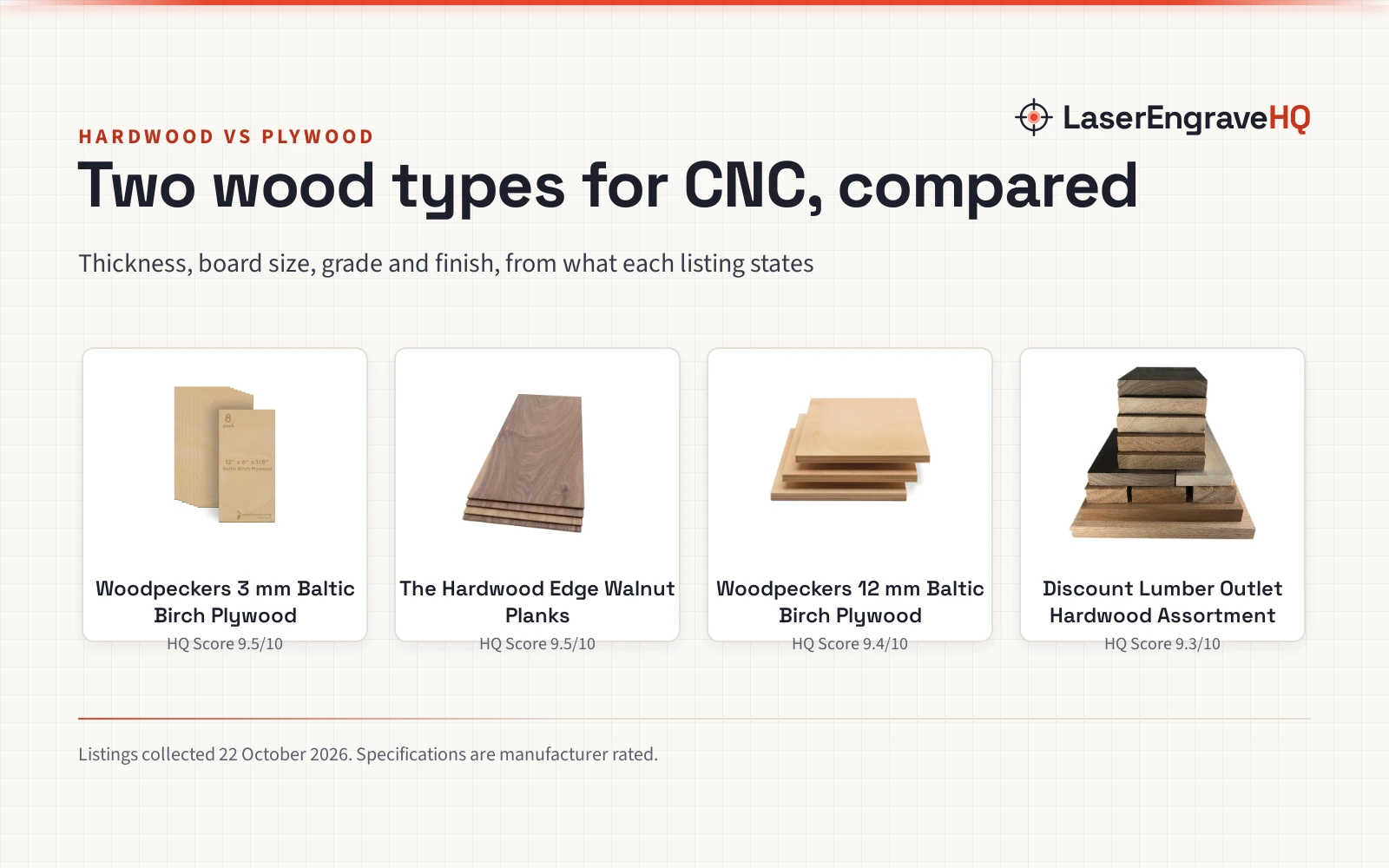
Hardwood vs plywood for CNC: walnut planks and a mixed hardwood assortment against 3 mm and 12 mm Baltic birch plywood, on thickness, size, grade and stated uses.

On this page
Top picks at a glance
As an Amazon Associate I earn from qualifying purchases.
- 1
 Walnut Hardwood Planks9.5/10View on Amazon
- 2
 6 mm Baltic Birch Plywood 1/4 x 12 x 12 Inch9.6/10View on Amazon
- 3
 Hardwood Lumber Assortment9.3/10View on Amazon
- 4
 Maple Hardwood PlanksView on Amazon
- 5
 6 mm Baltic Birch Plywood 1/4 x 12 x 16 InchView on Amazon
- 6
 Plywood 12PcsView on Amazon
- 7
 3 mm Baltic Birch Plywood 1/8 x 12 x 24 InchView on Amazon
- 8
 3 mm Baltic Birch Plywood 1/8 x 12 x 20 InchView on Amazon
- 9
 3 mm Baltic Birch Plywood 1/8 x 18 x 24 InchView on Amazon
Cut parts or engraved gifts? The stock you buy decides how much finishing, measuring and guesswork stands between the design and the finished piece. This guide looks at hardwood vs plywood for cnc through four listings: two solid hardwood options and two Baltic birch plywood options, compared on thickness, board size, grade, finish and what each listing says about CNC and laser use.
LaserEngraveHQ earns a commission from purchases made through these links, at no extra cost to you. Read our affiliate disclosure.
Verdict: pick plywood when you want flat, stable sheets with a stated grade and a true size for cutting parts; pick hardwood when you want solid-wood grain for engraved pieces. The Woodpeckers 3 mm birch leads for CNC cutting, the walnut planks lead for engraving blanks, the 12 mm birch suits thicker structural parts, and the assortment is a species sampler with no stated dimensions.
Machines on the list

3 mm Baltic Birch Plywood 1/8 x 6 x 12 Inch
A box of 8 B/BB grade Baltic birch sheets, 3 mm thick, with a thick face veneer the listing says gives CNC routers a smoother surface.
Pros
- B/BB grade with a thick face veneer for CNC routers
- Listing names laser and CNC cutting as intended uses
- True size stated: 5-7/8 x 11-7/8 inch
- 8 sheets in the box
Cons
- Thin stock at 3 mm, not for structural parts
- Back veneer typically has 1-2 small color-matched patches
- No warranty term stated
- 1.6 pounds for the box, so each sheet is light
Walnut Hardwood Planks - Walnut Wood
Four 1/4 inch solid walnut planks sold as laser engraving blanks, kiln dried, precision sliced and sanded smooth.
Pros
- 100% pure hardwood, not a veneer on plywood
- Sold as laser engraving blanks, Glowforge ready
- Kiln dried, precision sliced and sanded smooth
- 4 planks at 1/4 x 6 1/2 x 15 inch
Cons
- High color variability, pale brown to dark chocolate brown
- Spec table contradicts the title on thickness and density
- Warranty description is only the word Standard
- Small blanks, not full boards

Baltic Birch Plywood 8 x 12 x 1/2 Inch
A pack of 2 B/BB grade Baltic birch boards at 1/2 inch thick, listed for laser and CNC cutting plus shelves and cabinetry.
Pros
- 1/2 inch thick, the thickest stock here
- B/BB grade with a thick face veneer
- True size stated: 11-7/8 x 7-7/8 inch
- Listing names shelves, cubbies and cabinetry as uses
Cons
- Only 2 boards in the pack
- Back veneer typically has 1-2 small color-matched patches
- Warranty description states None
- Thicker stock cuts slower on small lasers

Hardwood Lumber Assortment - Mixed Species
A large box of mixed-species hardwood hobby lumber with at least 3 different species and no stated dimensions.
Pros
- At least 3 different species in the box
- Species list includes walnut, cherry, oak, maple and hickory
- Clear lumber with no scrap, defects, knots or end checks
- Good way to try species before buying boards
Cons
- No dimensions or thickness stated
- No way to know which species you will get
- 1 kg item weight gives no sense of board count
- No stated CNC or laser use on the listing
Other machines to compare
 Maple Hardwood PlanksCheck price on Amazon
 6 mm Baltic Birch Plywood 1/4 x 12 x 16 InchCheck price on Amazon
 Plywood 12PcsCheck price on Amazon
 3 mm Baltic Birch Plywood 1/8 x 12 x 24 InchCheck price on Amazon
 3 mm Baltic Birch Plywood 1/8 x 12 x 20 InchCheck price on Amazon
 3 mm Baltic Birch Plywood 1/8 x 18 x 24 InchCheck price on Amazon
Side by side
| Spec | Woodpeckers 3 mm Baltic Birch Plywood | The Hardwood Edge Walnut Planks | Woodpeckers 12 mm Baltic Birch Plywood | Discount Lumber Outlet Hardwood Assortment |
|---|---|---|---|---|
| Side | Plywood | Hardwood | Plywood | Hardwood |
| Thickness | 3 mm | 1/4 inch (6 mm) | 1/2 inch (12 mm) | Not stated |
| Board size | True size 5-7/8 x 11-7/8 inch | 1/4 x 6 1/2 x 15 inch | True size 11-7/8 x 7-7/8 inch | Not stated |
| Pack count | Box of 8 | 4 | Pack of 2 | Not stated |
| Grade or finish | B/BB grade | Kiln dried, sanded smooth | B/BB grade | No scrap, defects, knots or end checks |
| Stated CNC or laser use | Laser, CNC cutting | Laser cutting and engraving | Laser, CNC cutting | Not stated |
| Warranty | Not stated | Standard (no term) | None | Not stated |
Specifications are manufacturer rated, as published on each listing and collected 22 October 2026.
Hardwood vs plywood for cnc: how the listings differ
The two plywood listings are the only ones that state both a nominal size and a true size: 5-7/8 x 11-7/8 inch on the 3 mm sheets and 11-7/8 x 7-7/8 inch on the 12 mm boards. The walnut planks state one size, 1/4 x 6 1/2 x 15 inch, and the hardwood assortment states no dimensions at all. If your toolpaths need exact stock sizes, the plywood listings give you more to work with.
Thickness and what it fits
Thickness runs from 3 mm on the thin birch sheets to 1/4 inch (6 mm) on the walnut planks to 1/2 inch (12 mm) on the thick birch boards, while the assortment states no thickness. The 3 mm sheets suit layered projects and fine cutting where thin stock wastes less material; the 12 mm boards suit shelves, boxes and parts that need to hold screws, which the listing calls out with excellent holding power for glue and screws. The walnut sits between the two birch options and is sold specifically as engraving blanks.
Surface, grade and finish
Both Woodpeckers listings are graded B/BB, with a single-piece face veneer the maker calls smooth with a light uniform color, while the back typically has 1-2 small color-matched patches. The thick face veneer is the CNC-relevant detail: the listing says it gives CNC routers and engraving machines a smoother surface to glide on. The walnut planks are kiln dried, precision sliced and sanded to a smooth finish, with no chemicals used in growing or harvesting. The assortment promises clear lumber with no scrap, defects, knots or end checks, but states no grade.
Grain and engraving look
The walnut bullets describe a medium density wood with subdued, variable grain and high color variability from pale brown to dark chocolate brown, and call it easy to engrave and cut. The birch listings describe a beautiful lengthwise grain that takes stain well, with a light uniform face color. Neither birch listing names a density. If the finished look matters, walnut gives you varied solid-wood grain while birch gives you a uniform surface that takes stain well.
Stability claims
The birch listings claim exceptional durability, rigidity and stability, and call the birch creep resistant. The walnut listing makes no explicit stability claim; it describes its process: kiln dried, precision sliced and sanded. The assortment makes no stability claim. These are the makers’ claims, reported as stated; none of the listings gives a warping or moisture figure.
Cutting on a CNC
The 3 mm birch listing is the most CNC-specific: its layers are described as made to smoothly glide through laser cutters and scroll saws, and the thick face veneer is called out for CNC routers. The 12 mm birch listing names CNC cutting among its uses. The walnut listing says its planks are easy to engrave and cut and calls them laser cutting blanks. The assortment names no CNC or laser use at all. None of the four listings gives feeds, speeds or pass counts, so expect to dial in settings on your own machine with a scrap piece.
Choose plywood if
- You cut flat parts on a CNC router and want a stated grade and true size.
- You build layered projects, boxes or shelves from sheet goods.
- You want a uniform face that takes stain well.
Choose hardwood if
- You engrave signs, ornaments or gifts and want solid-wood grain.
- You want blanks that arrive sanded smooth and ready to engrave.
- You want to try several species for small projects.
For more material options, see the engraving materials hub.
Cutting and engraving wood makes dust and smoke: ventilate the work area and keep the machine’s exhaust path clear. Never cut materials with unknown coatings or finishes, and stay with the machine while it runs.
Project Match
- Cut parts and joinery on a CNC router: the Woodpeckers 3 mm birch, B/BB grade with a true size of 5-7/8 x 11-7/8 inch.
- Shelves, cubbies and small cabinetry: the Woodpeckers 12 mm birch, 1/2 inch thick with a true size of 11-7/8 x 7-7/8 inch.
- Engraved signs, ornaments and gifts: the walnut planks, laser engraving blanks at 1/4 x 6 1/2 x 15 inch in a 4 count.
- Trying several species for small projects: the hardwood assortment, at least 3 different species with no stated dimensions.
FAQ: lasers and CNC
Is plywood or hardwood better for CNC cutting?
For cutting flat parts, the plywood listings give you more: a stated B/BB grade, true sizes, and a thick face veneer the maker says suits CNC routers. For engraved finished pieces, the walnut listing offers solid-wood grain in blanks sold as easy to engrave and cut. Match the stock to the project rather than declaring a winner.
What thickness should I buy for a CNC router?
The listings here state 3 mm, 1/4 inch and 1/2 inch. The 3 mm sheets suit layered and detailed cutting, the 1/4 inch walnut suits engraving blanks, and the 12 mm boards suit shelves and parts that hold screws. The assortment states no thickness, so it cannot be matched to a project in advance.
Why do the plywood listings give two sizes for the same board?
The Woodpeckers listings give a nominal size and a true size: 6 x 12 nominal with a 5-7/8 x 11-7/8 inch true size on the 3 mm sheets, and 8 x 12 nominal with an 11-7/8 x 7-7/8 inch true size on the 12 mm boards. Use the true size when laying out toolpaths so parts come out the right size.
Can a small laser cut the 1/2 inch birch?
The 12 mm listing names laser cutting among its uses, but no listing here gives pass counts or power settings for any thickness. Thicker stock takes more passes on small lasers, so plan a trial cut on a scrap piece first.
Does the walnut need sanding before engraving?
The listing says the planks arrive precision sliced and sanded to a smooth finish, so they are sold ready to engrave. The birch sheets are described with a smooth face veneer that takes stain well if you finish after cutting.
Related: how to choose a laser engraver, best laser engraver for beginners, our diode vs CO2 guide, and the engraving materials hub.