Ultrasonic Cleaner Parts and Replacements Guide
A plain guide to the parts inside an ultrasonic cleaner, what each one does, and how to check and replace it.

On this page
Top picks at a glance
As an Amazon Associate I earn from qualifying purchases.
- 1
 Klivvio Ultrasonic Jewelry Cleaner9.5/10View on Amazon
- 2
 Ukoke UUC06S Ultrasonic Cleaner9.5/10View on Amazon
An ultrasonic cleaner looks like a simple steel tub, but several parts work together to clean a ring or a pair of glasses. Ultrasonic cleaner parts are the tank, the basket, the transducers, the timer, the heater and the cleaning solution, and each one has a job you can check. This guide names each part, explains what it does, and shows how to tell when it needs attention.
LaserEngraveHQ earns a commission from purchases made through these links, at no extra cost to you. Read our affiliate disclosure.
This guide gives no failure rates, because no maker states how long each part lasts. It names each part from what the makers state and tells you how to check it.
Ultrasonic cleaner parts: what each part does
The tank holds the water and the cleaning solution. The basket holds the jewelry or small parts so they sit in the solution without touching the tank floor. The transducers sit under the tank and turn electric power into sound waves, and those waves make the tiny bubbles that lift dirt from crevices. The timer sets how long a cycle runs. The heater warms the solution, and the solution itself loosens the dirt the bubbles lift.
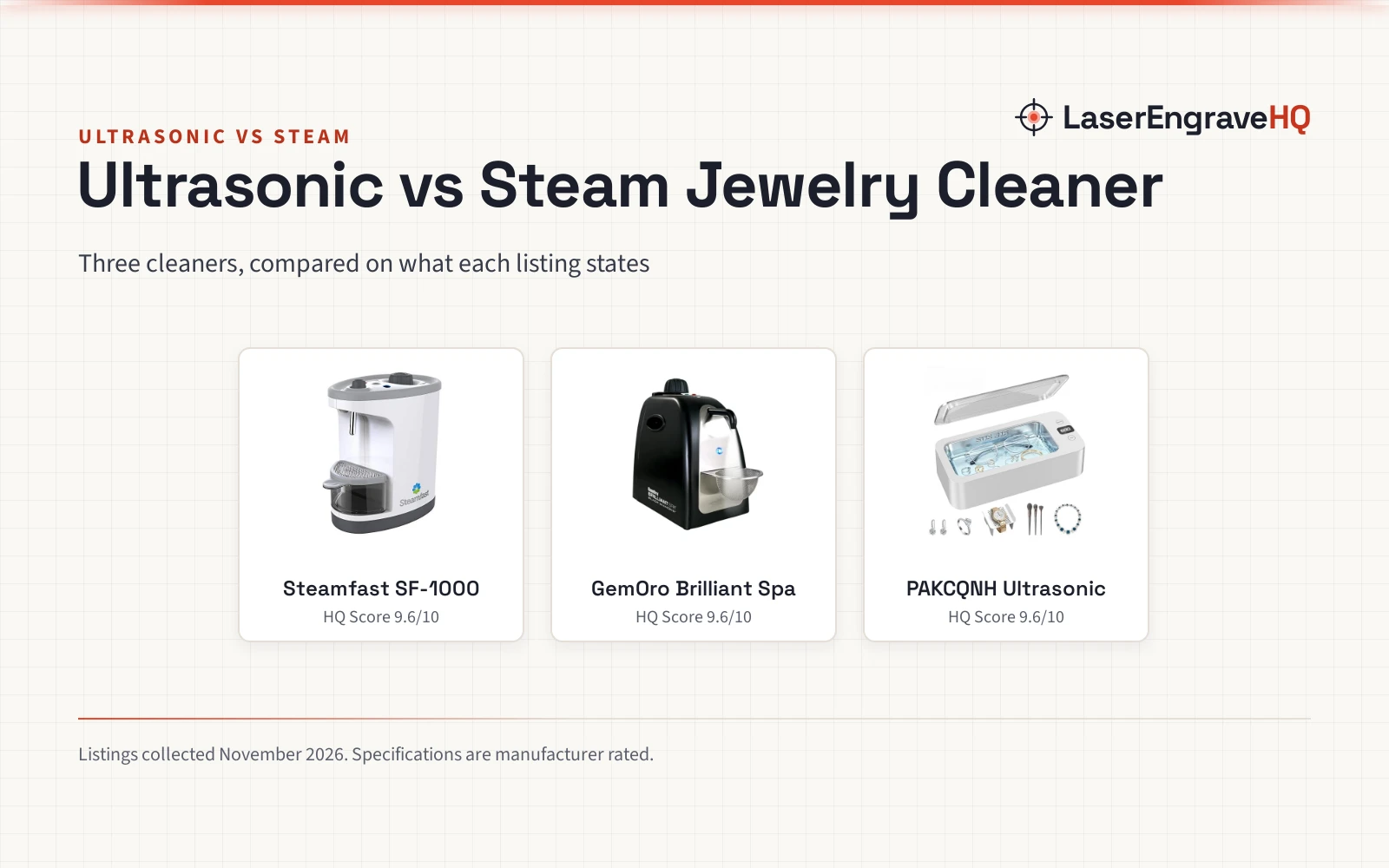
The listings in this guide state frequencies of 40kHz, 42kHz, 45kHz, 48kHz and 50kHz, and one model uses triple-frequency sound waves. Power varies too: the Klivvio cleaner (on Amazon) runs at 24W, while the CREWORKS and Granbo machines run at 120W.
Tank and basket
Most tanks in this guide are stainless steel. The CREWORKS and Granbo tanks use 304 stainless steel, and the PAKCQNH tank uses 316 stainless steel, which the maker calls corrosion-resistant. The CALOTO tank (on Amazon) is also 304 stainless steel.
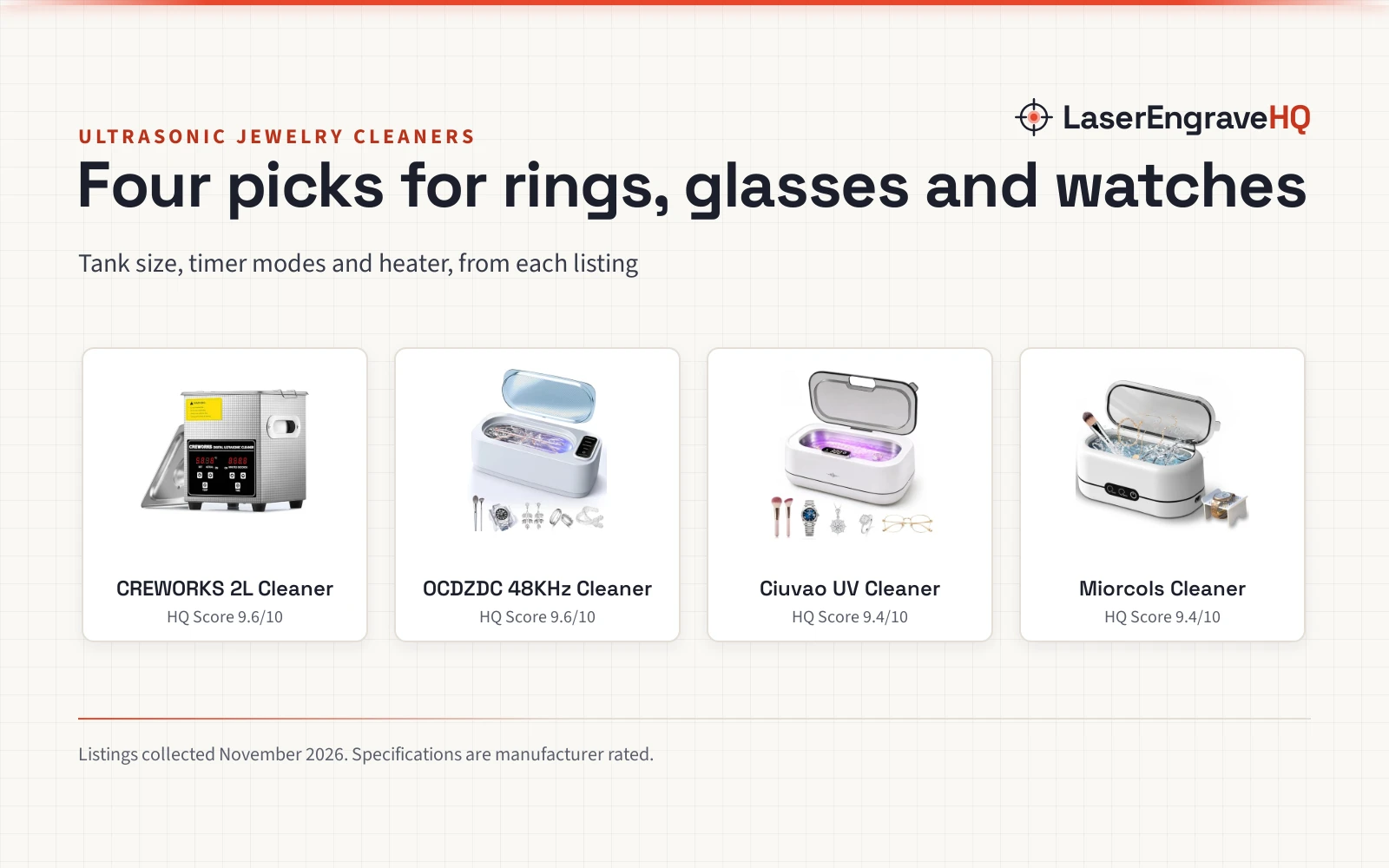
Tank size decides what fits. The BEESHOP pod (on Amazon) holds 200ml, the Klivvio cleaner holds 13.5oz, the PAKCQNH tank holds 500ml and cleans 4 to 6 jewelry pieces at once, the Ukoke tank (on Amazon) holds 600ml, the CALOTO tank holds 700ml, stated as 24 oz, and the CREWORKS and Granbo machines hold 3.2L, stated as 0.8 gal. The Granbo tank measures 9.4 by 5.3 by 4 inches, and the CREWORKS machine (on Amazon) measures 10.8 by 7.2 by 8.9 inches. For machine sizes, see our best ultrasonic jewelry cleaner guide.
The basket keeps pieces off the tank floor and lets the solution reach every side. The PAKCQNH kit includes a basket, a cord and a manual, and the Granbo cleaner comes with a basket for its 3.2L tank. If a basket bends or a wire breaks, replace it before the next cycle, because a piece resting on the tank floor cleans unevenly.
Transducers and frequency
Transducers are the part that makes the cleaning happen. They vibrate the tank wall at a set frequency, and the vibration makes microscopic bubbles in the solution. When the bubbles collapse against a surface, they lift dirt from crevices a cloth cannot reach. The Klivvio cleaner states 48,000Hz, the Ukoke cleaner states 42,000Hz, the BEESHOP pod states 45,000Hz, the Granbo machine states 40kHz, and the CALOTO cleaner states 50kHz. The PAKCQNH cleaner uses triple-frequency sound waves.
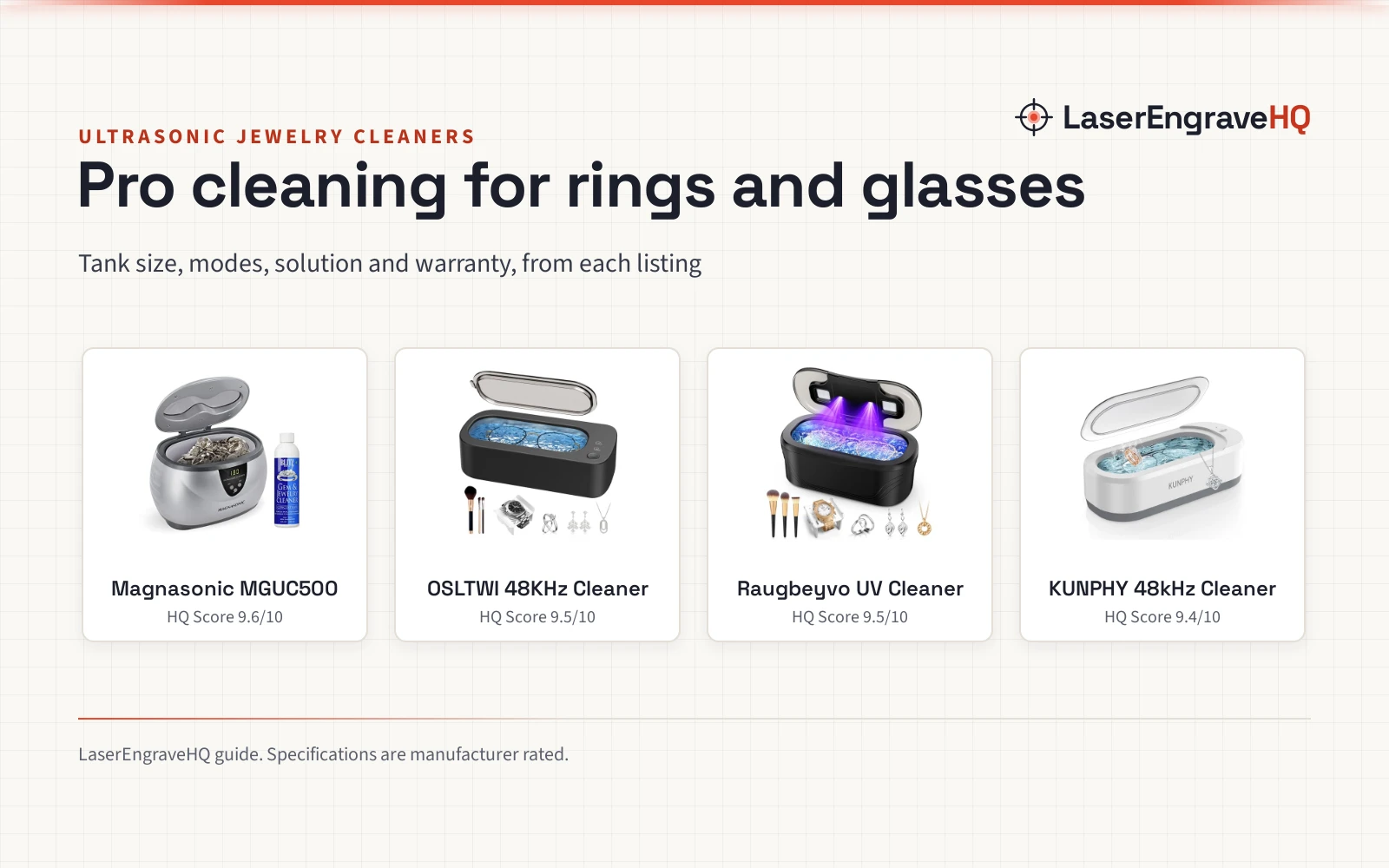
Two modes change how the transducers run. Degas mode removes trapped air bubbles from the solution so cavitation works better, and the Klivvio cleaner offers it on its 480 and 600 second modes while the Granbo machine has a dedicated degas mode. The Granbo machine also has a SEMIWAVE mode that cuts ultrasonic power in half for delicate items such as circuit boards, necklaces, watches and rings.
Timer, heater and controls
The timer is the part you touch most. The Klivvio cleaner has four preset modes at 180, 360, 480 and 600 seconds, with degas on the two longer modes. The PAKCQNH cleaner has five preset cycles, and the maker recommends the 600 second mode for fragile items such as pearls and antique jewelry. The CALOTO cleaner has five time modes, and it shuts off on its own when the preset time ends. The Ukoke cleaner has a 5-cycle digital timer from 90 to 600 seconds. The CREWORKS machine times cleaning up to 30 minutes with a knob, and the Granbo machine sets 0 to 30 minutes on a digital timer and stops on its own.
The heater warms the solution so it works faster. The CREWORKS machine has 100W of heating power with temperatures from 70 to 175°F, set with a second knob. The Granbo machine has a 150W heater that brings the solution to 176°F. The Klivvio and CALOTO cleaners shut off on their own when the cycle ends, and the Klivvio cleaner has a digital display that shows the cycle until it powers off. For larger machines with heaters, see our best professional ultrasonic jewelry cleaner guide.
Cleaning solution and water
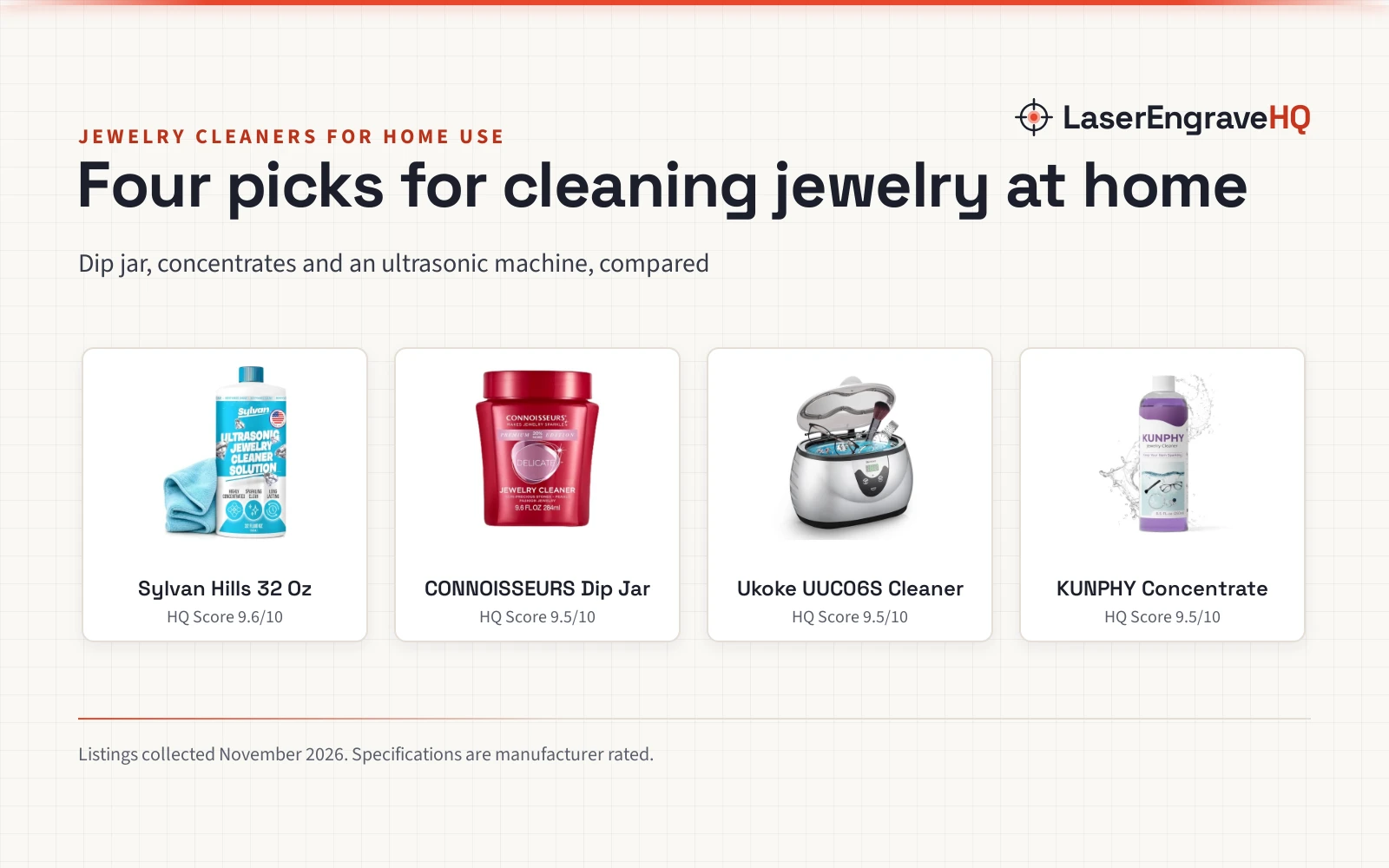
The solution is the part you use up. The iSonic solution comes as an 8 oz bottle in a 2-pack, and the maker states one capful per use. The WoldoClean concentrate comes as a 25.4 fl oz bottle that makes 8 gallons of ready-to-use liquid at a 1 to 40 dilution, and it works in tanks from 8 to 64 fl oz. Add one capful per tank of warm water, run the cycle, rinse the pieces with clean water and dry them with a lint-free cloth.
Tap water alone works for light cleaning. The PAKCQNH cleaner cleans jewelry in minutes using only tap water, and the maker says to add ultrasonic solution for stubborn grime. The Klivvio cleaner also works with water alone, and the maker says adding a cleaning agent gives better results. Our how to clean jewelry at home guide covers the same steps in more detail.
When to replace a part
Start with the parts you use up. Replace the cleaning solution when it looks dirty or when a fresh mix cleans better than the old one, and rinse the tank before you refill it. Check the basket each time you load it: if a wire is bent or broken, replace the basket so pieces stay clear of the tank floor.
Check the controls too. If a button stops responding or the timer no longer counts down, the control board is the part to ask the maker about. The same goes for a heater that no longer warms the solution or a transducer that no longer makes bubbles across the tank. For a dead transducer, a cracked tank or any repair inside the machine, contact the maker or a repair shop rather than opening the machine yourself.
Common mistakes to avoid
- Running the cleaner with no water in the tank. The BEESHOP maker states to always add water before powering on.
- Cleaning glasses with a scratched or cracked coating. The Klivvio maker states those glasses are not suitable for ultrasonic cleaning.
- Expecting the Klivvio cleaner to remove tarnish. The Klivvio maker states it will not remove tarnish.
- Mixing solution for the wrong tank size. The WoldoClean concentrate works in tanks from 8 to 64 fl oz, so check the tank size before you mix.
- Cleaning delicate items at full power. The Granbo SEMIWAVE mode cuts ultrasonic power in half for delicate items such as circuit boards, necklaces, watches and rings.
Ultrasonic cleaner parts: the short version
- Tank and basket hold the items in the solution.
- Transducers make the bubbles that lift dirt.
- Timer sets the cycle, and the heater warms the solution.
- Solution loosens dirt; replace it when it looks dirty.
- Check the basket, controls and heater before each use.
- Contact the maker or a repair shop for repairs inside the machine.
FAQ: lasers and CNC
What part of an ultrasonic cleaner makes the bubbles?
The transducers. They vibrate the tank wall at a set frequency, and the vibration makes microscopic bubbles in the solution. The listings in this guide state frequencies of 40kHz, 42kHz, 45kHz, 48kHz and 50kHz, and one model uses triple-frequency sound waves.
What size tank do I need for jewelry?
It depends on what you clean. The BEESHOP pod holds 200ml and the Klivvio cleaner holds 13.5oz, which suit a ring or a pair of glasses. The PAKCQNH tank holds 500ml and cleans 4 to 6 jewelry pieces at once, and the CREWORKS and Granbo machines hold 3.2L for larger loads.
Can I use tap water in an ultrasonic cleaner?
Yes, for light cleaning. The PAKCQNH cleaner cleans jewelry in minutes using only tap water, and the maker says to add ultrasonic solution for stubborn grime. The Klivvio maker also says adding a cleaning agent gives better results.
How much cleaning solution do I add?
Follow the solution maker. The WoldoClean concentrate mixes at a 1 to 40 dilution and the maker states one capful per tank of warm water. The iSonic solution also states one capful per use.
Do ultrasonic cleaners remove tarnish?
Not always. The Klivvio maker states its cleaner will not remove tarnish, even though it removes dirt and grease from crevices. Check what your own cleaner states about tarnish before relying on it for that.
Related: the jewelry and lapidary hub, best ultrasonic jewelry cleaner and how to clean jewelry at home. Also see our best jewelry cleaner.