Tear Away vs Cut Away Embroidery Stabilizer: Which One Should You Buy?
Tear away stabilizer tears off after stitching and suits firmly woven fabrics, while cut away stabilizer stays in place for knits, fleece and unstable fabrics.

On this page
An embroidery design needs backing while it stitches, and the backing choice changes how the finished piece feels and washes. Tear away backing comes off after stitching, while cut away backing stays in place for good. This comparison works through tear away vs cut away embroidery stabilizer using listings from the same brand, so the sides differ in backing type rather than brand.
As an Amazon Associate I earn from qualifying purchases. LaserEngraveHQ earns a commission from purchases made through these links, at no extra cost to you. Read our affiliate disclosure.
Verdict: pick tear away for firmly woven fabrics and natural fibers when the backing should come off cleanly after stitching. Pick cut away for knits, fleece, denim and fabric that moves or distorts when tugged, and for designs that must keep their shape after repeated washing. The rolls suit cutting custom sizes, while the precut sheets come ready to hoop.

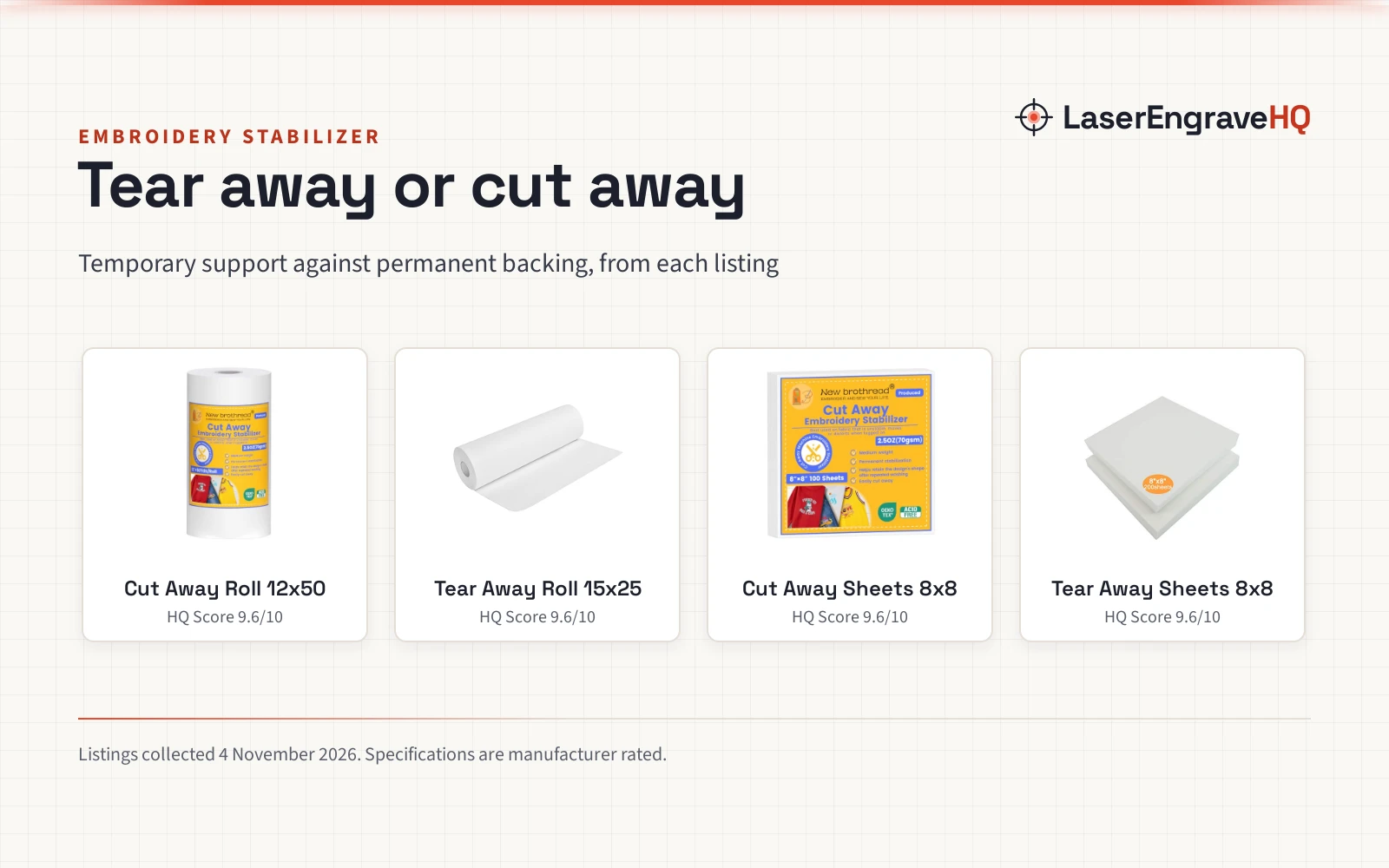
New brothread Cut Away Embroidery Stabilizer 12" x
A 12" x 50 yd cut away roll at medium weight 2.5oz, for knits, fleece, denim and unstable fabrics.
Pros
- Permanent backing that remains affixed and helps retain shape after repeated washing.
- 12" (30.5cm) width on a 50 yd roll, cut into variable sizes for most hoops.
- Listed for knits, fleece, denim and fabric that moves or distorts when tugged.
- Medium weight 2.5oz (70 Grams) for light to medium stitch density.
Cons
- Backing stays in the finished piece, so it never comes off.
- No item weight is stated.
- No warranty term is stated.
- No removal directions are stated in this roll listing.

New brothread Tear Away Embroidery Stabilizer 15"
A 15" x 25 yd tear away roll at medium weight 1.8 oz, for firmly woven fabrics and natural fibers.
Pros
- Temporary backing that tears away easily yet provides adequate stability.
- 15" (38cm) width on a 25 yd roll, cut into variable sizes for most hoops.
- Listed for firmly woven fabrics, natural fibers and thicker, softer fabrics.
- Medium weight 1.8 oz (50 Grams) for light to medium stitch density.
Cons
- Backing comes off, so it gives no permanent support after stitching.
- No item weight is stated.
- No warranty term is stated.
- No removal directions are stated in this roll listing.

New brothread Cut Away Embroidery Stabilizer 8"x8"
100 precut 8" x 8" cut away sheets at medium weight 2.5oz, fitting 4x4 and 6x6 hoops.
Pros
- Permanent backing that remains affixed and helps retain shape after repeated washing.
- 100 precut 8" x 8" sheets, ready to hoop.
- Fits 4x4 and 6x6 hoops, per the listing title.
- Medium weight 2.5oz (70 Grams) for light to medium stitch density.
Cons
- Backing stays in the finished piece, so it never comes off.
- Only 100 sheets, against 200 sheets in the tear away sheets pack.
- Removal needs rough cutting and trimming close to the stitches with sharp scissors.
- No warranty term is stated.

New brothread Tear Away Embroidery Stabilizer
200 precut 8" x 8" tear away sheets at medium weight 1.8 oz, for firmly woven fabrics and natural fibers.
Pros
- Temporary backing that tears away easily yet provides adequate stability.
- 200 precut 8" x 8" sheets, the largest sheet count here.
- Tears away in horizontal or vertical directions around the stitches.
- Medium weight 1.8 oz (50 Grams) for light to medium stitch density.
Cons
- Backing comes off, so it gives no permanent support after stitching.
- No hoop sizes are stated in this listing.
- No warranty term is stated.
- Sheets are 8" x 8" only, so larger hoops need the roll formats.
Side by side
| Spec | Cut Away Roll 12×50 | Tear Away Roll 15×25 | Cut Away Sheets 8×8 | Tear Away Sheets 8×8 |
|---|---|---|---|---|
| HQ Score | 60 | 59 | 58 | 57 |
| Side | Cut away | Tear away | Cut away | Tear away |
| Format | 12″ x 50 yd roll | 15″ x 25 yd roll | 8″ x 8″ precut, 100 sheets | 8″ x 8″ precut, 200 sheets |
| Weight | 2.5oz (70 Grams) | 1.8 oz (50 Grams) | 2.5oz (70 Grams) | 1.8 oz (50 Grams) |
| Stays or removes | Permanent, stays affixed | Temporary, tears away | Permanent, stays affixed | Temporary, tears away |
| Best fabrics (listing) | Knits, fleece, denim, unstable fabric | Firmly woven, natural fibers | Knits, fleece, denim, unstable fabric | Firmly woven, natural fibers |
| Warranty | Not stated | Not stated | Not stated | Not stated |
Specifications are manufacturer rated, as published on each listing and collected 3 November 2026.
Temporary versus permanent
Tear away stabilizer provides temporary support and tears away easily after stitching, while cut away stabilizer is permanent and remains affixed to the embroidery. The cut away listings say the backing helps retain the design’s shape after repeated washing. That difference drives the choice.
Fabric match
The tear away listings name firmly woven fabrics and fabrics made from natural fibers, plus thicker and softer fabrics. The cut away listings name knits, fleece, denim and fabric that is unstable, moves or distorts when tugged on. Both sides list the same project types: hoop embroidery, applique, thread stretching, computerized lace embroidery and decorative stitch sewing. Match the side to the fabric, not to the project type.
Weight and stitch density
Both sides are medium weight for light to medium stitch density, and both listings say to use more than one layer for much denser designs. The tear away listings state 1.8 oz (50 Grams), and the cut away listings state 2.5oz (70 Grams). The listings do not rank the two weights against each other.
Rolls versus precut sheets
The tear away roll is 15″ wide on a 25 yd roll, and the cut away roll is 12″ wide on a 50 yd roll; both roll listings say the width allows cutting into variable sizes to fit most hoops. The precut sheets are 8″ x 8″: 200 sheets on the tear away side and 100 sheets on the cut away side, with the cut away sheets listing fits for 4×4 and 6×6 hoops. Rolls suit custom sizes; sheets suit quick hooping.
Care and skin contact
All four listings describe the material as 100% first-class polyester, acid and lead free. Removal differs by side: the tear away sheets listing says to tear the stabilizer away in horizontal or vertical directions around the stitches, while the cut away sheets listing says to roughly cut the excess and trim close to the stitches with sharp scissors. The roll listings do not describe removal.
What the listings leave out
None of the four listings states a warranty term, so warranty scores are zero across the picks. None states a safety certification either. The tear away roll listing gives no item weight, and the cut away roll listing gives no item weight either; only the sheet listings state weights, at 0.2 pounds for tear away sheets and 0.6 pounds for cut away sheets. Treat those weights as pack figures, not as a side-to-side comparison, since the packs hold different sheet counts.
The picks: tear away vs cut away embroidery stabilizer
Choose tear away if
- You stitch firmly woven fabrics or natural fibers and want the backing gone after stitching.
- You want a 15″ roll to cut into variable sizes, or 8″ x 8″ precut sheets.
- You stitch light to medium density designs at 1.8 oz (50 Grams).
Choose cut away if
- You stitch knits, fleece, denim or fabric that moves or distorts when tugged.
- You want backing that stays affixed and keeps shape after repeated washing.
- You want a 12″ roll to cut into variable sizes, or 8″ x 8″ sheets that fit 4×4 and 6×6 hoops.
Project Match
Pair the project with the side from what the listings state:
- Hoop embroidery on firmly woven natural fiber fabric: tear away, listed for firmly woven fabrics and natural fibers.
- Applique on knits or fleece: cut away, listed for knits and fleece and for fabric that moves when tugged.
- Computerized lace embroidery: either side, since both sides list computerized lace embroidery among the applications.
- Decorative stitch sewing on denim: cut away, listed for denim.
- Dense designs: either side with more than one layer, since both sides say to use more than one layer for much denser designs.
FAQ: lasers and CNC
Can tear away stabilizer stay in the finished piece?
No. Tear away stabilizer provides temporary support and tears away easily after stitching. Cut away stabilizer is the permanent side and remains affixed to the embroidery.
Which stabilizer should I use for knit fabric?
Cut away. The cut away listings name knits, fleece, denim and fabric that is unstable, moves or distorts when tugged. Tear away listings name firmly woven fabrics and natural fibers instead.
Can I use more than one layer of stabilizer?
Yes, for much denser designs. Both sides state medium weight for light to medium stitch density and say to use more than one layer for much denser designs.
Do I cut or tear the backing after stitching?
It depends on the side. Tear the tear away backing away in horizontal or vertical directions around the stitches, per the tear away sheets listing. Roughly cut the cut away excess from the fabric, then trim close to the stitches with sharp scissors, per the cut away sheets listing.
Related: the sewing and embroidery machines hub and our best beginner embroidery machine. Also see our embroidery machine vs sewing machine and best magnetic hoop for embroidery machine.