Cork vs Slate Coasters: Which Material Engraves Better
Cork vs slate coasters: how the two materials engrave, feel and last, with three coaster sets featured.

On this page
Top picks at a glance
As an Amazon Associate I earn from qualifying purchases.
- 1
 60 Pcs Blank Ceramic Coasters White Ceramic Tiles for Crafts9.7/10View on Amazon
- 2
 68 Pcs Slate Coasters9.7/10View on Amazon
- 3
 36pcs Black Slate Coasters Bulk Set 18 Round & 18 Square9.6/10View on Amazon
- 4
 12 Pcs Cork CoastersView on Amazon
- 5
 Sweese Cork CoastersView on Amazon
- 6
 Tebery 20 Pack Cork Coasters RoundView on Amazon
- 7
 Faithful Panda Cork Coaster Blanks for Laser Engraving 100View on Amazon
- 8
 6Pcs Cork CoastersView on Amazon
- 9
 100 pcs Cork Coasters for DrinksView on Amazon
Cork vs slate coasters is a choice between soft and absorbent against hard and dramatic. Cork engraves fast at low power and gives a warm, dark brown mark; it absorbs condensation and feels soft under a glass. Slate engraves to a pale gray-white mark with striking contrast, but it is heavy, hard and sweats condensation onto the table. For a laser workshop, cork is the easy, forgiving blank and slate is the premium, high-contrast one.
Other machines to compare
 12 Pcs Cork CoastersCheck price on Amazon
 Sweese Cork CoastersCheck price on Amazon
 Tebery 20 Pack Cork Coasters RoundCheck price on Amazon
 Faithful Panda Cork Coaster Blanks for Laser Engraving 100Check price on Amazon
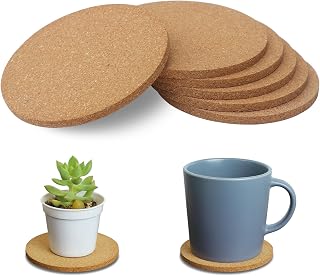 6Pcs Cork CoastersCheck price on Amazon
 100 pcs Cork Coasters for DrinksCheck price on Amazon
LaserEngraveHQ earns a commission from purchases made through these links, at no extra cost to you. Read our affiliate disclosure.
Cork vs slate coasters: the material difference
Cork is a bark product: light, soft, full of air. A laser chars it easily, which is why cork coasters take a mark at low power and high speed. The mark is a warm brown that darkens with power. Cork’s open texture also drinks up condensation, so a cold glass leaves no ring on the table. The Decopom listing states its coasters are thick, absorbent and heat-resistant, and the KFK listing states cork absorbs condensation better than plain plastic coasters.
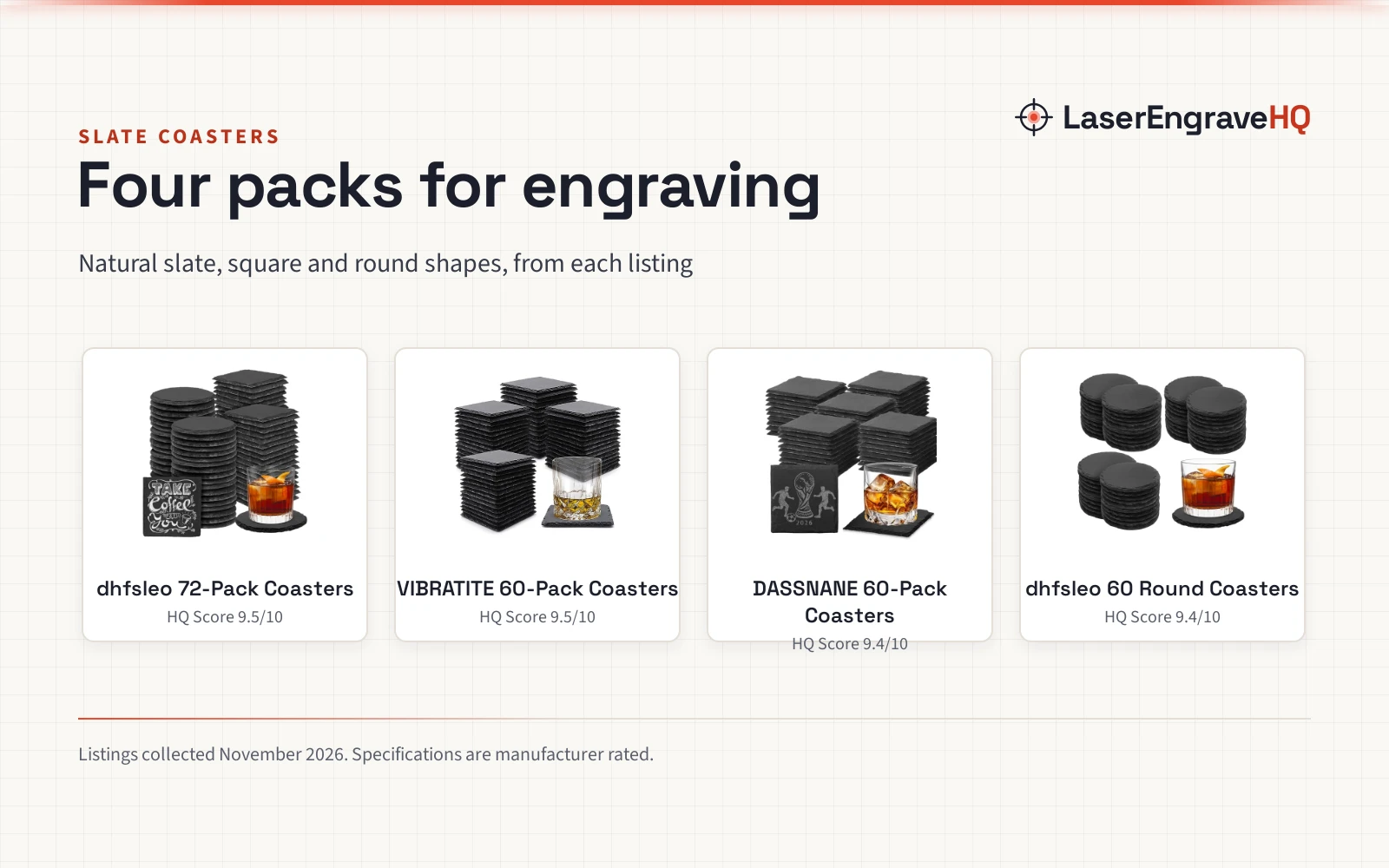
Slate is stone: dense, flat, heavy. A laser ablates the dark surface to reveal a pale gray-white layer underneath, giving the high-contrast engraved look that slate is known for. Slate does not absorb: condensation pools on it, so a slate coaster needs a felt or cork backing to protect the table. None of the three listings here is a slate set: the picks here are cork and cotton, which are the common affordable blanks.
How cork engraves
Cork is one of the most forgiving laser materials. It marks at low power, so start well below the settings used for wood and work up. The Decopom coasters are 4 inches in diameter and 0.2 inches thick; the KFK coasters are 4 inches and 1/5 inches thick. Thin cork chars through if the power is too high, so a settings check on one coaster is worth the cost. Cork dust is fine and light: run extraction or a fan, and keep a mask handy when cutting rather than engraving.
Cork takes detail well but not ultra-fine detail: the grain is coarse, so hairline text can break up. Bold lettering, simple logos and illustrations are the sweet spot. The Decopom set includes a metal holder with 16 coasters, which makes it a ready-made gift set once engraved; the KFK set is 6 coasters with no holder stated.
How slate engraves
Slate wants more power than cork and rewards it with contrast. The dark stone surface turns pale where the laser passes, so designs read clearly even from across the room. Slate is flat and consistent, which suits fine text and detailed graphics better than cork’s coarse grain. Work at higher power and lower speed than cork, and run a settings check: too much power craters the surface.
Slate dust is stone dust: extraction matters more than with cork, and a respirator is wise when cutting slate. Finished slate coasters are heavy and feel premium, which positions slate as the higher-priced option of the two. Seal the engraved mark if the coasters will see heavy use: a light coat of mineral oil or a stone sealer keeps the contrast crisp.
The three sets in this guide
The Decopom set is the cork pick here: 16 round 4-inch cork coasters with a metal holder, stated as thick, absorbent and heat-resistant. Sixteen blanks leave room for settings checks and mistakes, and the holder turns the finished set into a gift. The KFK set is the smaller cork option: 6 coasters, 4 inches, 1/5 inch thick, with no holder stated. It is the trial-run pack: enough to learn cork engraving without committing to sixteen.
The Lazebox set is the odd one out: 8 cotton and linen coasters, 4 inches, stated as absorbent and easy to clean. Cotton and linen mark on a laser like fabric, with a scorched-brown edge on the design. It is not a cork or slate set, but it shows how absorbent materials behave under the beam: they mark fast and dark, like cork, with even less resistance.
Cork vs slate coasters for selling
For a workshop selling engraved coasters, the two materials serve different customers. Cork sets are the volume product: lower-cost blanks, fast engraving, easy to personalize with names and dates. The Decopom 16-pack is built for this: engrave a set, drop it in the holder, sell it as a housewarming gift. Slate sets are the premium product: slower to engrave, heavier to ship, but the contrast sells them at higher prices.
Price the work by the material: cork blanks cost little, so the margin comes from volume and personalization. Slate blanks cost more and engrave slower, so price per piece accordingly. Either way, photograph the finished set on a table with a glass: buyers buy the look, not the laser settings.
Care and finishing
Cork coasters need no finishing: the Decopom and KFK listings both state hand wash only, and a damp cloth is enough. Do not soak cork: it swells and the engraved mark can fade. Slate coasters wipe clean with a damp cloth; the engraved mark is in the stone and does not wash off. Back slate coasters with felt or cork pads: bare stone scratches tabletops, which is the one real drawback of slate against cork’s soft touch.
Store blanks flat and dry. Cork warps if stored damp; slate chips if stacked without padding. The Decopom metal holder keeps finished cork sets tidy between sales.
Settings: where to start
Every machine differs, so treat these as starting points for a settings check, not recipes. On a diode laser, cork typically marks well at a fraction of wood settings: start low, run a power grid on a spare coaster and pick the cleanest cell. The 0.2-inch Decopom and 1/5-inch KFK coasters are thin, so power that is too high chars through. On slate, start higher: the mark should turn pale gray-white without cratering. On a fiber laser, slate marks fast and crisp at settings far below metal marking.
Speed matters as much as power. Cork rewards higher speed: the beam kisses the surface and moves on, leaving a clean brown mark without deep char. Slate rewards lower speed: the beam needs dwell time to ablate the surface. Run the grid in both dimensions, power and speed, on one spare coaster from the pack. The Decopom 16-pack and KFK 6-pack both leave spares for this.
Design tips for each material
On cork, keep designs bold. The coarse grain breaks up hairline text and fine crosshatching, so lettering should be chunky and illustrations simple. Monograms, house numbers, simple logos and short quotes are the cork sweet spot. On slate, go finer: the flat stone holds small text and detailed linework, so intricate designs and photo-style engraving read well. Chalk-style white-on-dark designs look native on slate.
Center the design with room to spare: a 4-inch coaster with a 3-inch design leaves a clean border. For sets, keep one design file and run it across the pack: consistency is what makes a set look professional. Number or initial the backs if the designs vary within a set, so the set stays matched.
Common mistakes to avoid
Running slate settings on cork: the power that marks slate chars straight through 0.2-inch cork. Running cork settings on slate: the mark barely shows. Skipping the settings check: every batch of blanks varies, and one wasted coaster is cheaper than a ruined set. Engraving without extraction: cork dust is light and slate dust is stone, and neither belongs in the air. Forgetting the backing: slate on a bare table scratches; cork does not, which is why cork wins the everyday-use argument.
FAQ: lasers and CNC
Which engraves faster, cork or slate?
Cork: it marks at low power and high speed. Slate needs more power and slower passes for its pale contrast mark.
Which absorbs condensation better?
Cork: the Decopom and KFK listings both state their cork coasters absorb moisture. Slate does not absorb; it needs a backing.
Which is better for fine detail?
Slate: its flat, dense surface holds fine text better than cork’s coarse grain.
Which should a beginner start with?
Cork: forgiving settings, cheap blanks and fast results. The KFK 6-pack is the low-commitment start.