Cast Acrylic vs Extruded Acrylic: Which One Should You Buy?
A practical guide comparing cast acrylic vs extruded acrylic for laser cutting and engraving, covering edge finish, engraving frost, melting risks, and project selection.

On this page
Top picks at a glance
As an Amazon Associate I earn from qualifying purchases.
- 1
 Pack of 10 Clear Cast Acrylic Sheet 8" x 10" x 1/8" Thick9.6/10View on Amazon
- 2
 Audab Acrylic Keychain Blanks Kit9.7/10View on Amazon
- 3
 Pack of 10 Clear Cast Acrylic Sheet 12" x 16" x 1/8" Thick9.6/10View on Amazon
- 4
 KINLINK 12x16 3mm 1/8" White Cast Acrylic Sheets PlasticView on Amazon
- 5
 Adrattnay Acrylic Sheets 1/8" ThickView on Amazon
- 6
 KAITELA Clear Cast Acrylic Sheet 12" x 16" x 1/4" ThickView on Amazon
- 7
 Colored Cast Acrylic SheetsView on Amazon
- 8
 KAITELA Clear Acrylic Sheet 3/8" Thick Cast Plexiglass PieceView on Amazon
- 9
 Duco 1/8" Clear Cast Acrylic SheetView on Amazon
When making edge-lit signs, keychains, display cases or decorative wall art, choosing between cast acrylic vs extruded acrylic determines your finished project quality. For crisp, frosty white engraving, choose cast acrylic: its high molecular weight vaporizes cleanly under a laser beam for sharp contrast. For consistent sheet thickness in slot-and-tab assemblies or simple cut letters with glass-smooth, flame-polished edges, choose extruded acrylic. The sections below explain the differences step by step.
Other machines to compare
 KINLINK 12x16 3mm 1/8" White Cast Acrylic Sheets PlasticCheck price on Amazon
 Adrattnay Acrylic Sheets 1/8" ThickCheck price on Amazon
 KAITELA Clear Cast Acrylic Sheet 12" x 16" x 1/4" ThickCheck price on Amazon
 Colored Cast Acrylic SheetsCheck price on Amazon
 KAITELA Clear Acrylic Sheet 3/8" Thick Cast Plexiglass PieceCheck price on Amazon
 Duco 1/8" Clear Cast Acrylic SheetCheck price on Amazon
LaserEngraveHQ earns a commission from purchases made through these links, at no extra cost to you. Read our affiliate disclosure.
Cast acrylic turns frosty white under a laser beam because its structure vaporizes directly into gas. Extruded acrylic softens at lower temperatures, producing a gummy, clear groove when engraved, but leaving naturally flame-polished, smooth edges when cut.
Step 1: Understand how manufacturing creates cast and extruded acrylic
The mechanical differences start in manufacturing. Cast acrylic, or cell cast acrylic, is produced by pouring liquid methyl methacrylate monomer between polished glass plates, allowing the material to polymerize and solidify slowly in a warm bath. This batch process yields long polymer chains, providing high molecular weight, structural stability, and optical clarity.
Extruded acrylic is manufactured continuously by feeding acrylic pellets into an extruder, melting the plastic, and pushing it through a die and rolling cylinders. This continuous process produces shorter polymer chains aligned in the direction of extrusion, lowering the softening point and creating directional stresses that react differently to laser heat.
Step 2: Compare engraving clarity and surface frost
Engraving clarity represents the clearest divide between the two materials. When a laser beam contacts cast acrylic, the plastic vaporizes without passing through a messy liquid stage. This reaction leaves a micro-textured, bright white frosted finish that catches light and provides sharp visual contrast. Makers producing illuminated night lights and plaques rely on cast stock for this reason. For instance, Senbota lists clear cast acrylic blanks sized at 5.9 x 5.1 inches with a 4mm (0.16 inches) thickness, including a 2.6 inch base slot and 0.5 inch depth designed to fit compatible LED night lamp bases.
Extruded acrylic reacts poorly to raster engraving. The beam melts the surface into an uneven, clear or grayish trough with tacky edges. If your projects center on engraved text or artwork, consult our guide to acrylic sheets for laser engraving.
Step 3: Compare laser cutting performance and edge finish
When cutting simple exterior shapes, extruded acrylic offers a distinct cosmetic benefit. Because extruded acrylic softens at a lower temperature, the focused laser beam melts the kerf edge, allowing the plastic to reflow and solidify into a smooth, glossy, flame-polished finish. For simple cutouts, perimeter letters, and display risers, this natural flame polish saves finishing labor.
Cast acrylic also cuts cleanly with crisp, sharp edges. While cast edges do not reflow into the same liquid gloss as extruded stock, cast acrylic vaporizes rather than liquefying, producing clean vertical walls without gummy buildup along the bottom of the cut. For larger cast panels, KAITELA lists clear cast sheets in a 12 x 16 inch size at 1/4 inch (6mm, 0.24 inches) thickness in a 4-pack, and 3/8 inch (10mm, 0.38 inches) sheets in a 1-pack. For cutting setup, read how to laser cut acrylic without melting edges and our best laser for cutting acrylic guide.
Step 4: Check thickness tolerance and joint assembly
Thickness tolerance is critical for joinery. Extruded acrylic passes through precision rollers during fabrication, which provides far more consistent sheet thickness across each panel than cell casting can achieve. If you build boxes, interlocking stands, or slot-and-tab assemblies where mortises must mate snugly with tenons, extruded acrylic significantly reduces the risk of loose joints or tight binding.
Cast acrylic lacks that dimensional consistency. Because liquid resin settles between glass plates, thickness varies across a single panel. A nominal 1/8 inch cast sheet can measure thicker along one side than the other. For flat crafts, this variation is harmless: KINLINK lists 12 x 16 inch white cast sheets at 3mm (1/8 inch, 0.13 inches) thickness in a 4-pack, and Adrattnay lists 8 x 8 inch cast sheets at 3mm (1/8 inch) thickness in a 20-pack with 20 colors. For interlocking tabs, measure stock with calipers first.
Step 5: Evaluate heat sensitivity and melting behavior
Heat behavior during laser cutting reveals the tradeoff behind that melted edge. The same low softening temperature that gives extruded acrylic a glossy edge can cause problems on detailed designs. On intricate cuts, tight corners, or narrow interior cutouts, excess heat accumulation causes extruded acrylic to melt across the kerf, fusing small dropouts back into the sheet. Achieving clean results on extruded stock requires dialed-in speed and gentle airflow to prevent re-welding without chilling the edge into a frosted finish.
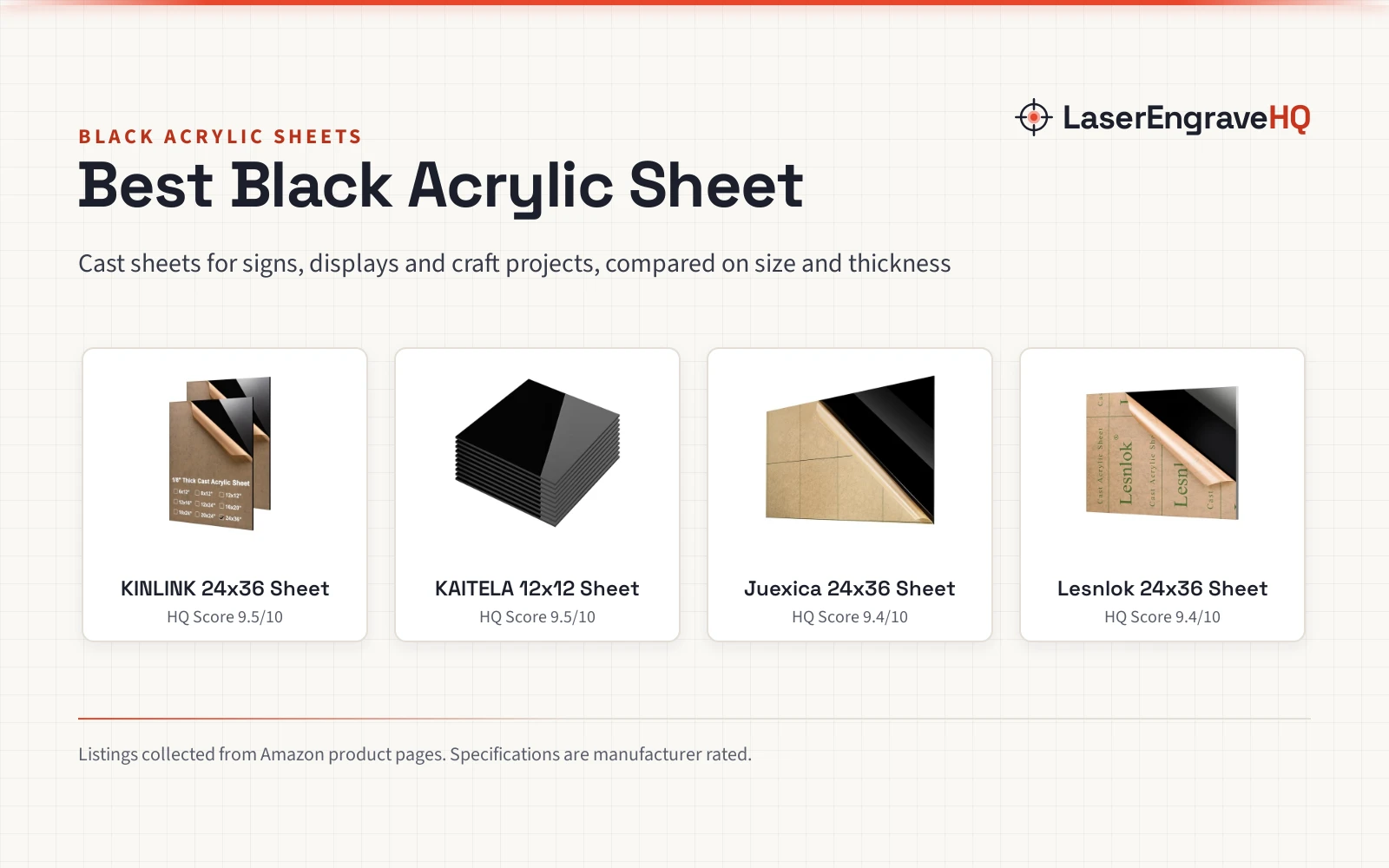
Cast acrylic handles concentrated laser heat with far greater stability. Because its high molecular weight causes it to vaporize directly into gas rather than pooling as a runny liquid, fine details and tight geometric cutouts drop free cleanly without re-fusing. For thin accents, Egofine lists black cast acrylic sheets measuring 8 x 10 inches at 1mm (0.04 inch) thickness in a 12-pack with 0% light transmittance that cut cleanly without edge curling. For large panels, CALPALMY lists 24 x 36 inch clear cell cast acrylic sheets at 1/4 inch (0.25 inches) thickness in a 2-pack. Not all acrylic sheets on the market are intended for laser processing: RNOAGCV lists 20 x 24 inch clear acrylic panels at 1/8 inch (3mm) thickness in a 2-pack, specifying hand tools, power saws, and mechanical engravers while advising against laser cutting.
Step 6: Account for workshop safety and ventilation
Cutting and engraving either acrylic type releases methyl methacrylate vapor, which carries a sharp odor and irritates respiratory passages without adequate exhaust. Always vent the laser cabinet outside with an inline blower or run an air cleaner from our fume extractor guide.
Fire risk requires active precautions. Acrylic is flammable and can ignite if a dropped scrap traps the beam. Run gentle air assist to clear vapors and suppress flare-ups without chilling cut edges (see our laser air assist guide), keep an extinguisher beside the bench (see our laser fire extinguisher guide), and never leave a cutting job unattended. Avoid hazardous plastics: PVC, vinyl, PVC faux leather, polycarbonate, and ABS release toxic hydrochloric fumes or melt unpredictably and must never enter a laser cabinet. For eye safety, wear rated safety glasses matching your beam, as outlined in our laser safety glasses guide.
Step 7: Choose the right acrylic sheet for your project
Pairing material characteristics with your specific product line prevents wasted blanks and speeds up production:
- Edge-lit signs and awards: Choose clear cast acrylic for frosty white engraving contrast. Senbota lists clear cast 5.9 x 5.1 inch blanks at 4mm (0.16 inches) thickness with a 2.6 inch base slot designed to fit compatible LED night lamp bases.
- Color tags, badges, and small gifts: Choose colored cast acrylic. YMYKLB offers 12 x 12 inch cast sheets at 3mm (1/8 inch) thickness in a 12-pack with 12 colors, weighing 2.5 pounds, while Adrattnay supplies 8 x 8 inch cast sheets at 3mm in a 20-pack with 20 colors.
- Opaque backplates and signage: Choose solid cast sheets. KINLINK lists white cast panels in a 12 x 16 inch 4-pack at 3mm (1/8 inch) with 0% light transmittance, and Egofine lists black cast sheets in an 8 x 10 inch 12-pack at 1mm (0.04 inch) thickness with 0% transmittance for opaque backdrops.
- Slot-and-tab boxes and precision assemblies: Choose extruded acrylic when joinery depends on consistent thickness across the sheet. The uniform gauge helps tabs seat securely into slots without binding. For large structural panels where thick cell cast stock is preferred, CALPALMY lists clear acrylic sheets in a 24 x 36 inch size at 1/4 inch (0.25 inches) thickness in a 2-pack.
To compare sheet selections across makers, see our roundup of the best acrylic sheets for laser cutting.
Common mistakes to avoid
- Attempting to engrave extruded acrylic when seeking a crisp, frosty white graphic.
- Designing tight slot-and-tab joinery in cast acrylic without verifying sheet thickness first.
- Cutting extruded acrylic with excessive heat or insufficient airflow, causing the kerf to fuse shut.
- Confusing acrylic with hazardous plastics like PVC, polycarbonate, or vinyl.
- Leaving the laser machine unattended while running thick acrylic cutting jobs.
Cast acrylic vs extruded acrylic: the short version
- Identify whether your project centers on engraved artwork or precision joinery.
- Pick cast acrylic for high-contrast, frosty white engraving on signs and awards.
- Pick extruded acrylic for uniform sheet thickness in slot-and-tab assemblies.
- Use extruded acrylic when you need naturally flame-polished, glossy cut edges.
- Check cast stock with calipers prior to cutting interlocking tabs.
- Maintain gentle air assist and proper exhaust ventilation on every cut.
Matching your design to the right acrylic stock keeps scrap low and workflow predictable.
FAQ: lasers and CNC
Can a diode laser cut clear cast or extruded acrylic?
No. Visible diode laser beams pass straight through clear acrylic without absorption, regardless of whether the sheet is cast or extruded. A CO2 laser is necessary to cut or engrave clear acrylic because its beam wavelength is absorbed by the plastic. Diode lasers can only process select opaque acrylic colors, such as black, that absorb visible light, and makers generally recommend CO2 lasers for cutting sheet acrylic cleanly.
Why does cast acrylic turn white when engraved?
Cast acrylic features high molecular weight polymer chains that vaporize directly into fine particles when struck by a laser. This leaves a textured crater that scatters light, creating a crisp, snowy white frosted finish.
Why does extruded acrylic get sticky when laser cut?
Extruded acrylic has shorter polymer chains and a lower softening point. The laser beam liquefies the plastic rather than vaporizing it directly into gas. If cutting speed is too slow or heat accumulates in the cut, the molten edges become tacky and can re-weld before cooling.
Which acrylic is better for slot-and-tab construction?
Extruded acrylic is generally preferred for slot-and-tab construction because rolling dies produce tighter thickness consistency across the sheet. Cast acrylic exhibits natural thickness variations across a single panel, so slot-and-tab joints often require measuring the stock with calipers and adjusting kerf offsets in your vector files.
Can I cut cast and extruded acrylic with a CNC router?
Yes. Both materials can be machined on a CNC router using spiral end mills designed for plastics. Cast acrylic chips cleanly, while extruded acrylic requires careful feed control to prevent the plastic from melting onto the bit.
How do I tell cast acrylic from extruded acrylic if the label is missing?
Perform a quick sample engraving on a scrap corner. If the raster pass yields a bright, frosty white mark, the material is cast acrylic. If the pass leaves a clear, melted depression, the material is extruded acrylic.
Related: the engraving materials hub, best acrylic sheets for laser cutting and best laser for cutting acrylic. Also see our guide on how to laser cut acrylic without melting edges. Also see our best acrylic sheet guide.