PETG vs ASA Filament: Which One Should You Buy?
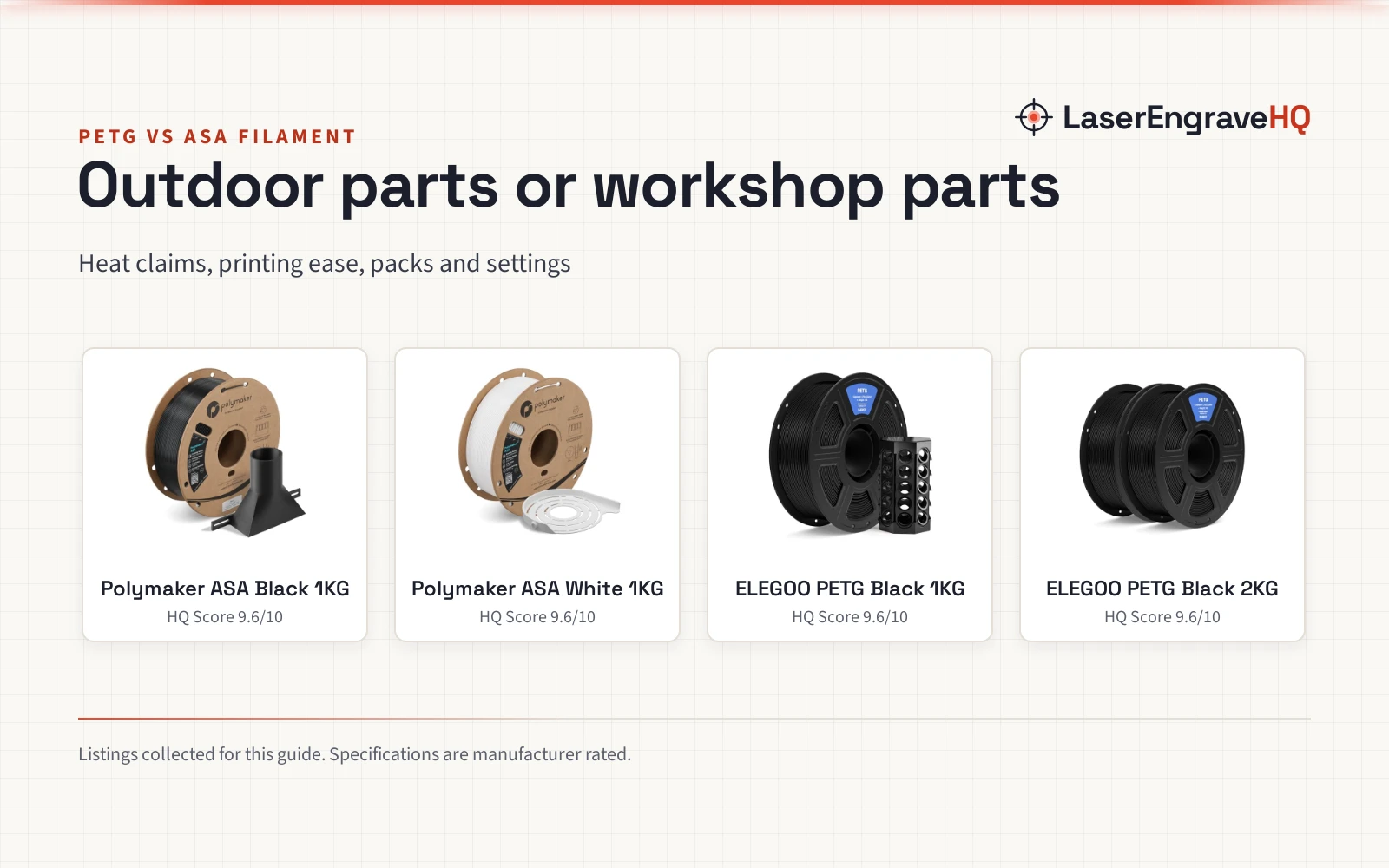
Two PETG and two ASA filament spools compared on outdoor and heat claims, printing ease, diameter accuracy, pack size and stated print settings.

On this page
Top picks at a glance
As an Amazon Associate I earn from qualifying purchases.
- 1
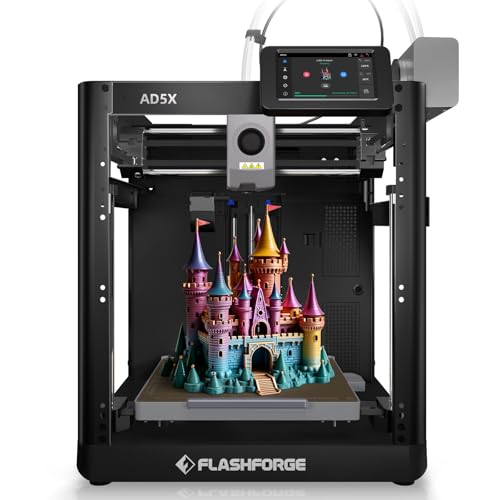 FLASHFORGE AD5X Multi-Color & Material 3D Printer with IFS9.7/10View on Amazon
- 2
 Polymaker ASA Filament 1.75mm Black 1KG9.6/10View on Amazon
- 3
 Mintion 3D Printer Filtration System for Bambu Lab P1S/X1C &9.6/10View on Amazon
- 4
 OVERTURE High Speed PETG Filament 1.75mmView on Amazon
- 5
 OVERTURE 4KG Bundle High Speed PETG Filament 1.75mmView on Amazon
- 6
 SUNLU High Speed PETG Filament 1.75mm 4KGView on Amazon
- 7
 SUNLU PETG Filament 1.75mmView on Amazon
- 8
 Creality PETG Filament 1.75mmView on Amazon
- 9
 OVERTURE ASA Filament 1.75mmView on Amazon
A part for outdoor use and a bracket for the workshop ask different things from a spool. This comparison looks at petg vs asa filament through four listings, two on each side, and opens with the short version: pick the ASA examples for outdoor functional parts, where the listings state UV and weather resistance, and pick the PETG examples for mechanical parts, holders and clamps, where the listings stress minimal warping and smooth printing.
LaserEngraveHQ earns a commission from purchases made through these links, at no extra cost to you. Read our affiliate disclosure.
Verdict: the ASA examples suit outdoor functional parts, with UV and weather resistance and heat resistance up to 100˚C (212°F) stated on the listing. The PETG examples suit mechanical parts, holders and clamps, with minimal warping and shrinkage and smooth printing stressed on the listing. Neither side states the other side’s headline figures, so choose by the job, not by a single number.
Machines on the list
Polymaker ASA Filament 1.75mm Black 1KG
A black 1kg ASA filament spool at 1.75mm, stating UV and weather resistance, heat resistance up to 100˚C (212°F), and print settings of nozzle temperature 250˚C, bed temperature 90˚C and speed 50mm/s.
Pros
- UV and weather resistant, for outdoor functional parts
- Heat resistance up to 100˚C (212°F) stated on the listing
- Stated print settings: nozzle 250˚C, bed 90˚C, speed 50mm/s
- Strength, rigidity and reliable layer adhesion stated for functional parts
Cons
- Large parts need an enclosed printer to prevent warping, per the listing
- No printer compatibility list stated
- No warranty term stated; the listing offers lifetime technical support instead
- Settings point readers to standard ABS filament settings for adjustment

Polymaker ASA Filament 1.75mm White 1KG
A white 1kg ASA filament spool at 1.75mm, stating UV and weather resistance, heat resistance up to 100˚C (212°F), and print settings of nozzle temperature 250˚C, bed temperature 90˚C and speed 50mm/s.
Pros
- UV and weather resistant, for outdoor functional parts
- Heat resistance up to 100˚C (212°F) stated on the listing
- Stated print settings: nozzle 250˚C, bed 90˚C, speed 50mm/s
- Strength, rigidity and reliable layer adhesion stated for functional parts
Cons
- Large parts need an enclosed printer to prevent warping, per the listing
- No printer compatibility list stated
- No warranty term stated; the listing offers lifetime technical support instead
- White color choice only; no pack option beyond 1kg stated
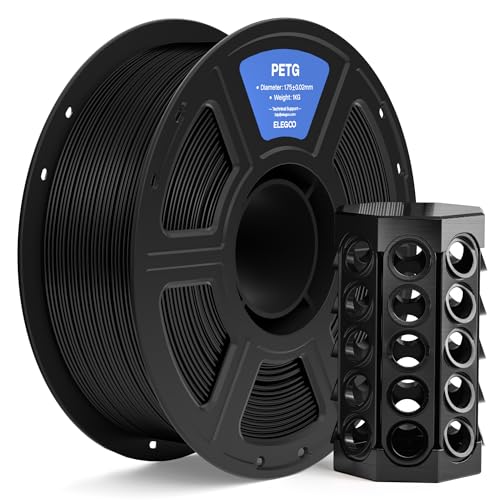
ELEGOO PETG 3D Printer Filament 1.75mm Black 1KG
A black 1kg PETG filament spool at 1.75mm, stating diameter accuracy of +/- 0.02 mm, minimal warping and shrinkage, and universal compatibility with most 1.75 mm FDM 3D printers.
Pros
- Diameter accuracy of +/- 0.02 mm stated on the listing
- Smooth printing with minimal warping and shrinkage stated
- Full mechanical winding and manual inspection to reduce tangles and snaps
- Dried before packing and vacuum sealed against moisture and dust
Cons
- No UV, weather or heat figure stated
- No nozzle, bed or speed figures stated
- No warranty term stated
- Use as soon as possible after unpacking, per the listing

ELEGOO PETG 3D Printer Filament 1.75mm Black 2KG
A black 2KG PETG filament pack with two 1kg spools at 1.75mm, stating diameter accuracy of +/- 0.02 mm, minimal warping and shrinkage, and universal compatibility with most 1.75 mm FDM 3D printers.
Pros
- Two 1kg spools in one pack for longer runs
- Diameter accuracy of +/- 0.02 mm stated on the listing
- Smooth printing with minimal warping and shrinkage stated
- Dried before packing and vacuum sealed against moisture and dust
Cons
- No UV, weather or heat figure stated
- No nozzle, bed or speed figures stated
- No warranty term stated
- Same filament as the single spool, so no new performance claim
Other machines to compare
 OVERTURE High Speed PETG Filament 1.75mmCheck price on Amazon
 OVERTURE 4KG Bundle High Speed PETG Filament 1.75mmCheck price on Amazon
 SUNLU High Speed PETG Filament 1.75mm 4KGCheck price on Amazon
 SUNLU PETG Filament 1.75mmCheck price on Amazon
 Creality PETG Filament 1.75mmCheck price on Amazon
 OVERTURE ASA Filament 1.75mmCheck price on Amazon
Side by side
| Model | HQ Score | Diameter | Pack size | Heat and weather notes |
|---|---|---|---|---|
| Polymaker ASA Black 1KG | 9.6/10 | 1.75mm | 1kg | Up to 100˚C (212°F); UV and weather resistant |
| Polymaker ASA White 1KG | 9.6/10 | 1.75mm | 1kg | Up to 100˚C (212°F); UV and weather resistant |
| ELEGOO PETG Black 1KG | 9.6/10 | 1.75mm | 1kg (2.2lbs) | Not stated |
| ELEGOO PETG Black 2KG | 9.6/10 | 1.75mm | Two 1kg spools | Not stated |
Specifications are manufacturer rated, as published on each listing and collected for this guide. A figure from one listing describes that listing only.
PETG vs ASA filament: what separates the two sides
Heat, weather and outdoor use
The ASA listings state UV and weather resistance, less proneness to environmental stress cracking, and heat resistance up to 100˚C (212°F), with outdoor applications such as RC planes and car accessories named. The PETG listings state no UV figure, no weather figure and no heat figure, so the two sides cannot be ranked on heat or weather from the PETG listings alone. On the stated figures, only the ASA examples carry an outdoor claim, while the PETG examples make no outdoor claim at all.
Printing ease and warping
The PETG listings stress a smooth printing process with minimal warping and shrinkage, superior layer adhesion, and consistent feeding from a diameter accuracy of +/- 0.02 mm. The ASA listings name reliable layer adhesion too, but add that large parts need an enclosed printer to prevent warping, and point readers to standard ABS filament settings. The contrast is plain: the PETG listings present easy printing as a headline point, while the ASA listings attach a condition for large parts.
Diameter, packs and compatibility
All four listings state 1.75mm filament. The PETG side offers a single 1kg spool at 2.2lbs and a 2KG pack with two 1kg spools, while the ASA side offers 1kg spools in black and white. The PETG listings claim universal compatibility with most 1.75 mm FDM 3D printers and name Neptune, Ender, Adventurer and Kobra series. The ASA listings give no printer compatibility list and instead say to adjust settings as needed per printer.
Settings the listings state
Only the ASA listings state print settings: nozzle temperature 250˚C, bed temperature 90˚C, and speed 50mm/s. The PETG listings state no nozzle, bed or speed figures, so settings cannot be compared across the two sides from the listings alone. The ASA listings also describe the filament as combining the properties of ABS with added weather resistance, while the PETG listings describe the filament as combining the best properties of PLA and ABS.
Choose the PETG examples if
- You print mechanical parts, holders and clamps and want the minimal warping and shrinkage the PETG listings stress.
- You want a diameter accuracy of +/- 0.02 mm stated on the listing.
- You want a two-spool 2KG pack option for longer runs of the same filament.
Choose the ASA examples if
- You print outdoor functional parts and want the UV and weather resistance stated on the ASA listings.
- You want stated print settings, at nozzle temperature 250˚C, bed temperature 90˚C and speed 50mm/s.
- You want heat resistance up to 100˚C (212°F) stated on the listing.
For large ASA parts, use an enclosed printer to prevent warping, as the ASA listings advise. On the PETG side, the listings state the filament is dried before packing and vacuum sealed, and advise using it as soon as possible after unpacking and drying it completely before using again. See the enclosed vs open 3D printer guide and the best filament dryer for PETG.
Project Match
- Outdoor functional parts, RC planes and car accessories: the Polymaker ASA examples, whose listings state UV and weather resistance.
- Mechanical parts, holders, clamps and printer parts: the ELEGOO PETG examples, whose listings name those uses and stress durability and high impact resistance.
- Functional prototypes, brackets, housings and replacement parts: the Polymaker ASA examples, whose listings name those uses and stress strength and rigidity.
- Longer runs of one PETG filament: the ELEGOO PETG 2KG pack, with two 1kg spools stated on the listing.
- Parts where the listing states no outdoor or heat figure: Not stated for the PETG examples, so do not assume outdoor or heat performance from those listings.
FAQ: lasers and CNC
Can PETG filament be used outdoors?
These listings give no basis for outdoor use: the PETG listings state no UV figure and no weather figure, while the ASA listings state UV and weather resistance for outdoor applications. For outdoor functional parts, the ASA examples carry the stated claim.
What print settings do the ASA listings state?
Nozzle temperature 250˚C, bed temperature 90˚C, and speed 50mm/s, with a note to adjust as needed per printer and to refer to standard ABS filament settings. The PETG listings state no nozzle, bed or speed figures.
Does PETG need an enclosed printer?
The PETG listings do not call for an enclosed printer; they stress minimal warping and shrinkage instead. The enclosed-printer note sits on the ASA side, for large parts, to prevent warping.
What pack sizes are listed?
The PETG side lists a single 1kg spool at 2.2lbs and a 2KG pack with two 1kg spools. The ASA side lists 1kg spools in black and white.
Do both sides fit most FDM printers?
The PETG listings claim universal compatibility with most 1.75 mm FDM 3D printers. The ASA listings give no compatibility list and say to adjust settings as needed per printer, so check the listing for the printer in hand.
Related: ABS vs ASA filament, PETG vs ABS filament, best PETG filament for outdoor use and the FDM 3D printers hub.