PLA vs PETG Filament: Which One Should You Buy?
A maker-first comparison of PLA and PETG for FDM printing, with four PLA spools and their stated settings.

On this page
PLA vs PETG filament is a choice between easy printing and tougher parts. PLA prints with less fuss on most FDM machines, while PETG suits functional parts that need more durability and resistance to the elements. The sections below compare ease of printing, strength, finish and storage, then list PLA spools with stated specs.
As an Amazon Associate I earn from qualifying purchases. LaserEngraveHQ earns a commission from purchases made through these links, at no extra cost to you. Read our affiliate disclosure.
PLA vs PETG filament at a glance
PLA is the easy starter material. SUNLU describes its PLA as reliable, versatile and easy to use, and ELEGOO describes its PLA as having a lower melting temperature with low warp and shrinkage. PETG asks for more care at the printer but rewards it with parts that hold up better under load and outdoors. Neither material fits every job, so match the material to the part.
| Question | PLA | PETG |
|---|---|---|
| Ease of printing | Easy, low warp, forgiving setup | Needs more care with adhesion and stringing |
| Strength | Good for display models and decorative items | Better for functional parts and outdoor use |
| Finish | Smooth or matte, depending on the spool | Glossy by nature, layer lines show more |
| Storage | Keep sealed and dry | Keep sealed and dry |
Ease of printing
PLA earns its reputation as a beginner material from the listings themselves. SUNLU describes its PLA as reliable, versatile and easy to use, with excellent layer adhesion, and ELEGOO calls its PLA ideal for beginners. The stated settings back that up: SUNLU PLA lists a nozzle temperature of 200-230°C, a bed temperature of 50-65°C and a printing speed of 50-100mm/s, while SUNLU PLA+ 2.0 lists a nozzle temperature of 205-220°C, a bed temperature of 50-60°C and a print speed of 100-300mm/s. PETG generally prints hotter and sticks harder to the bed, so bed preparation and retraction settings matter more. For a first spool, PLA removes variables. For later spools, PETG rewards patience.
Strength and use
PLA suits models, prototypes, miniatures and decorative items. SUNLU PLA+ 2.0 is described as more resistant to brittleness and cracking than standard PLA+ filament, which makes it the stronger PLA pick here for functional parts. OVERTURE Matte PLA is aimed at prints needing high visual quality and fine surface detail. PETG fits parts that need more give before breaking than PLA, hold a load, or sit outdoors. When a part must survive handling, drops or weather, PETG is the usual pick. When a part sits on a shelf, PLA is enough.
Finish and detail
Finish is where spool choice matters as much as material choice. OVERTURE Matte PLA gives a frosted, gloss-free finish that conceals layer lines, which suits display pieces and prototypes shown to clients. ELEGOO PLA is described as giving a glossy surface with strong layer adhesion. SUNLU PLA promises smooth printing with neat winding, and SUNLU PLA+ 2.0 is aimed at high-precision models as well as functional parts and decorative items. PETG tends toward a glossy finish where layer lines stay visible, so it suits working parts more than show pieces.
Storage and handling
Filament and moisture do not mix. SUNLU PLA+ 2.0 spools are sealed in airtight vacuum packaging to stay moisture-free, and ELEGOO PLA is dried before packaging and vacuum sealed to protect against moisture. OVERTURE states a 1-year shelf life for unopened spools where proper storage is required. Keep every spool sealed until printing, and dry a spool that has sat open. PETG also absorbs moisture, so sealed storage matters at least as much for PETG as for PLA.
PLA spools in this guide
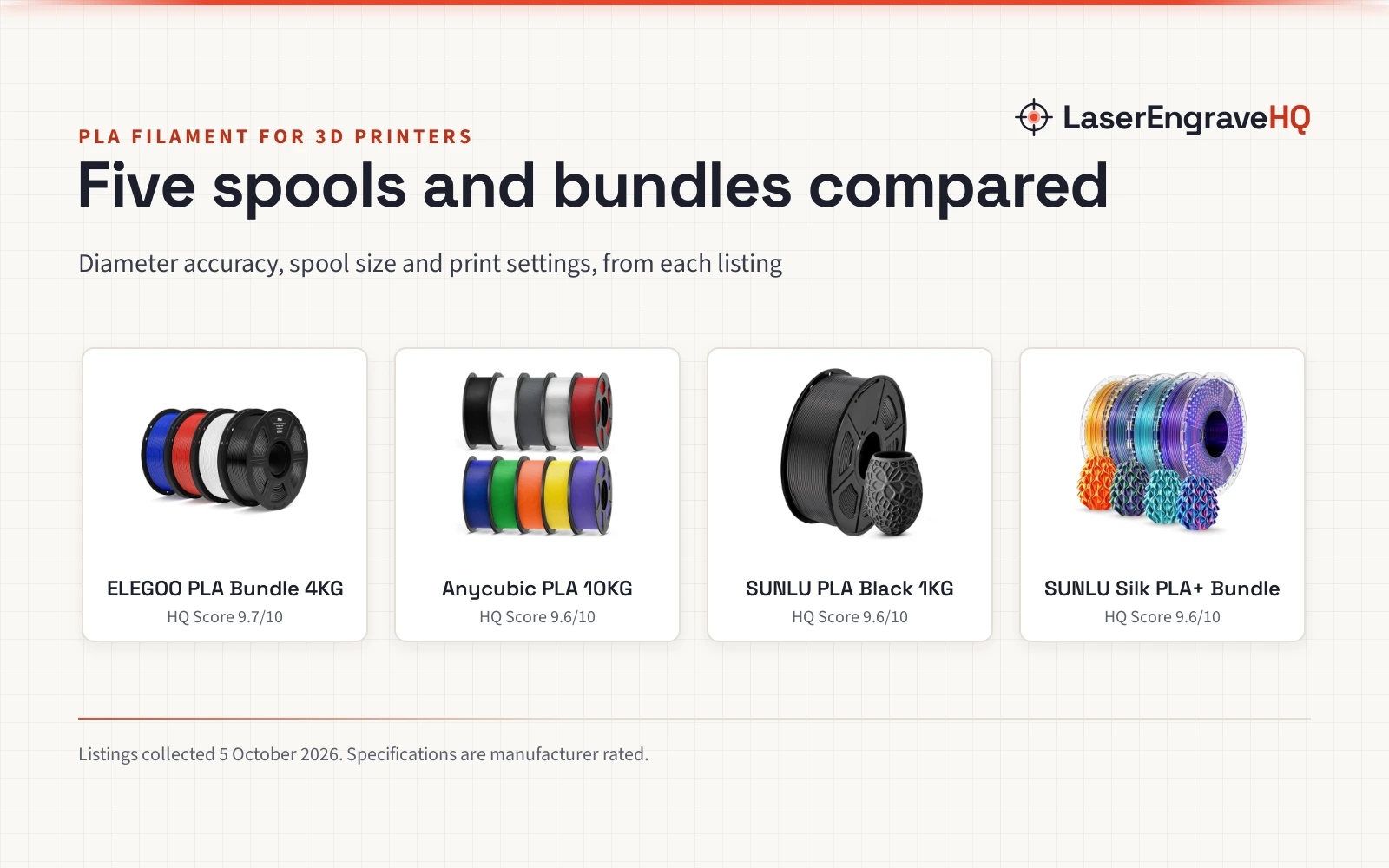
The gear section below lists PLA spools only, ranked by stated specs: print speed, toughness claims, warranty terms and pack variety. Read each listing for the full setting range before buying.
SUNLU PLA+ 2.0, 4-pack
The strongest PLA pick here. The listing states 1.75mm filament with dimensional accuracy of +/- 0.02mm, a nozzle temperature of 205-220°C, a bed temperature of 50-60°C and a print speed of 100-300mm/s. The pack holds 4 spools of 1 kg each, each spool measuring 195mm in diameter, 57mm in width, with a 63mm hub hole. SUNLU describes the filament as more resistant to brittleness and cracking than standard PLA+ filament, and states a 1 year warranty. It suits makers who print functional parts and decorative items and want faster printing. Its limitation is pack size: the listing sells 4 spools together, so a maker who wants a single spool should look elsewhere.
ELEGOO PLA bundle, 4-pack
The variety pick. The bundle holds 4 spools of 1 kg each in Black, White, Dark Blue and True Red, all at 1.75mm with dimensional accuracy of +/- 0.02mm. ELEGOO describes the filament as having a lower melting temperature, low warp and shrinkage, and an odorless print, with each spool neatly wound and dried before packaging. The listing states a 30-day term for quality problems. It suits makers who print in several colors and want an easy setup. Its limitation is the short quality-problem term compared with the 1 year terms stated on other spools here.
SUNLU PLA, 1 kg, Black
The single-spool starter pick. The listing states 1.75mm filament with dimensional accuracy of +/- 0.02mm, a nozzle temperature of 200-230°C, a bed temperature of 50-65°C and a printing speed of 50-100mm/s. The spool measures 8.00 inches in diameter, 2.50 inches in width, with a 2.20 inch hub hole. SUNLU describes the filament as reliable, versatile and easy to use, with neat winding that reduces tangles and jams. It suits a beginner buying a first spool or a maker who needs black only. Its limitation is print speed: the stated top speed sits at the bottom of the PLA+ 2.0 range.
OVERTURE Matte PLA, 1 kg, Matte Light Brown
The finish pick. The listing states 1.75mm filament with dimensional accuracy of +/- 0.02mm and a weight of 1 kg (2.2lbs). OVERTURE describes a frosted matte finish that conceals layer lines, excellent bed adhesion, improved overhang performance and easy removal of rafts, brims and tree supports. The listing states a 1-year shelf life for unopened spools where proper storage is required, and a 1-year warranty. It suits display prints, models and prototypes where surface quality matters. Its limitation is color range in this listing: only Matte Light Brown is listed here.
Which one should you buy
Buy PLA when the part is a model, a prototype or a decorative item and ease of printing matters most. Buy PETG when the part must take handling, load or outdoor exposure. Makers who own one printer and print for fun can stay with PLA for a long time. Makers who sell functional parts should learn PETG early, since it opens jobs PLA cannot hold. For more comparisons, see PLA vs ABS filament and PETG vs ABS filament. For a first machine, see best beginners 3D printer.
FAQ: lasers and CNC
Is PLA or PETG better for beginners?
PLA. SUNLU describes its PLA as ideal for beginners and experienced users, and ELEGOO calls its PLA ideal for beginners, with low warp and easy setup.
Does PETG need different settings than PLA?
Yes. PETG generally prints hotter and needs more bed preparation than PLA. Check the spool listing for its stated range: the PLA listings here state nozzle temperatures of 200-230°C and 205-220°C, with bed temperatures of 50-65°C and 50-60°C.
Can PLA parts go outdoors?
PLA suits indoor display models and decorative items. For parts that sit outdoors or take loads, PETG is the better pick, since it holds up better under handling and weather.
How should filament be stored?
Sealed and dry. SUNLU PLA+ 2.0 is vacuum packed to stay moisture-free, ELEGOO PLA is dried before packaging and vacuum sealed, and OVERTURE states a 1-year shelf life for unopened spools where proper storage is required.
Which spool is the best value in this guide?
The 4-packs hold the most filament: SUNLU PLA+ 2.0 and ELEGOO PLA each hold 4 spools of 1 kg. A maker who prints often or in several colors gets more material per order from a 4-pack than from a single 1 kg spool.
Related: PLA vs TPU filament, filament dryer vs food dehydrator and enclosed vs open 3D printer. Also see best beginners 3D printer.