10w vs 30w Diode Laser: Which One Should You Buy?
A 10W diode laser engraves and cuts thin stock; a 30W cuts faster and deeper, so choose by the materials and thicknesses you plan to run.

On this page
Top picks at a glance
As an Amazon Associate I earn from qualifying purchases.
- 1
 CREALITY FALCON 10w Laser Engraver with Air Assist9.6/10View on Amazon
- 2
 SCULPFUN iCube Ultra Dual 1.2W IR and 12W Diode Laser Engraver9.4/10View on Amazon
- 3
 AtomStack Kraft Enclosed Dual Laser Cutter9.4/10View on Amazon
- 4
 ATOMSTACK 10W Laser EngraverView on Amazon
- 5
 Creality Falcon 10W Laser Engraver MachineView on Amazon
- 6
 LASER TREE Laser Engraving ModuleView on Amazon
- 7
 80W Laser Module with Air AssistView on Amazon
- 8
 LaserPecker LP2 Plus SpinTrack BundleView on Amazon
- 9
 WECREAT Vista 10W Laser Engraving Machine with 9-in 1 RotaryView on Amazon
Want to sell engraved cutting boards and leather patches, or cut thicker parts for a small product line? The 10w vs 30w diode laser question is really about what you plan to cut: both powers engrave wood, leather, dark acrylic and similar materials, while 30W cuts thicker stock and does it faster. Start from your thickest planned material, not the engraving, because cutting is what separates the two.
Other machines to compare
 ATOMSTACK 10W Laser EngraverCheck price on Amazon
 Creality Falcon 10W Laser Engraver MachineCheck price on Amazon
 LASER TREE Laser Engraving ModuleCheck price on Amazon
 80W Laser Module with Air AssistCheck price on Amazon
 LaserPecker LP2 Plus SpinTrack BundleCheck price on Amazon
 WECREAT Vista 10W Laser Engraving Machine with 9-in 1 RotaryCheck price on Amazon
LaserEngraveHQ earns a commission from purchases made through these links, at no extra cost to you. Read our affiliate disclosure.
10w vs 30w diode laser: the practical difference
Optical watts are the number that matters: 10W optical and 30W optical both engrave, but the 30W machine pushes more energy into each pass, so it cuts deeper and moves faster through the same material. A 10W diode handles engraving on wood, leather, dark acrylic, glass and coated metals, plus thin cuts in a few passes. The step up to 30W buys shorter cut times and thicker single-pass cuts, which matters once you batch parts.
What 10W handles well
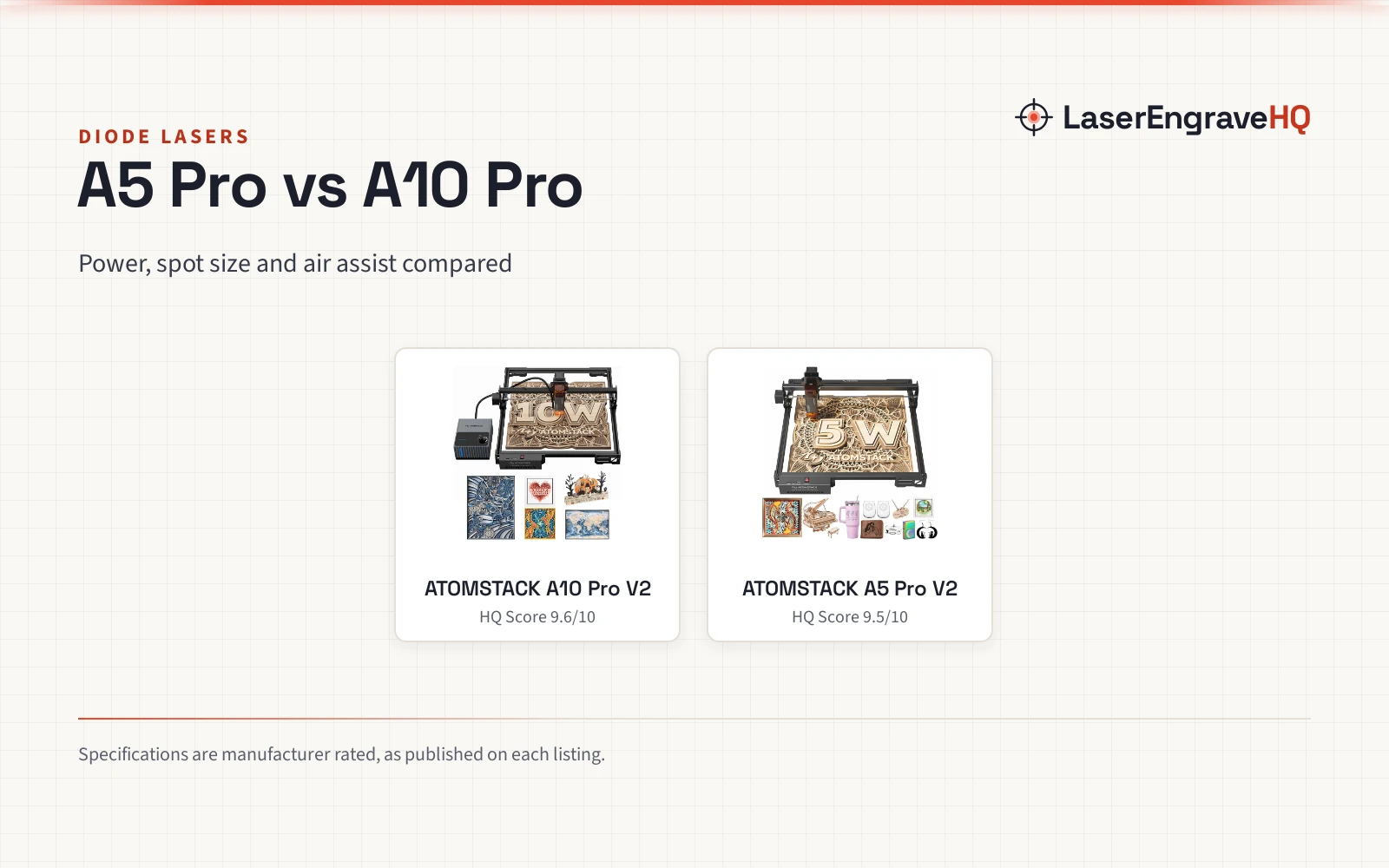
The two 10W listings below show the class: the ATOMSTACK A10 Pro V2 lists 10W optical output with a 0.06 x 0.08 mm spot, a 410 x 380 mm work area and speeds up to 400 mm/s, plus a 60W machine power figure for the electrical side. The Creality Falcon lists 10W optical with a 0.06 x 0.06 mm spot, a 400 x 415 mm area and 10000 mm/min speed, alongside a 72W figure that reads as input power. Both pair with LightBurn, and both ship eye protection: the ATOMSTACK a magnetic cover and glasses, the Creality an anti-UV acrylic filter and goggles.
Expect engraving on wood, leather, dark acrylic, glass and coated metal, and cuts in thin wood and dark acrylic with multiple passes. If your thickest job is thin stock and your runs are short, 10W is the economical pick.
What 30W adds
The jump to 30W is about cutting, not engraving quality: the same jobs get done with fewer passes and in less time, and thicker stock becomes practical. That pays off for sellers who cut parts in batches or take orders for thicker signs and panels. The trade is a bigger machine, more heat to manage and a higher draw on your power setup.
If you only engrave and never cut, 30W buys you little. Match the power to the cut list, not the wishlist. A 30W machine also keeps more headroom for dense hardwoods and dark acrylic that a 10W would fight.
Gear for the 10W route
Both listings here are 10W machines, ranked by what they state. The ATOMSTACK A10 Pro V2 leads: it bundles a 60 L/min air assist pump, an R6 rotary roller with 180-degree tilt and 360-degree rotation, 100 mm riser pads, and a 1 year warranty, at 20.5 pounds. Air assist is the single most useful cutting extra, since it clears smoke and lowers charring.
The Creality Falcon is the lighter, simpler 10W: 10.93 pounds, SD card offline creation, and support for LightBurn and LaserGRBL. Watch the power figures: the listing names 10W optical output next to a 72W figure, which reads as input power. No warranty term is stated.
Safety for cutting work
Cutting makes more smoke and more fire risk than engraving. Ventilate the workspace, keep a suitable extinguisher within reach and never leave a running job unattended. Keep the workspace clear of sawdust and offcuts, and let the machine cool between long cutting runs. Use eyewear only if its listing states an optical density and a wavelength range that matches your laser. Never laser PVC, vinyl, PVC-based faux leather, polycarbonate or ABS.
FAQ: lasers and CNC
Is 30W twice as fast as 10W?
Not exactly, and the listings do not give a formula. More optical power means deeper cuts per pass and higher speeds, but the real numbers depend on the material and the machine. Treat 30W as meaningfully faster at cutting, not as a strict multiple. Neither listing here is a 30W machine, so compare 30W models by their own stated cut depths, not by scaling the 10W numbers.
Can a 10W diode laser cut wood?
Yes, within limits. The ATOMSTACK listing names 10 mm basswood in fewer passes, and the Creality names 12 mm wood boards in one pass. Thicker stock takes more passes or a stronger machine.
Do I need air assist?
For cutting, it helps a lot: the ATOMSTACK bundle includes a 60 L/min pump that clears smoke and reduces charring. For engraving-only work it matters less. The Creality listing does not name an air assist pump, so plan for one if you cut often.
Which software works with these lasers?
Both listings name LightBurn; the Creality also names LaserGRBL and supports offline creation from an SD card. Confirm your operating system on the listing before you buy.
What materials should a diode laser never run?
Never laser PVC, vinyl, PVC-based faux leather, polycarbonate or ABS: they can release harmful fumes and damage the machine. When in doubt, check the material against the maker guidance first.
Related: the laser engraver hub, best laser engraver for small business and how to choose a laser engraver.