1/4 vs 1/2 Shank Router Bits: Which One Should You Buy?
1/4 vs 1/2 shank router bits: what the shank size changes, when each is the right pick, how to read a bit listing, and four 1/4 inch shank sets ranked.


On this page
Top picks at a glance
As an Amazon Associate I earn from qualifying purchases.
- 1
 SpeTool Carbide Single Flute CNC Router Bits 1/8" Cutting9.7/10View on Amazon
- 2
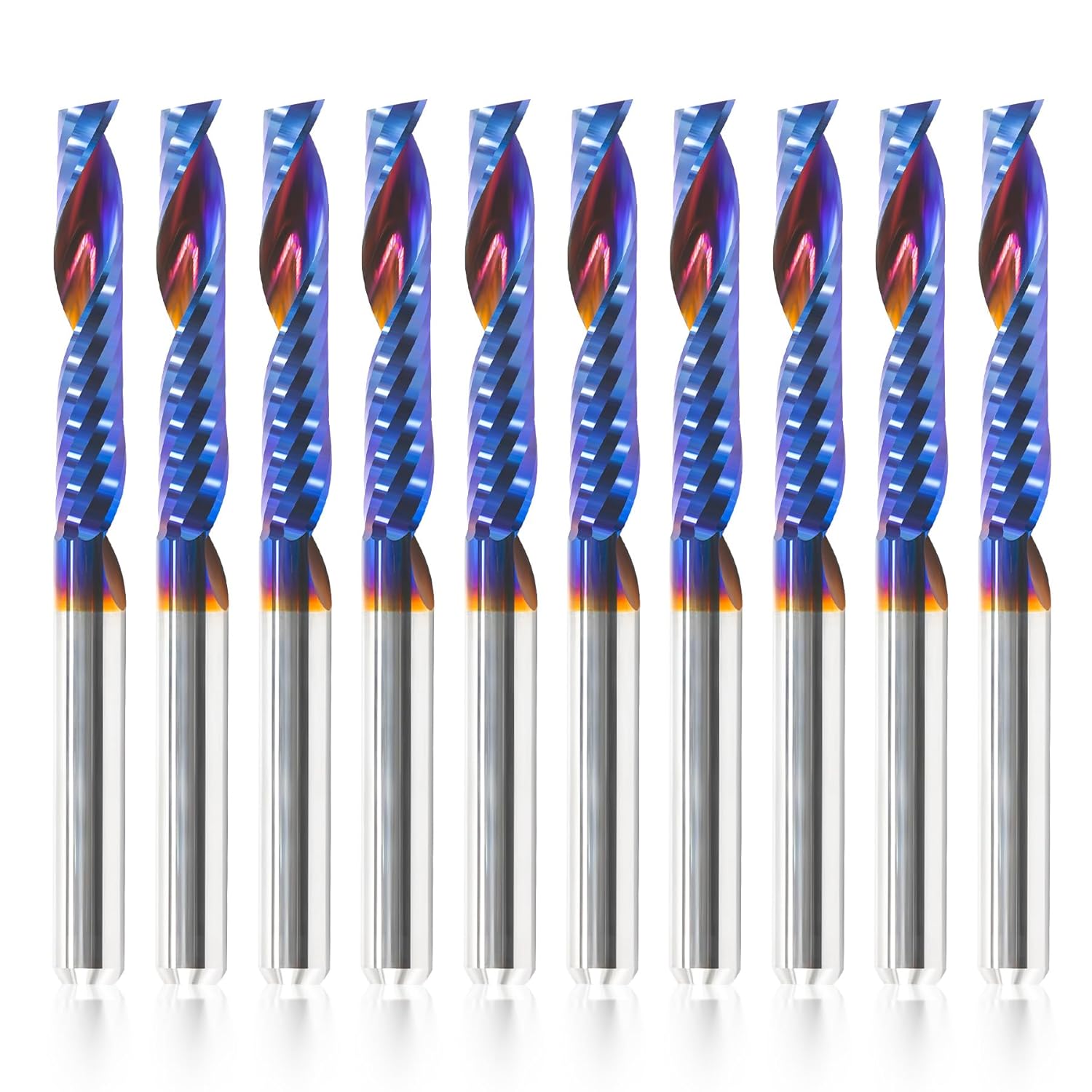 HQMaster 1/8" Shank O Flute CNC Router Bits9.6/10View on Amazon
- 3
 90 Degree V Groove Router Bit 1/4 Inch Shank9.6/10View on Amazon
- 4
 Router Bits Sets of 35B Pieces 1/4 Shank Router Bit Set TView on Amazon
- 5
 CNC Spoilboard Surfacing Router BitView on Amazon
- 6
 LU&MN Carbide Tipped Router Bit SetView on Amazon
- 7
 6Pcs Straight Router Bit Set 1/4 ShankView on Amazon
- 8
 Junreox 4PCS Flush Trim Route Bit 1/4 Shank with BearingView on Amazon
- 9
 CNC Spoilboard Surfacing Router BitsView on Amazon
1/4 vs 1/2 shank router bits comes down to stiffness: a 1/2 inch shank is twice the diameter, four times the cross-section, so it vibrates less and handles bigger bits and heavier cuts, while a 1/4 inch shank fits the compact routers and trim routers most shops start with. All four sets in this guide are 1/4 inch shank, which is the common ground: standard 1/4 inch collets, broad router compatibility, and plenty of bit choice. If your router takes both, the rule is simple: run 1/2 inch shanks on big bits and heavy cuts, and 1/4 inch on everything else.
Other machines to compare
 Router Bits Sets of 35B Pieces 1/4 Shank Router Bit Set TCheck price on Amazon
 CNC Spoilboard Surfacing Router BitCheck price on Amazon
 LU&MN Carbide Tipped Router Bit SetCheck price on Amazon
 6Pcs Straight Router Bit Set 1/4 ShankCheck price on Amazon
 Junreox 4PCS Flush Trim Route Bit 1/4 Shank with BearingCheck price on Amazon
 CNC Spoilboard Surfacing Router BitsCheck price on Amazon
LaserEngraveHQ earns a commission from purchases made through these links, at no extra cost to you.
All four sets featured below are 1/4 inch shank. No 1/2 inch shank set is in this listing set, so the gear section shows the 1/4 inch side and the comparison explains when to choose 1/2 inch instead.
What the shank size changes
The shank is the part the collet grips. A 1/2 inch shank has four times the cross-section of a 1/4 inch shank, which makes the bit stiffer: less deflection under load, less vibration, and a cleaner cut on big profiles and deep passes. The KOWOOD 15-piece listing states that 1/4 inch shank bits provide greater stability and less vibration during use, which is true within the 1/4 inch class. For large panel-raising bits and heavy stock removal, 1/2 inch is the standard for a reason.
The trade is compatibility. Trim routers and many compact routers take 1/4 inch collets only, while full-size routers usually include both 1/4 and 1/2 inch collets. The KOWOOD 35-piece and both MNA sets state universal 1/4 inch shanks compatible with major router brands, handheld or table-mounted, which is why 1/4 inch sets dominate the beginner and mid-range market.
When 1/4 inch shank is the right pick
- Trim and compact routers. If your router only takes 1/4 inch, the choice is made: all four sets here fit.
- Small bits and light cuts. Straight bits, roundovers, chamfers and groove cuts in the sizes these sets carry run fine on 1/4 inch shanks.
- Starting out. The 15-piece KOWOOD and the 25 and 35-piece MNA sets cover a wide range of profiles in a single box.
- Router tables with 1/4 inch collets. Table work is steadier than handheld work, which narrows the stiffness gap.
When 1/2 inch shank is the right pick
- Large bits. Panel-raising, big roundover and large ogee bits belong on 1/2 inch shanks; the extra steel resists the leverage of a wide cutter.
- Deep or heavy cuts. Deep grooves, mortises and full-depth passes in hardwood push a 1/4 inch shank harder than a 1/2 inch one.
- Production work. Long runs and daily use reward the stiffness and the longer edge life that comes with less vibration.
- You own a full-size router. If the collets are in the drawer, use them: run 1/2 inch wherever the bit is offered in both.
1/4 vs 1/2 Shank Router Bits: The Gear
Four 1/4 inch shank sets from the listings, ranked from most to least versatile.
#1: MNA 35-piece set, C3 carbide
The MNA 35-piece is the completeness pick: 35 carbide-tipped bits in a professional aluminum storage case, stated as American industry classification C3 carbide with superior wear resistance and sharp edges. The universal 1/4 inch shank fits all major router brands, handheld or benchtop, and the set covers MDF, hardwood, softwood and particle board. At 1.82 kg it is a full kit, not a starter handful.
#2: KOWOOD 35-piece set, C2 carbide
The KOWOOD 35-piece is the value pick: 35 bits in 1/4 inch shank with C2 carbide for clean trimming, edging and grooving, in an aluminum carry case. The listing calls it the most cost-effective set and names the same broad brand compatibility. The spec table lists 5 flutes; read the set contents for the exact profiles before you buy.
#3: MNA 25-piece European Edition set
The MNA 25-piece is the mid-size pick: 25 carbide-tipped bits in an aluminium case, with the same C3 carbide claim and universal 1/4 inch shank compatibility. The spec table lists 2 flutes, uncoated finish and straight shank type. Fewer bits than the 35-piece sets, but the same professional positioning for the woodworker who wants the common profiles without duplicates.
#4: KOWOOD 15-piece beginner set
The KOWOOD 15-piece is the starter pick: 15 bits in 1/4 inch shank in a wooden case, with an anti-kickback design and a stated purpose as a general woodwork set for beginners. The listing states 1/4 inch shank bits give greater stability and less vibration, and names woods, MDF, particle board, plywood and compact panel as materials. It is the smallest set here and the easiest way into the 1/4 inch system.
How to read a router bit listing
Listings mix shank size, cut type and carbide grade, so check each one:
- Shank: all four sets here are 1/4 inch. The MNA 25-piece spec table confirms straight shank type.
- Carbide grade: the MNA sets state C3 carbide, the KOWOOD 35-piece states C2, and the KOWOOD 15-piece states tungsten carbide. The MNA listings claim superior wear resistance for their C3 carbide; take grade claims as the maker’s word.
- Cut types: the KOWOOD 35-piece names dovetail, ogee and straight cuts; the KOWOOD 15-piece names groove cuts; the MNA 35-piece lists multiple.
- Speed ratings: the KOWOOD 15-piece lists 18,000 to 24,000 RPM for bits under 1 inch and lower speeds for bigger bits. Match the speed to the bit diameter.
Dust, noise and spinning bits. A router throws chips and fine dust at high speed. Wear eye protection and hearing protection, extract or ventilate the dust, keep hands clear of the bit, and check the collet is tight before every cut. The KOWOOD 15-piece notes an anti-kickback design, but it does not replace careful feed direction.
FAQ: lasers and CNC
Can I use 1/4 inch bits in a 1/2 inch collet?
Only with a 1/4 inch collet or a reducing sleeve made for your router. Never run a 1/4 inch shank loose in a 1/2 inch collet.
Are 1/2 inch bits always better?
Not always. On small bits and light cuts the difference is small, and 1/4 inch sets like the four here cover most profiles. The 1/2 inch advantage shows on large bits and heavy cuts.
What is the difference between C2 and C3 carbide?
Both are carbide grades; the MNA sets here state C3 and the KOWOOD 35-piece states C2, with C3 claimed for superior wear resistance. For hobby use either cuts wood well.
How many bits do I need to start?
The 15-piece KOWOOD is positioned as a beginner set; the 25 and 35-piece sets add profiles. Start with the common shapes and add individual bits as projects demand them.
What speed should I run router bits at?
The KOWOOD 15-piece listing gives 18,000 to 24,000 RPM for bits under 1 inch and 16,000 to 18,000 RPM for 1 to 2 inch bits; it lists no speed for larger bits, so check the bit maker’s guidance.
Related: the CNC router hub and desktop CNC routers.